
Purpose
Order 1 Rule 10 CPC empowers the court to add, strike out, or substitute parties so that all real and necessary controversies involved in the suit can be effectively adjudicated.
Relevant Provisions
Order 1 Rule 10(1)
- Court may strike out or add parties at any stage of the proceedings.
- Can be done without application (suo motu) or on application of a party.
Order 1 Rule 10(2) (Most Important)
- Court may add any person:
- Who ought to have been joined (necessary party), or
- Whose presence is necessary for complete and effective adjudication (proper party).
Step-by-Step Procedure
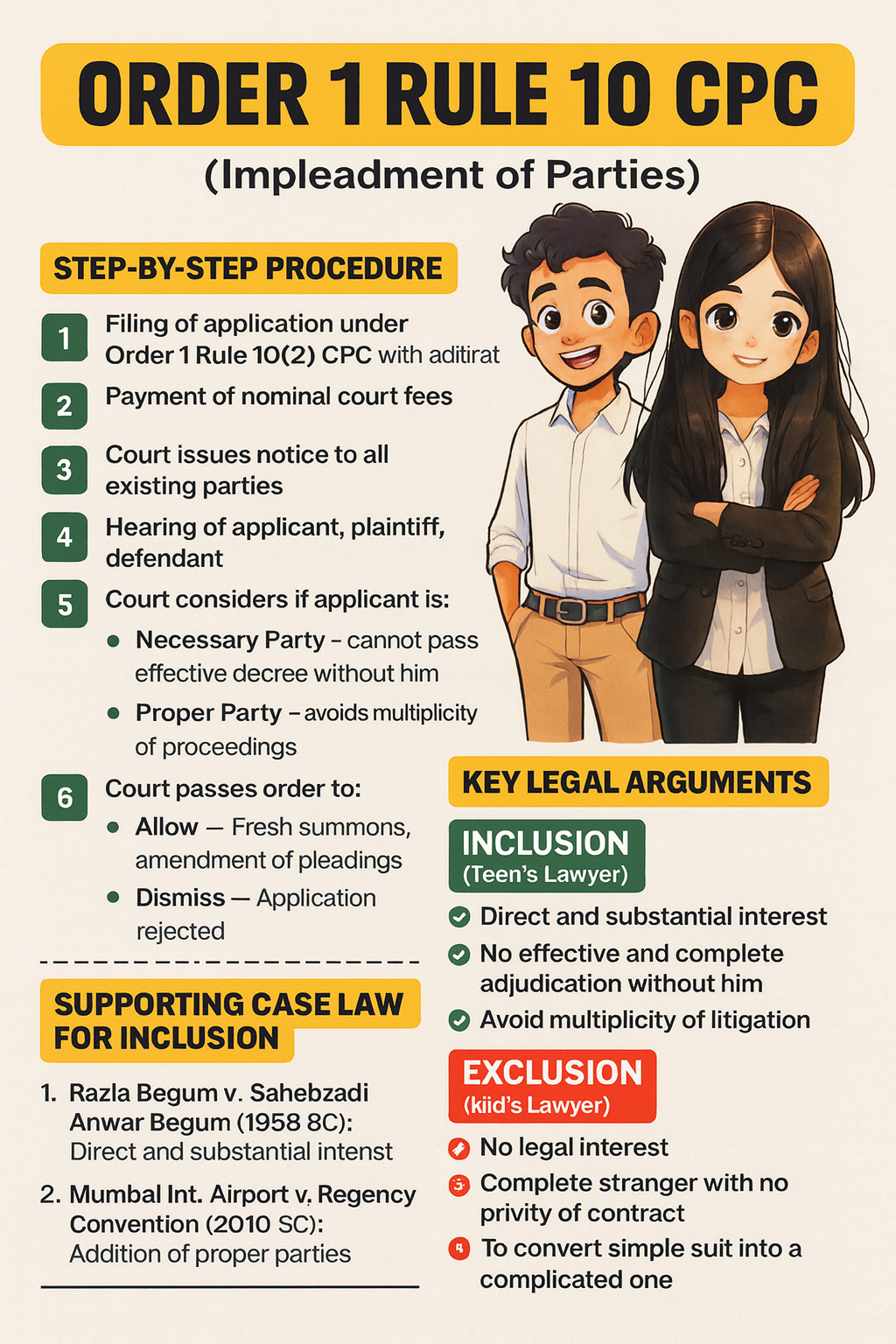
Step 1: Filing Application
- Application under Order 1 Rule 10(2) CPC
- Filed by:
- Plaintiff, or
- Defendant, or
- Proposed party (third person)
- Supported by an affidavit
Contents of application:
- Description of the proposed party
- Nature of interest in the suit property/subject matter
- Reason why presence is necessary/proper
- Stage of the suit
Step 2: Court Fees
- Nominal court fee (as per State amendment / court rules)
Step 3: Issuance of Notice
- Court issues notice to existing parties
- Opportunity of hearing is given to:
- Plaintiff
- Defendant
- Proposed party (if present)
Step 4: Hearing & Consideration by Court
Court examines:
- Whether the proposed party is a:
- Necessary party (no effective decree possible without him), or
- Proper party (helps in complete adjudication)
- Whether impleadment will:
- Change nature of suit ❌
- Cause delay or prejudice ❌
- Lead to multiplicity of proceedings ❌
Step 5: Order of the Court
- If Allowed:
- Party is added as Plaintiff or Defendant
- Amendment of plaint/written statement permitted
- Fresh summons issued to newly added party
- If Rejected:
- Application dismissed with reasons
Step 6: Amendment of Pleadings
- Plaintiff amends the plaint under Order 6 Rule 17 CPC
- Newly added party files Written Statement
- Suit proceeds further
Key Legal Principles (For Arguments)
Necessary Party
A person without whom no effective decree can be passed
Example: Co-owner in partition suit
Proper Party
A person whose presence enables complete adjudication
Example: Subsequent purchaser in property dispute
Important Case Laws
- Razia Begum v. Sahebzadi Anwar Begum (1958 SC)
→ Interest must be direct and substantial - Mumbai International Airport v. Regency Convention Centre (2010 SC)
→ Distinction between necessary & proper party - Kasturi v. Iyyamperumal (2005 SC)
→ In specific performance suits, strangers generally not allowed
When Order 1 Rule 10 Application is Rejected
- Applicant has no legal interest
- Impleadment alters the nature of suit
- Application filed only to delay proceedings
Practical Drafting Tip
Always mention:
- “To avoid multiplicity of litigation”
- “For complete and effective adjudication”
DRAFT APPLICATION
(Under Order 1 Rule 10(2) CPC – Impleadment of Party)
IN THE COURT OF ____________
Civil Suit No. ____ of 20__
A …………………………… Plaintiff
Versus
B …………………………… Defendant
APPLICATION UNDER ORDER 1 RULE 10(2) CPC
Most Respectfully Submitted:
- That the above-mentioned suit is pending adjudication before this Hon’ble Court.
- That the present suit relates to (brief description of subject matter / property / transaction).
- That the applicant (name of proposed party) has a direct, legal and substantial interest in the subject matter of the suit inasmuch as:
- (State how right/title/interest arises)
- (Mention documents, if any)
- That without the presence of the applicant, no effective and complete adjudication of the issues involved in the suit is possible.
- That the applicant is a necessary / proper party and ought to have been impleaded at the time of filing of the suit.
- That non-impleadment will result in multiplicity of litigation and conflicting decisions.
- That the impleadment will not change the nature of the suit nor cause prejudice to any party.
- That this Hon’ble Court is empowered to implead parties at any stage of proceedings under Order 1 Rule 10 CPC.
PRAYER
It is therefore most respectfully prayed that this Hon’ble Court may be pleased to:
a) Allow the present application;
b) Implead (name of proposed party) as Plaintiff / Defendant No.__;
c) Permit amendment of pleadings;
d) Pass any other order deemed fit in the interest of justice.
Applicant
Through Counsel
Place:
Date:
REPLY / OBJECTION
(To Application under Order 1 Rule 10 CPC)
IN THE COURT OF ____________
Civil Suit No. ____ of 20__
Reply on behalf of Defendant / Plaintiff
- That the application is false, frivolous, and misconceived and liable to be dismissed.
- That the applicant has no legal or enforceable right in the subject matter of the suit.
- That the applicant is neither a necessary party nor a proper party as:
- Effective decree can be passed without his presence.
- His alleged interest is remote and speculative.
- That the suit is confined to (specific relief) and the applicant is a stranger to the contract / transaction.
- That impleadment will:
- Change the nature of the suit
- Delay trial
- Cause serious prejudice to the replying party
- That the application is filed only to delay proceedings and harass the parties.
- That Order 1 Rule 10 CPC cannot be used to expand the scope of the suit.
PRAYER
It is therefore prayed that the application under Order 1 Rule 10 CPC be dismissed with costs.
Respondent
Through Counsel
Place:
Date:
ORAL ARGUMENTS (FOR ALLOWING APPLICATION)
May it please Your Honour:
- The applicant has a direct and substantial interest in the subject matter.
- Without his presence, no effective decree can be passed.
- Order 1 Rule 10 CPC empowers the Court at any stage.
- The impleadment will avoid multiplicity of litigation.
- The nature of the suit remains unchanged.
- Supreme Court in Mumbai International Airport case (2010) clearly allows addition of proper parties for complete adjudication.
Hence, the application deserves to be allowed.
ORAL ARGUMENTS (FOR DISMISSAL)
May it please Your Honour:
- Applicant is a complete stranger to the suit.
- No legal right is disclosed—only a commercial or personal interest.
- Effective decree can be passed without the applicant.
- Order 1 Rule 10 CPC cannot be used to convert a simple suit into a complex one.
- Supreme Court in Kasturi v. Iyyamperumal bars impleadment of strangers.
- Application is a delay tactic.
Hence, the application is liable to be dismissed.
PRACTICAL COURT TIP
If you are Plaintiff opposing impleadment, argue dominus litis principle.
If you are Applicant, stress complete adjudication + multiplicity avoidance.
Our Linkedin
https://www.linkedin.com/in/ushavats/

Add a Comment