

1. WhatsApp Messages as Evidence
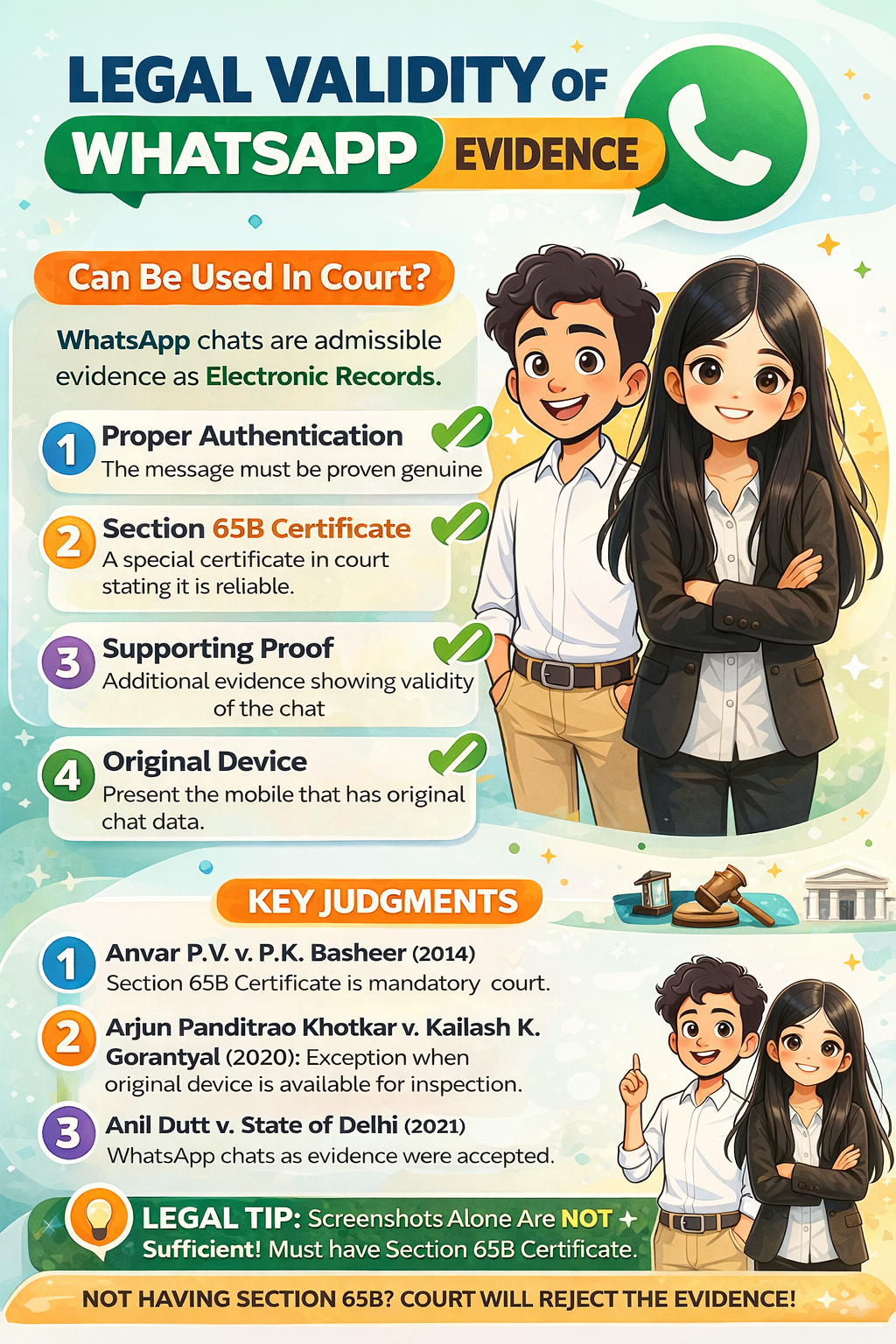
WhatsApp chats are admissible as electronic records under Indian law.
Statutory Basis
✔ Information Technology Act, 2000
- Section 3: Definitions of electronic record
- Section 65A: Electronic records are admissible
- Section 65B: Admissibility of electronic records with certificate
➡ WhatsApp messages are covered because they are:
- Stored electronically
- Transmitted electronically
2. Requirement of Authentication
To use WhatsApp chats as evidence, you must prove:
✅ The message was sent by the person claimed
✅ The content was not tampered with
✅ Chain of custody is maintained
This is usually done through:
- Sender/receiver testimony
- Metadata (logs/time)
- WhatsApp backup/export
- Mobile phone forensic report
3. Mandatory Certificate under Section 65B
Any electronic record (like WhatsApp chat) must be accompanied by a 65B Certificate or equivalent compliance.
What the certificate must state:
✔ The record was produced from a computer/mobile
✔ The process of retrieval was regular
✔ The device/system was in proper working condition
Without a valid 65B certificate, courts routinely reject WhatsApp evidence.
Key Judgments on WhatsApp Evidence
Anvar P.V. v. P.K. Basheer (2014) 10 SCC 473
Supreme Court clearly held:
- Electronic records are admissible only if Section 65B is complied with
- No electronic evidence can be read into record without Section 65B certificate
- Even if the evidence is spoken to by witness, it must still satisfy 65B
Ratio:
No evidence of electronic record without 65B certificate.
Arjun Panditrao Khotkar v. Kailash Kushanrao Gorantyal (2020) 3 SCC 343
Supreme Court refined the rule:
✔ If the original device is in physical custody of court/police, then a certified copy may be admitted without 65B in law
✔ Default rule still requires 65B where device is not available
Key Takeaway:
When the original machine is available for inspection, such evidence may be read without 65B.
Anil Dutt vs. The State of NCT Delhi (2021)
Delhi High Court held:
- WhatsApp audio messages and chats are admissible
- WhatsApp messages were read as part of evidence after proper certification
State vs. Navjot Sandhu (2005)
Though before WhatsApp era, the Supreme Court held:
Confessions to a police officer are inadmissible
– This affects WhatsApp confession messages too if they are not voluntary admissions.
Triloki Nath vs. State of Delhi (1998)
Supreme Court set out the principles of admissibility:
- Relevance
- Authenticity
- Non-suspicious conditions of reporting
These are applied to WhatsApp evidence too.
How Courts Treat WhatsApp Evidence (Practical Principles)
1. Authentication
Court looks for:
- Who sent the message?
- How it was extracted?
- Were there tampering signs?
Usually done through:
✔ witness testimony
✔ metadata
✔ screenshots + export
2. 65B Certificate
Absolutely necessary unless:
✔ original device is produced in court
✔ and entire chat log is examined by court expert
3. Screenshots Alone Are Not Enough
Screenshots are not primary evidence.
They must have:
✔ export with timestamps, OR
✔ forensic extraction
4. Forwarded Messages
Forwarded messages are weak evidence unless:
✔ originator is identified
✔ circumstance proves its relevance
5. WhatsApp Voice Notes
Also admissible with same principles:
✔ metadata confirmation
✔ 65B compliance
✔ witness recognition
6. Screenshot vs Real Chat
Courts prefer:
✔ Exported chat with timestamp & phone info
✔ WhatsApp backup file
✔ Forensic report from mobile
Screenshot alone is weak but can form part of evidence with 65B & supporting proof.
Checklist for Using WhatsApp Evidence in Court
| Requirement | Required? |
|---|---|
| WhatsApp message | Yes |
| 65B Certificate | Yes |
| Authenticity proof | Yes |
| Metadata/Forensic evidence | Highly Recommended |
| Device inspection | If possible |
| Witness to confirm | Yes |
Sample 65B Certificate Format (Quick Idea)
I, ____________________, do hereby certify that:

1. The electronic record (WhatsApp chat) was produced from the digital device ___________ belonging to __________.
2. The device was in proper working condition at all relevant times.
3. The record was extracted using regular process.
4. The attached electronic record is a true and correct copy of the original stored in the device memory.
Place:
Date:
Signature:
Important Case Law Summary (for citations)
| Case | Court | Key Principle |
|---|---|---|
| Anvar P.V. v. P.K. Basheer (2014) | SC | 65B compliance is mandatory for electronic evidence |
| Arjun Panditrao Khotkar (2020) | SC | Exception when original device is available for inspection |
| Anil Dutt v. State (2021) | Delhi HC | WhatsApp chats + audio admissible with proper certification |
| Triloki Nath v. State (1998) | SC | Core principles of relevance & authenticity |
Practical Scenarios (Examples)
Example 1 – Civil Matter
WhatsApp chat between parties about settlement →
✔ Export chats + 65B → Admissible
Example 2 – Criminal Case
WhatsApp confession: “I did it” →
✔ If authenticated + not coerced + 65B → Admissible
✖ But if just screenshot shown → Weak
Example 3 – Family Matter
WhatsApp message about maintenance or threats →
✔ Section 65B + witness confirmation → Admissible
Conclusion
WhatsApp messages and voice notes are admissible legal evidence in Indian courts if:
- Authenticated properly
- Supported by 65B certificate
- Original device is available or process is proven
Supreme Court has repeatedly emphasized 65B compliance as the primary condition.
Our Linkedin :
https://www.linkedin.com/in/ushavats/

Add a Comment