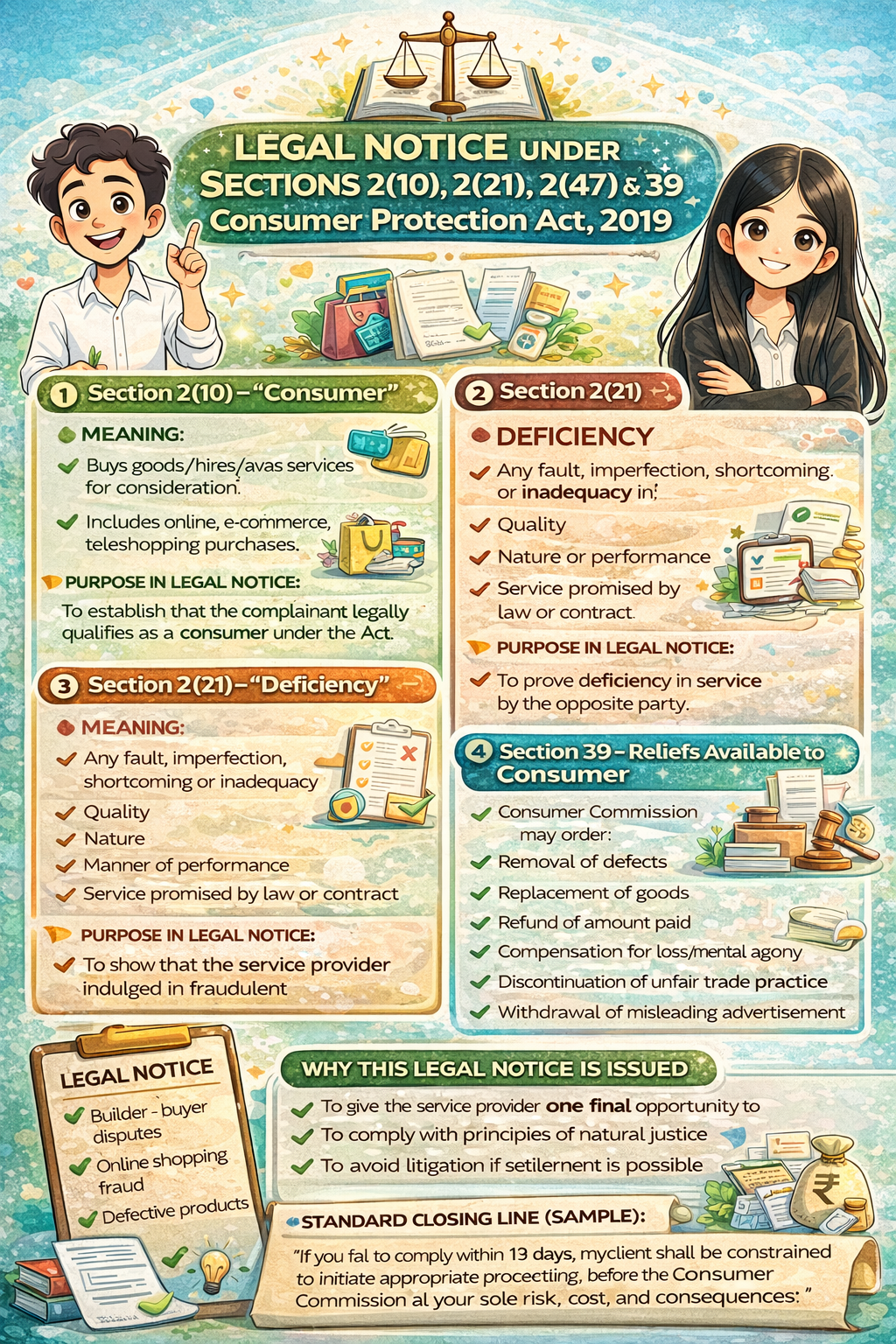
Buys goods or hires/avails services for consideration
Includes online, e-commerce, teleshopping purchases
Does not include goods/services taken for resale or commercial purpose (except self-employment)
Purpose in Legal Notice: To establish that the complainant legally qualifies as a consumer under the Act.
2. Section 2(21) – “Deficiency”
Meaning: Any fault, imperfection, shortcoming or inadequacy in:
Quality
Nature
Manner of performance
Service promised by law or contract
Examples:
Delay in delivery
Poor service
Non-refund
Incomplete work
Purpose in Legal Notice: To prove deficiency in service by the opposite party.
3. Section 2(47) – “Unfair Trade Practice”
Meaning: Any unfair or deceptive practice, including:
False representation
Misleading advertisements
Charging excess price
Concealment of material facts
Purpose in Legal Notice: To show that the service provider indulged in fraudulent or misleading conduct.
Section 39 – Reliefs Available to Consumer
Consumer Commission may order: ✔ Removal of defects ✔ Replacement of goods ✔ Refund of amount paid ✔ Compensation for loss/mental agony ✔ Discontinuation of unfair trade practice ✔ Withdrawal of misleading advertisement ✔ Punitive damages (where applicable)
Purpose in Legal Notice: To formally demand reliefs and warn of legal action before filing a consumer complaint.
Why This Legal Notice Is Issued
To give the service provider one final opportunity to resolve the dispute
To comply with principles of natural justice
To avoid litigation if settlement is possible
Common Situations Where This Notice Is Used
Builder–buyer disputes
Online shopping fraud
Defective products
Insurance claim rejection
Medical negligence
Travel & hospitality disputes
Coaching institute fraud
Standard Closing Line (Sample)
If you fail to comply within 15 days, my client shall be constrained to initiate appropriate proceedings before the Consumer Commission at your sole risk, cost, and consequences.
CASE LAWS SUPPORTING CONSUMER LEGAL NOTICE
(CPA, 2019 – Definitions, Deficiency & Reliefs)
1. Who is a “Consumer” – Section 2(10)
Laxmi Engineering Works v. P.S.G. Industrial Institute
(1995) 3 SCC 583 – Supreme Court
✔ Held that:
A person purchasing goods/services for self-use or livelihood is a consumer
Commercial purpose must be interpreted narrowly
Use in Notice:
Establishes complainant’s status as a “consumer”.
Kavita Ahuja v. Shipra Estates Ltd.
I (2016) CPJ 31 (NC)
✔ Buyer of flat is a consumer ✔ Delay/defects amount to deficiency
Useful for: Builder-buyer disputes
2. Deficiency in Service – Section 2(21)
Lucknow Development Authority v. M.K. Gupta
(1994) 1 SCC 243 – Supreme Court
✔ Deficiency includes:
Delay
Negligence
Harassment
Mental agony
Landmark case – most cited in consumer notices
Haryana Urban Development Authority v. Raje Ram
(2008) 17 SCC 407
✔ Failure to deliver promised service = deficiency ✔ Compensation is justified
Ghaziabad Development Authority v. Balbir Singh
(2004) 5 SCC 65
✔ Consumer Commissions can grant:
Compensation
Interest
Mental agony damages
3. Unfair Trade Practice – Section 2(47)
Skypak Couriers Ltd. v. Tata Chemicals Ltd.
(2000) 5 SCC 294
✔ Misrepresentation & false assurances = unfair trade practice ✔ Disclaimers cannot override consumer rights
DLF Ltd. v. Mridul Estate Pvt. Ltd.
(2013) 14 SCC 22
✔ One-sided terms & misleading promises are unfair trade practices
Use when:
Hidden charges
False advertising
One-sided contracts
4. Reliefs by Consumer Commission – Section 39
Charan Singh v. Healing Touch Hospital
(2000) 7 SCC 668 – Supreme Court
✔ Compensation must:
Redress injury
Deter wrongdoing
Be realistic & just
Spring Meadows Hospital v. Harjol Ahluwalia
(1998) 4 SCC 39
✔ Compensation can be awarded for:
Mental agony
Harassment
Negligent service
5. Online / E-commerce Consumers Covered
Amazon Seller Services Pvt. Ltd. v. Amrita Nanda
2022 (NC)
✔ Online buyers are consumers ✔ Platform liability recognised
Very relevant for e-commerce disputes
HOW TO CITE IN LEGAL NOTICE (Sample Line)
“The acts of your client squarely fall within the definition of ‘deficiency in service’ under Section 2(21) of the Consumer Protection Act, 2019 as laid down by the Hon’ble Supreme Court in Lucknow Development Authority v. M.K. Gupta (1994) 1 SCC 243…”


Add a Comment