
1. Meaning
Judicial Separation
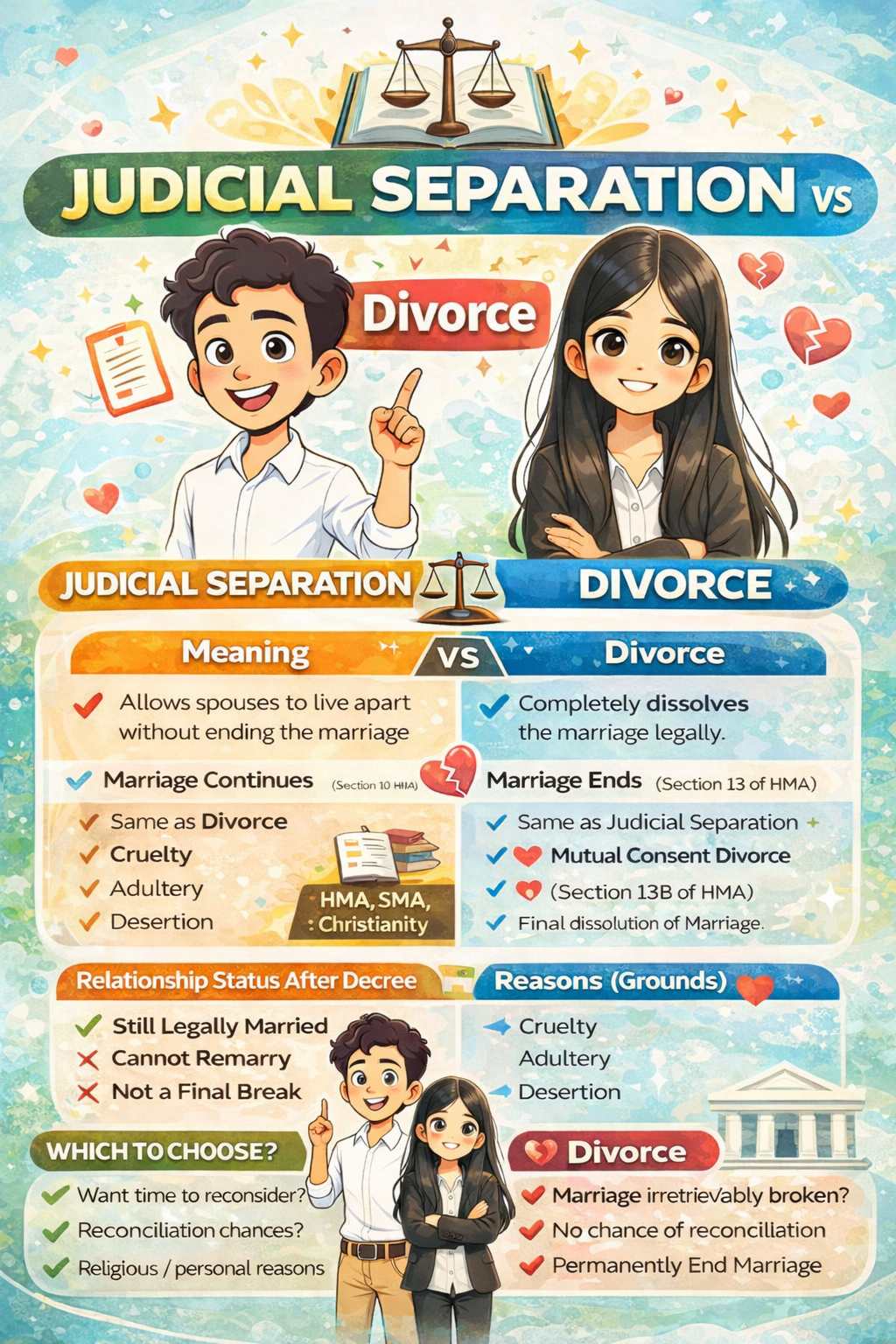
Judicial Separation means:
Court permits husband and wife to live separately, but marriage is not dissolved.
➡ Marriage continues legally.
Divorce
Divorce means:
Complete dissolution of marriage by a decree of court.
➡ Marriage ends permanently.
2. Relevant Legal Provisions
| Law | Judicial Separation | Divorce |
|---|---|---|
| Hindu Marriage Act, 1955 | Section 10 | Sections 13 & 13B |
| Special Marriage Act | Section 23 | Section 27 |
| Christian Law | Available | Available |
| Muslim Law | Concept exists (Faskh) | Talaq / Khula / Mubarat |
3. Nature of Relationship After Decree
| Point | Judicial Separation | Divorce |
|---|---|---|
| Marriage status | Continues | Dissolved |
| Husband & Wife | Still legally married | Not husband & wife |
| Right to remarry | ❌ Not allowed | ✅ Allowed |
| Cohabitation duty | Suspended | Ends forever |
4. Grounds
Judicial Separation
- Same grounds as divorce
- Cruelty
- Desertion
- Adultery
- Mental disorder etc.
Court can grant judicial separation even if divorce is not sought.
Divorce
- Same grounds
- Plus Mutual Consent (Section 13B)
5. Time Factor
| Aspect | Judicial Separation | Divorce |
|---|---|---|
| Cooling period | No fixed period | Mandatory in 13B |
| Can convert? | Yes | Not applicable |
➡ If no cohabitation for 1 year after judicial separation → Divorce can be sought
6. Maintenance & Custody
| Issue | Judicial Separation | Divorce |
|---|---|---|
| Maintenance | ✔ Allowed | ✔ Allowed |
| Child custody | ✔ Decided | ✔ Decided |
| Alimony | Interim only | Interim + Permanent |
Purpose / Intention
Judicial Separation is preferred when:
✔ Parties want time to reconsider
✔ Religious or personal reasons
✔ Divorce not immediately desired
Divorce is preferred when:
✔ Marriage has irretrievably broken down
✔ No chance of reconciliation
✔ Parties want final closure
8. Important Case Laws
Savitri Pandey v. Prem Chandra Pandey (2002) 2 SCC 73
Supreme Court held:
Judicial separation gives parties time to reflect and reconcile before final divorce.
Lachman Utamchand Kirpalani v. Meena (1964)
SC observed:
Judicial separation does not end marriage but suspends marital obligations.
9. One-Line Difference (For Court Use)
Judicial separation suspends marital rights without dissolving marriage, whereas divorce permanently dissolves the marital bond.
Quick Comparison Table
| Basis | Judicial Separation | Divorce |
|---|---|---|
| Marriage | Exists | Ends |
| Living together | Not compulsory | Ends |
| Remarriage | Not allowed | Allowed |
| Finality | Temporary | Permanent |
Conclusion
- Judicial Separation = Pause Button
- Divorce = Stop Button
DRAFT – PETITION FOR JUDICIAL SEPARATION
(Under Section 10, Hindu Marriage Act, 1955)
IN THE COURT OF THE PRINCIPAL JUDGE, FAMILY COURT AT _______
HMA Petition No. ___ of 20__
IN THE MATTER OF:
Smt. ____________
W/o Sh. ____________
Age: ___ years
R/o ______________________
… Petitioner
VERSUS
Sh. ____________
S/o Sh. ____________
Age: ___ years
R/o ______________________
… Respondent
PETITION UNDER SECTION 10 OF THE HINDU MARRIAGE ACT, 1955 FOR JUDICIAL SEPARATION
MOST RESPECTFULLY SHOWETH:
- Marriage
That the marriage between the petitioner and the respondent was solemnized on //_____ at __________ according to Hindu rites and ceremonies. - Status & Jurisdiction
That both parties are Hindus governed by the Hindu Marriage Act, 1955 and this Hon’ble Court has jurisdiction as the parties last resided together at __________. - Cohabitation
After marriage, the parties cohabited at __________ and one child was born out of the wedlock, namely __________ (if applicable). - Cruelty / Grounds
That after marriage, the respondent subjected the petitioner to mental and/or physical cruelty, including:- (brief facts: abuse, neglect, harassment, threats, etc.)
- Living Separately
That due to the respondent’s conduct, the petitioner has been living separately since //_____. - No Collusion
That this petition is not filed in collusion with the respondent. - Cause of Action
That the cause of action arose on //_____ and continues till date.
PRAYER
It is, therefore, most respectfully prayed that this Hon’ble Court may be pleased to:
a) Pass a decree of Judicial Separation under Section 10 of the Hindu Marriage Act, 1955;
b) Grant any other relief(s) deemed fit in the interest of justice.
PETITIONER
Through Counsel
Place: ______
Date: ______
DRAFT – DIVORCE PETITION (CONTESTED)
(Under Section 13, Hindu Marriage Act, 1955)
IN THE COURT OF THE PRINCIPAL JUDGE, FAMILY COURT AT _______
HMA Petition No. ___ of 20__
IN THE MATTER OF:
Smt./Sh. ____________
… Petitioner
VERSUS
Smt./Sh. ____________
… Respondent
PETITION UNDER SECTION 13 OF THE HINDU MARRIAGE ACT, 1955 FOR DISSOLUTION OF MARRIAGE
MOST RESPECTFULLY SHOWETH:
- Marriage details (date/place)
- Jurisdiction facts
- Acts of cruelty/desertion/adultery (as applicable)
- Separation period
- No collusion
- No previous petition pending
PRAYER
a) Pass a decree of Divorce dissolving the marriage;
b) Grant permanent alimony / custody (if prayed);
c) Any other relief deemed fit.
PETITIONER
Through Counsel
DRAFT – MUTUAL CONSENT DIVORCE (13B – FIRST MOTION)
(Under Section 13B, Hindu Marriage Act, 1955)
IN THE COURT OF THE PRINCIPAL JUDGE, FAMILY COURT AT _______
HMA Petition No. ___ of 20__
IN THE MATTER OF:
Petitioner No.1: Smt. ____________
Petitioner No.2: Sh. ____________
JOINT PETITION UNDER SECTION 13B(1) OF THE HINDU MARRIAGE ACT, 1955
MOST RESPECTFULLY SHOWETH:
- Marriage solemnized on //_____ at ______.
- Parties living separately since //_____.
- No cohabitation possible.
- All disputes settled voluntarily.
- Permanent alimony of ₹______ paid/settled (details).
- Child custody with ______ (if applicable).
- No coercion or undue influence.
PRAYER
That this Hon’ble Court may be pleased to record statements and grant permission for Second Motion.
PETITIONERS
SECOND MOTION (13B(2)) – SHORT FORMAT
Parties reaffirm consent, settlement complied with, and pray for decree of divorce by mutual consent.
PRACTICE NOTE (IMPORTANT)
- Judicial Separation → Can be converted to Divorce after 1 year
- Mutual Divorce → Cooling period may be waived (Amardeep Singh case)
Our Linkedin :
https://www.linkedin.com/in/ushavats/

Add a Comment