A complaint is an allegation made to a Magistrate (or police in some cases) that an offence has been committed.
Legal Definition
Section 2(d) CrPC / Section 2(e) BNSS
Complaint means any allegation made orally or in writing to a Magistrate, with a view to his taking action, that some person has committed an offence, but does not include a police report (charge-sheet).
Who can file?
Victim
Any private person
Sometimes authorised authority
Filed before whom?
Judicial Magistrate
Sometimes police (for non-cognizable offences)
Types of Complaint
Private Complaint (directly before Magistrate)
Complaint to Police (may or may not convert into FIR)
Relevant Sections
CrPC: Sections 200–203
BNSS: Sections 223–226
Example
A woman files a complaint before Magistrate alleging offence under Section 498A IPC against husband and in-laws.
Magistrate may:
Take cognizance
Order inquiry
Direct police to register FIR (u/s 156(3))
Key Points
✔ Filed before FIR / without FIR ✔ Magistrate applies judicial mind ✔ Evidence may be recorded first
2. FIR (First Information Report)
Definition
FIR is the first information given to police about commission of a cognizable offence.
Legal Provision
CrPC Section 154
BNSS Section 173
Who can lodge FIR?
Victim
Witness
Any person having information
Filed before whom?
Police Station (SHO)
Nature of FIR
Only for cognizable offences
Police can arrest & investigate without court permission
Example
A person goes to police station and reports robbery under Section 392 IPC.
➡ Police registers FIR and starts investigation.
Key Points
✔ Starting point of police investigation ✔ No evidence needed at FIR stage ✔ Delay, contradictions matter later
3. CHARGE-SHEET
Definition
A charge-sheet is the final police report submitted after completion of investigation.
Legal Provision
CrPC Section 173(2)
BNSS Section 193
Filed by whom?
Investigating Officer (Police)
Filed before whom?
Judicial Magistrate / Sessions Court
What does charge-sheet contain?
✔ FIR details ✔ List of accused ✔ List of witnesses ✔ Evidence collected ✔ Opinion of IO ✔ Sections applied
Example
After investigating FIR under Section 376 IPC, police files charge-sheet stating sufficient evidence exists.
➡ Court considers framing of charge.
Key Points
✔ Filed after investigation ✔ Basis for trial ✔ Can be challenged (discharge / quashing)
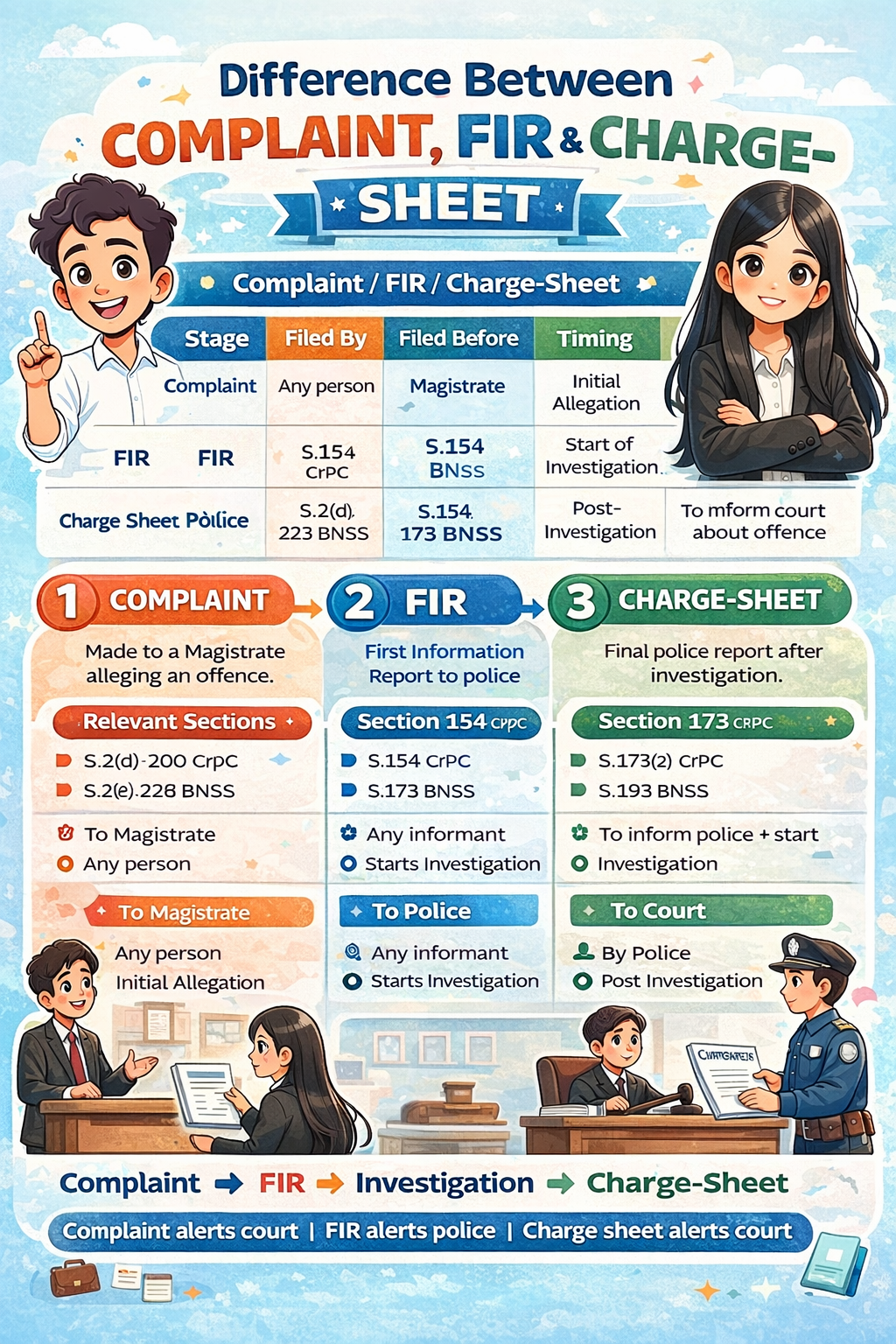
COMPARATIVE TABLE
Point
Complaint
FIR
Charge-Sheet
Filed by
Any person
Any informant
Police
Filed before
Magistrate
Police
Court
Stage
Initial
Investigation start
Post-investigation
Legal section
S.2(d), 200 CrPC
S.154 CrPC
S.173 CrPC
Police power
No
Yes
Already exercised
Evidence
Minimal
Not required
Compiled
FLOW OF CRIMINAL CASE (EASY TO REMEMBER)
Complaint → FIR → Investigation → Charge-Sheet → Trial
OR
Complaint → Magistrate → FIR u/s 156(3) → Charge-Sheet
PRACTICAL COURT DIFFERENCE
Complaint Case
Evidence starts early
Accused summoned later
Common in DV / NI Act / Defamation
FIR Case
Police driven
Arrest possible
Common in robbery / rape / assault
Charge-Sheet Stage
Defence can:
Seek discharge
Challenge evidence
Apply for quashing
ONE-LINE MEMORY TRICK (EXAM)
Complaint = allegation to Magistrate FIR = information to police Charge-sheet = police conclusion


Add a Comment