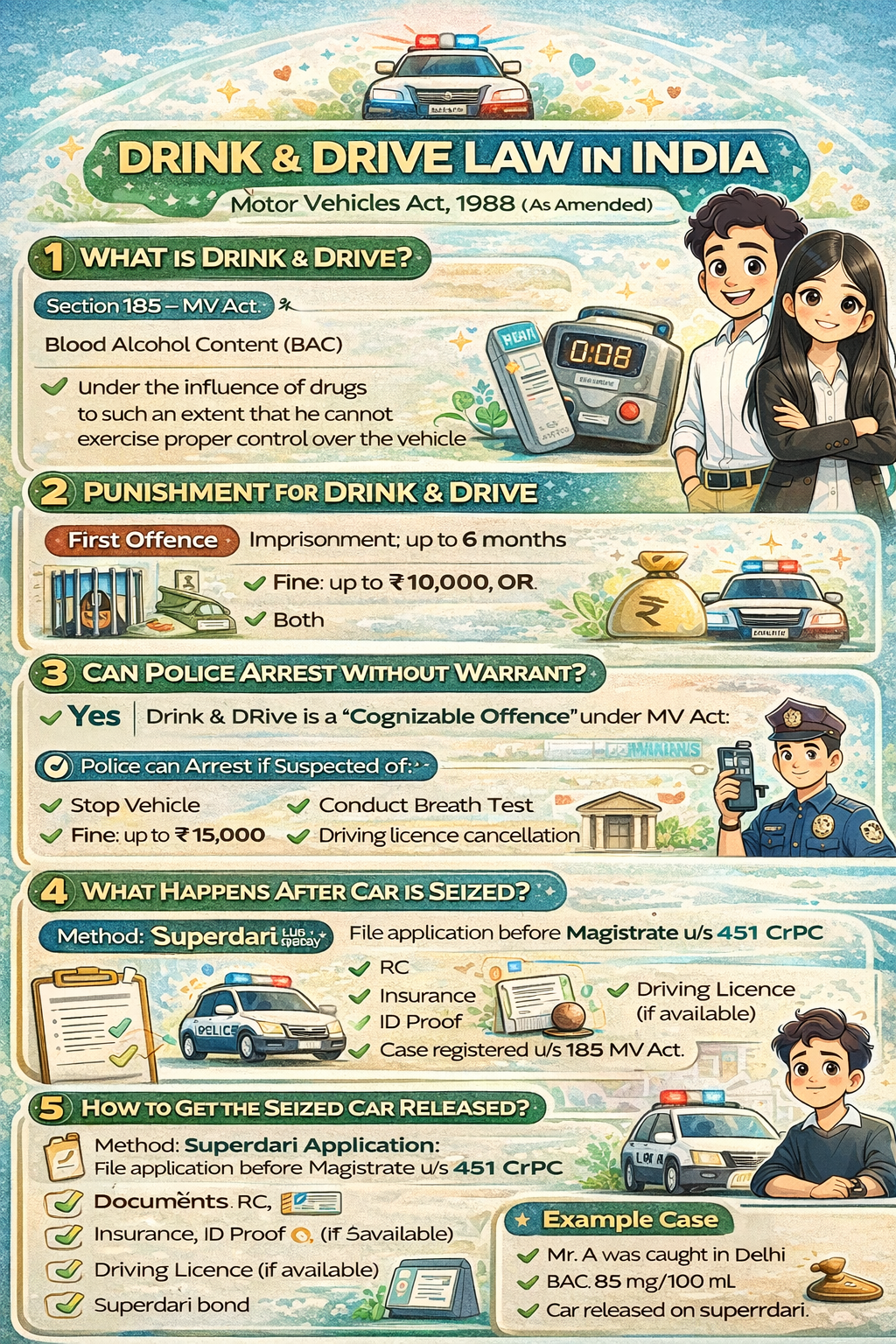
Blood Alcohol Content (BAC) exceeds 30 mg per 100 ml of blood, OR
Is under the influence of drugs to such an extent that he cannot exercise proper control over the vehicle.
✔ Checked by:
Breath Analyzer
Blood test (government hospital)
2. PUNISHMENT FOR DRINK & DRIVE
First Offence
Imprisonment: up to 6 months, OR
Fine: up to ₹10,000, OR
Both
Second or Subsequent Offence (within 3 years)
Imprisonment: up to 2 years
Fine: up to ₹15,000
Driving licence cancellation / suspension
3. CAN POLICE ARREST WITHOUT WARRANT?
✔ Yes
Drink & drive is a cognizable offence under MV Act:
Police can stop vehicle
Conduct breath test
Arrest without warrant
Produce accused before Magistrate
4. VEHICLE SEIZURE – IS IT LEGAL?
YES, police can seize the vehicle if:
Driver is intoxicated
Vehicle is being driven dangerously
Driver is incapable of safe driving
No sober person is available to take charge
Legal Basis:
Section 202 MV Act – Power to arrest
Section 207 MV Act – Power to detain/seize vehicle
5. WHAT HAPPENS AFTER CAR IS SEIZED?
Step-by-Step Process
Vehicle seized by police
Challan prepared (online / manual)
Vehicle taken to police station / impound yard
Driver produced before Magistrate
Case registered under Section 185 MV Act
6. HOW TO GET THE SEIZED CAR RELEASED?
Method: Superdari Application
File application before the concerned Magistrate under:
Section 451 CrPC (or BNSS equivalent)
Documents Required:
RC (Registration Certificate)
Insurance
Driving Licence (if available)
ID Proof
Superdari bond
Court may:
Release vehicle on superdari
Impose conditions
Direct payment of fine
7. EXAMPLE CASE (PRACTICAL SCENARIO)
Example:
Mr. A was stopped at a Delhi police checkpoint at night. Breath analyzer showed BAC = 85 mg/100 ml.
Police Action:
Arrested Mr. A
Seized car
Issued challan under Section 185 MV Act
Court Action:
Magistrate imposed ₹10,000 fine
Licence suspended for 6 months
Car released on superdari after application
8. CAN LICENCE BE SUSPENDED?
✔ Yes Under Section 19 MV Act, Licensing Authority may:
Suspend or cancel driving licence
Especially in repeat offences
9. IMPORTANT COURT OBSERVATIONS
🔹 State of Maharashtra v. Mohd. Yakub
✔ Drunk driving is a serious offence affecting public safety
🔹 Alister Anthony Pareira v. State of Maharashtra (2012)
✔ Driving under influence shows criminal negligence
10. IMPORTANT POINTS TO REMEMBER
✔ Legal limit: 30 mg/100 ml ✔ Even sitting in driver seat with engine ON = offence ✔ Saying “I drank less” is no defence ✔ Vehicle seizure is temporary, not confiscation ✔ First offence often ends in fine, not jail
11. DEFENCES AVAILABLE (LIMITED)
Faulty breath analyzer
No proper calibration
Illegal detention
BAC below permissible limit
Violation of testing procedure
🔚 CONCLUSION
Drink & Drive is treated as a serious public safety offence. Police have wide powers, but vehicle seizure is not permanent and can be challenged through court.
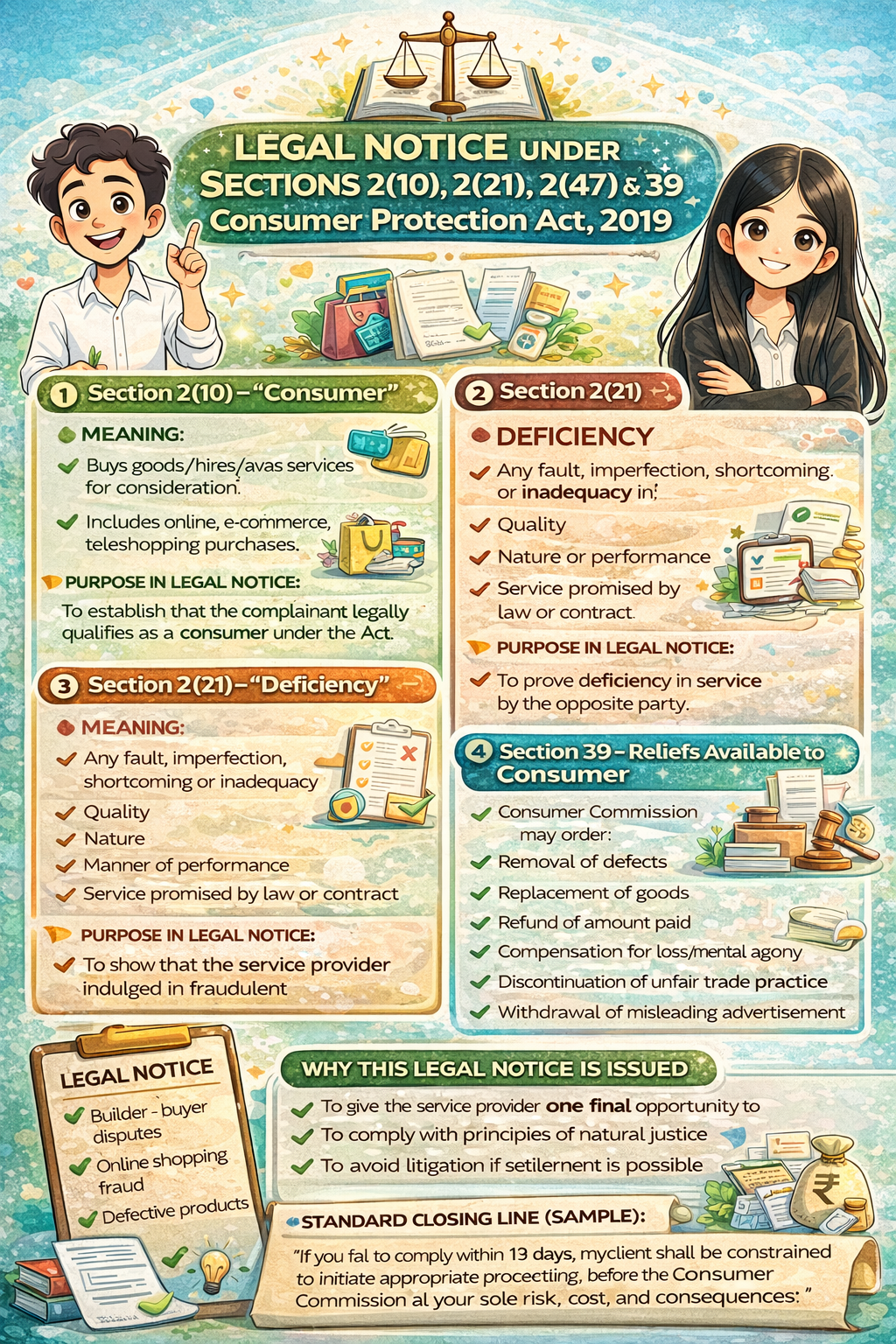
Buys goods or hires/avails services for consideration
Includes online, e-commerce, teleshopping purchases
Does not include goods/services taken for resale or commercial purpose (except self-employment)
Purpose in Legal Notice: To establish that the complainant legally qualifies as a consumer under the Act.
2. Section 2(21) – “Deficiency”
Meaning: Any fault, imperfection, shortcoming or inadequacy in:
Quality
Nature
Manner of performance
Service promised by law or contract
Examples:
Delay in delivery
Poor service
Non-refund
Incomplete work
Purpose in Legal Notice: To prove deficiency in service by the opposite party.
3. Section 2(47) – “Unfair Trade Practice”
Meaning: Any unfair or deceptive practice, including:
False representation
Misleading advertisements
Charging excess price
Concealment of material facts
Purpose in Legal Notice: To show that the service provider indulged in fraudulent or misleading conduct.
Section 39 – Reliefs Available to Consumer
Consumer Commission may order: ✔ Removal of defects ✔ Replacement of goods ✔ Refund of amount paid ✔ Compensation for loss/mental agony ✔ Discontinuation of unfair trade practice ✔ Withdrawal of misleading advertisement ✔ Punitive damages (where applicable)
Purpose in Legal Notice: To formally demand reliefs and warn of legal action before filing a consumer complaint.
Why This Legal Notice Is Issued
To give the service provider one final opportunity to resolve the dispute
To comply with principles of natural justice
To avoid litigation if settlement is possible
Common Situations Where This Notice Is Used
Builder–buyer disputes
Online shopping fraud
Defective products
Insurance claim rejection
Medical negligence
Travel & hospitality disputes
Coaching institute fraud
Standard Closing Line (Sample)
If you fail to comply within 15 days, my client shall be constrained to initiate appropriate proceedings before the Consumer Commission at your sole risk, cost, and consequences.
CASE LAWS SUPPORTING CONSUMER LEGAL NOTICE
(CPA, 2019 – Definitions, Deficiency & Reliefs)
1. Who is a “Consumer” – Section 2(10)
Laxmi Engineering Works v. P.S.G. Industrial Institute
(1995) 3 SCC 583 – Supreme Court
✔ Held that:
A person purchasing goods/services for self-use or livelihood is a consumer
Commercial purpose must be interpreted narrowly
Use in Notice:
Establishes complainant’s status as a “consumer”.
Kavita Ahuja v. Shipra Estates Ltd.
I (2016) CPJ 31 (NC)
✔ Buyer of flat is a consumer ✔ Delay/defects amount to deficiency
Useful for: Builder-buyer disputes
2. Deficiency in Service – Section 2(21)
Lucknow Development Authority v. M.K. Gupta
(1994) 1 SCC 243 – Supreme Court
✔ Deficiency includes:
Delay
Negligence
Harassment
Mental agony
Landmark case – most cited in consumer notices
Haryana Urban Development Authority v. Raje Ram
(2008) 17 SCC 407
✔ Failure to deliver promised service = deficiency ✔ Compensation is justified
Ghaziabad Development Authority v. Balbir Singh
(2004) 5 SCC 65
✔ Consumer Commissions can grant:
Compensation
Interest
Mental agony damages
3. Unfair Trade Practice – Section 2(47)
Skypak Couriers Ltd. v. Tata Chemicals Ltd.
(2000) 5 SCC 294
✔ Misrepresentation & false assurances = unfair trade practice ✔ Disclaimers cannot override consumer rights
DLF Ltd. v. Mridul Estate Pvt. Ltd.
(2013) 14 SCC 22
✔ One-sided terms & misleading promises are unfair trade practices
Use when:
Hidden charges
False advertising
One-sided contracts
4. Reliefs by Consumer Commission – Section 39
Charan Singh v. Healing Touch Hospital
(2000) 7 SCC 668 – Supreme Court
✔ Compensation must:
Redress injury
Deter wrongdoing
Be realistic & just
Spring Meadows Hospital v. Harjol Ahluwalia
(1998) 4 SCC 39
✔ Compensation can be awarded for:
Mental agony
Harassment
Negligent service
5. Online / E-commerce Consumers Covered
Amazon Seller Services Pvt. Ltd. v. Amrita Nanda
2022 (NC)
✔ Online buyers are consumers ✔ Platform liability recognised
Very relevant for e-commerce disputes
HOW TO CITE IN LEGAL NOTICE (Sample Line)
“The acts of your client squarely fall within the definition of ‘deficiency in service’ under Section 2(21) of the Consumer Protection Act, 2019 as laid down by the Hon’ble Supreme Court in Lucknow Development Authority v. M.K. Gupta (1994) 1 SCC 243…”
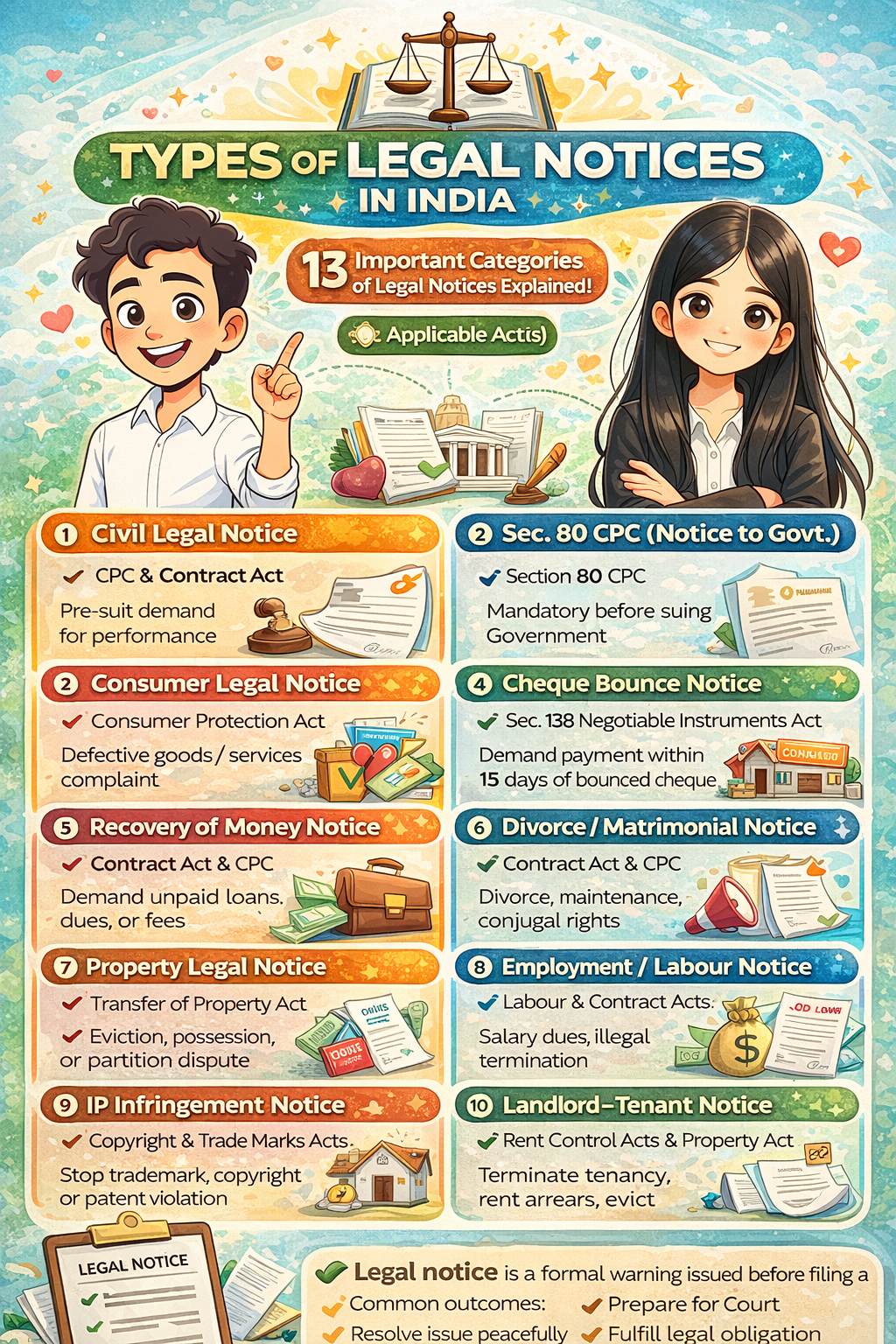
Purpose / Meaning: Issued before filing a civil suit to:
Demand performance of obligation
Seek recovery of money/property
Give last opportunity to settle dispute
📌 Common in:
Property disputes
Recovery suits
Injunction matters
2. Legal Notice under Section 80 CPC (Notice to Government)
Applicable Act:
Section 80, Code of Civil Procedure, 1908
Purpose / Meaning: Mandatory notice before filing a suit against:
Central / State Government
Public officers for official acts
2 months’ notice is compulsory (except urgent cases).
3. Cheque Bounce Legal Notice
Applicable Act:
Section 138, Negotiable Instruments Act, 1881
Purpose / Meaning: Sent by payee to drawer when cheque is dishonoured:
Demands payment within 15 days
Mandatory before filing criminal complaint
Without notice → case not maintainable.
4. Consumer Legal Notice
Applicable Act:
Consumer Protection Act, 2019
Purpose / Meaning: Issued against:
Defective goods
Deficient services
Unfair trade practices
Not mandatory, but strongly recommended.
5. Legal Notice for Recovery of Money
Applicable Acts:
Indian Contract Act, 1872
CPC, 1908
Purpose / Meaning: To demand payment of:
Loan
Outstanding dues
Professional fees
Often leads to settlement without litigation.
6. Employment / Labour Legal Notice
Applicable Laws:
Industrial Disputes Act, 1947
Shops & Establishments Acts
Contract Act
Purpose / Meaning: Used by employer or employee for:
Illegal termination
Salary dues
Breach of employment contract
7. Legal Notice for Divorce / Matrimonial Disputes
Applicable Acts:
Hindu Marriage Act, 1955
Special Marriage Act, 1954
Muslim / Christian personal laws
Purpose / Meaning: Issued for:
Divorce intention
Maintenance
Restitution of conjugal rights
Acts as pre-litigation intimation.
8. Legal Notice for Property Matters
Applicable Acts:
Transfer of Property Act, 1882
CPC, 1908
Purpose / Meaning: Used for:
Eviction
Possession
Encroachment
Partition disputes
9. Tenant–Landlord Legal Notice
Applicable Acts:
Transfer of Property Act, 1882
Rent Control Acts (State-specific)
Purpose / Meaning: Issued for:
Termination of tenancy
Rent arrears
Eviction demand
10. Copyright / Trademark / IP Legal Notice
Applicable Acts:
Copyright Act, 1957
Trade Marks Act, 1999
Patents Act, 1970
Purpose / Meaning: Sent to stop:
Infringement
Unauthorized use
Passing off
Often called Cease & Desist Notice.
11. Defamation Legal Notice
Applicable Laws:
IPC / BNS (Criminal Defamation)
Law of Torts (Civil Defamation)
Purpose / Meaning: Issued for:
False allegations
Reputation damage
Media / social media content
12. Company / Corporate Legal Notice
Applicable Acts:
Companies Act, 2013
Insolvency & Bankruptcy Code (IBC), 2016
Purpose / Meaning: Used for:
Shareholder disputes
Oppression & mismanagement
Debt default (IBC demand notice)
13. Legal Notice under IBC (Demand Notice)
Applicable Act:
Insolvency & Bankruptcy Code, 2016
Purpose / Meaning: Issued by operational creditor to:
Demand unpaid operational debt
Trigger insolvency process
Mandatory before filing NCLT petition.
14. Legal Notice for Breach of Contract
Applicable Act:
Indian Contract Act, 1872
Purpose / Meaning: Sent for:
Non-performance
Delay
Violation of terms
Quick Summary Table
Type
Act
Purpose
Civil Notice
CPC
Dispute settlement
Sec. 80 CPC
CPC
Notice to Government
Cheque Bounce
NI Act
Mandatory payment demand
Consumer
CPA 2019
Deficiency in service
Divorce
HMA / SMA
Matrimonial disputes
Property
TPA
Possession / eviction
Employment
Labour laws
Service disputes
IP
IP Acts
Stop infringement
IBC
IBC 2016
Debt recovery
Conclusion (One Line)
Legal notice is a formal legal warning and opportunity to resolve disputes before litigation, governed by specific statutes depending on the nature of dispute.
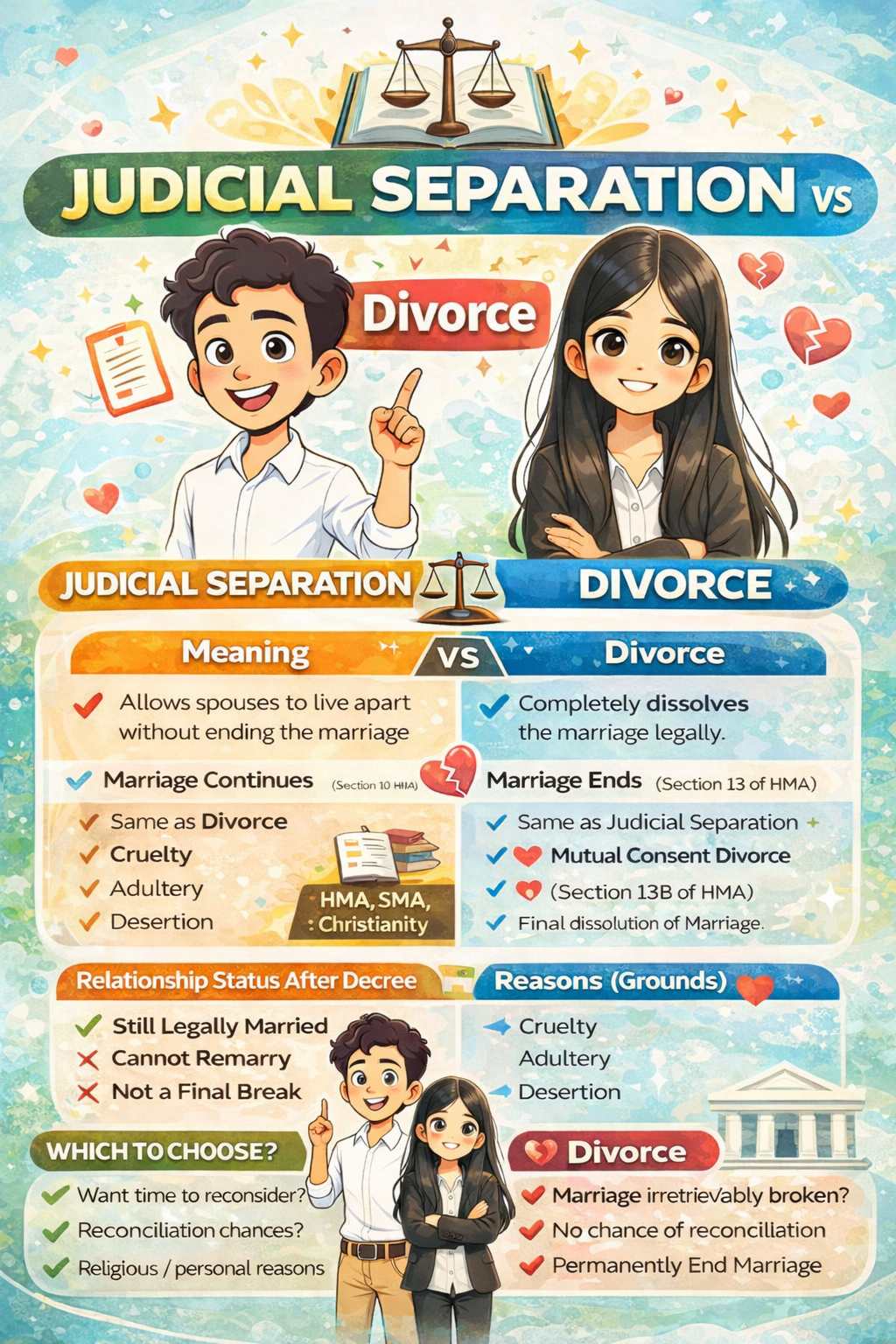
PETITION UNDER SECTION 10 OF THE HINDU MARRIAGE ACT, 1955 FOR JUDICIAL SEPARATION
MOST RESPECTFULLY SHOWETH:
Marriage That the marriage between the petitioner and the respondent was solemnized on //_____ at __________ according to Hindu rites and ceremonies.
Status & Jurisdiction That both parties are Hindus governed by the Hindu Marriage Act, 1955 and this Hon’ble Court has jurisdiction as the parties last resided together at __________.
Cohabitation After marriage, the parties cohabited at __________ and one child was born out of the wedlock, namely __________ (if applicable).
Cruelty / Grounds That after marriage, the respondent subjected the petitioner to mental and/or physical cruelty, including:
Living Separately That due to the respondent’s conduct, the petitioner has been living separately since //_____.
No Collusion That this petition is not filed in collusion with the respondent.
Cause of Action That the cause of action arose on //_____ and continues till date.
PRAYER
It is, therefore, most respectfully prayed that this Hon’ble Court may be pleased to:
a) Pass a decree of Judicial Separation under Section 10 of the Hindu Marriage Act, 1955; b) Grant any other relief(s) deemed fit in the interest of justice.
PETITIONER
Through Counsel Place: ______ Date: ______
DRAFT – DIVORCE PETITION (CONTESTED)
(Under Section 13, Hindu Marriage Act, 1955)
IN THE COURT OF THE PRINCIPAL JUDGE, FAMILY COURT AT _______
HMA Petition No. ___ of 20__
IN THE MATTER OF:
Smt./Sh. ____________ … Petitioner
VERSUS
Smt./Sh. ____________ … Respondent
PETITION UNDER SECTION 13 OF THE HINDU MARRIAGE ACT, 1955 FOR DISSOLUTION OF MARRIAGE
MOST RESPECTFULLY SHOWETH:
Marriage details (date/place)
Jurisdiction facts
Acts of cruelty/desertion/adultery (as applicable)
Separation period
No collusion
No previous petition pending
PRAYER
a) Pass a decree of Divorce dissolving the marriage; b) Grant permanent alimony / custody (if prayed); c) Any other relief deemed fit.
PETITIONER Through Counsel
DRAFT – MUTUAL CONSENT DIVORCE (13B – FIRST MOTION)
(Under Section 13B, Hindu Marriage Act, 1955)
IN THE COURT OF THE PRINCIPAL JUDGE, FAMILY COURT AT _______
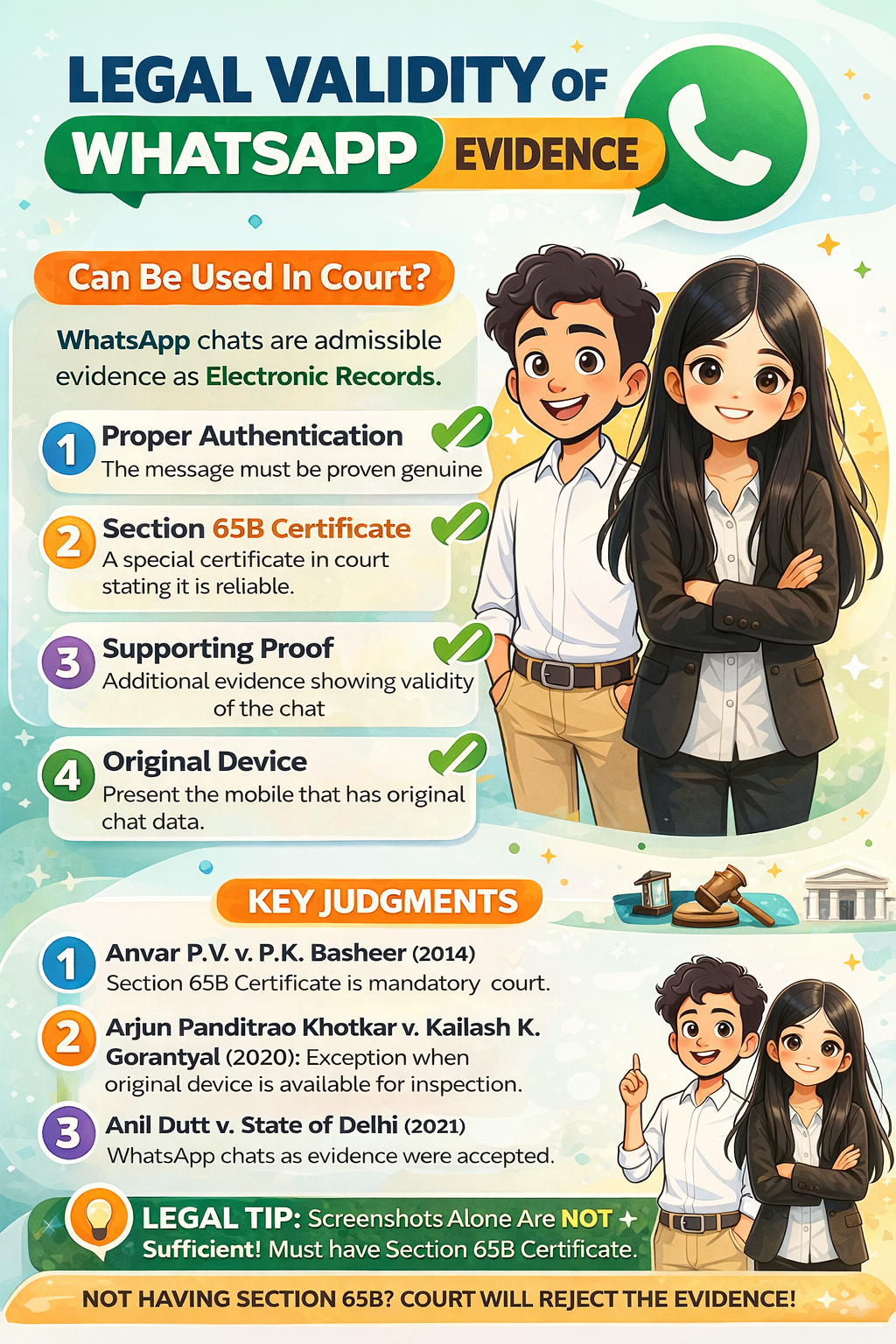
WhatsApp chats are admissible as electronic records under Indian law.
Statutory Basis
✔ Information Technology Act, 2000
Section 3: Definitions of electronic record
Section 65A: Electronic records are admissible
Section 65B: Admissibility of electronic records with certificate
➡ WhatsApp messages are covered because they are:
Stored electronically
Transmitted electronically
2. Requirement of Authentication
To use WhatsApp chats as evidence, you must prove: ✅ The message was sent by the person claimed ✅ The content was not tampered with ✅ Chain of custody is maintained
This is usually done through:
Sender/receiver testimony
Metadata (logs/time)
WhatsApp backup/export
Mobile phone forensic report
3. Mandatory Certificate under Section 65B
Any electronic record (like WhatsApp chat) must be accompanied by a 65B Certificate or equivalent compliance.
What the certificate must state: ✔ The record was produced from a computer/mobile ✔ The process of retrieval was regular ✔ The device/system was in proper working condition
Without a valid 65B certificate, courts routinely reject WhatsApp evidence.
Key Judgments on WhatsApp Evidence
Anvar P.V. v. P.K. Basheer (2014) 10 SCC 473
Supreme Court clearly held:
Electronic records are admissible only if Section 65B is complied with
No electronic evidence can be read into record without Section 65B certificate
Even if the evidence is spoken to by witness, it must still satisfy 65B
Ratio:
No evidence of electronic record without 65B certificate.
Supreme Court refined the rule: ✔ If the original device is in physical custody of court/police, then a certified copy may be admitted without 65B in law ✔ Default rule still requires 65B where device is not available
Key Takeaway:
When the original machine is available for inspection, such evidence may be read without 65B.
Anil Dutt vs. The State of NCT Delhi (2021)
Delhi High Court held:
WhatsApp audio messages and chats are admissible
WhatsApp messages were read as part of evidence after proper certification
State vs. Navjot Sandhu (2005)
Though before WhatsApp era, the Supreme Court held:
Confessions to a police officer are inadmissible – This affects WhatsApp confession messages too if they are not voluntary admissions.
Triloki Nath vs. State of Delhi (1998)
Supreme Court set out the principles of admissibility:
Relevance
Authenticity
Non-suspicious conditions of reporting
These are applied to WhatsApp evidence too.
How Courts Treat WhatsApp Evidence (Practical Principles)
Absolutely necessary unless: ✔ original device is produced in court ✔ and entire chat log is examined by court expert
3. Screenshots Alone Are Not Enough
Screenshots are not primary evidence. They must have: ✔ export with timestamps, OR ✔ forensic extraction
4. Forwarded Messages
Forwarded messages are weak evidence unless: ✔ originator is identified ✔ circumstance proves its relevance
5. WhatsApp Voice Notes
Also admissible with same principles: ✔ metadata confirmation ✔ 65B compliance ✔ witness recognition
6. Screenshot vs Real Chat
Courts prefer: ✔ Exported chat with timestamp & phone info ✔ WhatsApp backup file ✔ Forensic report from mobile
Screenshot alone is weak but can form part of evidence with 65B & supporting proof.
Checklist for Using WhatsApp Evidence in Court
Requirement
Required?
WhatsApp message
Yes
65B Certificate
Yes
Authenticity proof
Yes
Metadata/Forensic evidence
Highly Recommended
Device inspection
If possible
Witness to confirm
Yes
Sample 65B Certificate Format (Quick Idea)
I, ____________________, do hereby certify that:

1. The electronic record (WhatsApp chat) was produced from the digital device ___________ belonging to __________.
2. The device was in proper working condition at all relevant times.
3. The record was extracted using regular process.
4. The attached electronic record is a true and correct copy of the original stored in the device memory.
Place:
Date:
Signature:
Important Case Law Summary (for citations)
Case
Court
Key Principle
Anvar P.V. v. P.K. Basheer (2014)
SC
65B compliance is mandatory for electronic evidence
Arjun Panditrao Khotkar (2020)
SC
Exception when original device is available for inspection
Anil Dutt v. State (2021)
Delhi HC
WhatsApp chats + audio admissible with proper certification
Triloki Nath v. State (1998)
SC
Core principles of relevance & authenticity
Practical Scenarios (Examples)
Example 1 – Civil Matter
WhatsApp chat between parties about settlement → ✔ Export chats + 65B → Admissible
Example 2 – Criminal Case
WhatsApp confession: “I did it” → ✔ If authenticated + not coerced + 65B → Admissible
✖ But if just screenshot shown → Weak
Example 3 – Family Matter
WhatsApp message about maintenance or threats → ✔ Section 65B + witness confirmation → Admissible
Conclusion
WhatsApp messages and voice notes are admissible legal evidence in Indian courts if:
Authenticated properly
Supported by 65B certificate
Original device is available or process is proven
Supreme Court has repeatedly emphasized 65B compliance as the primary condition.
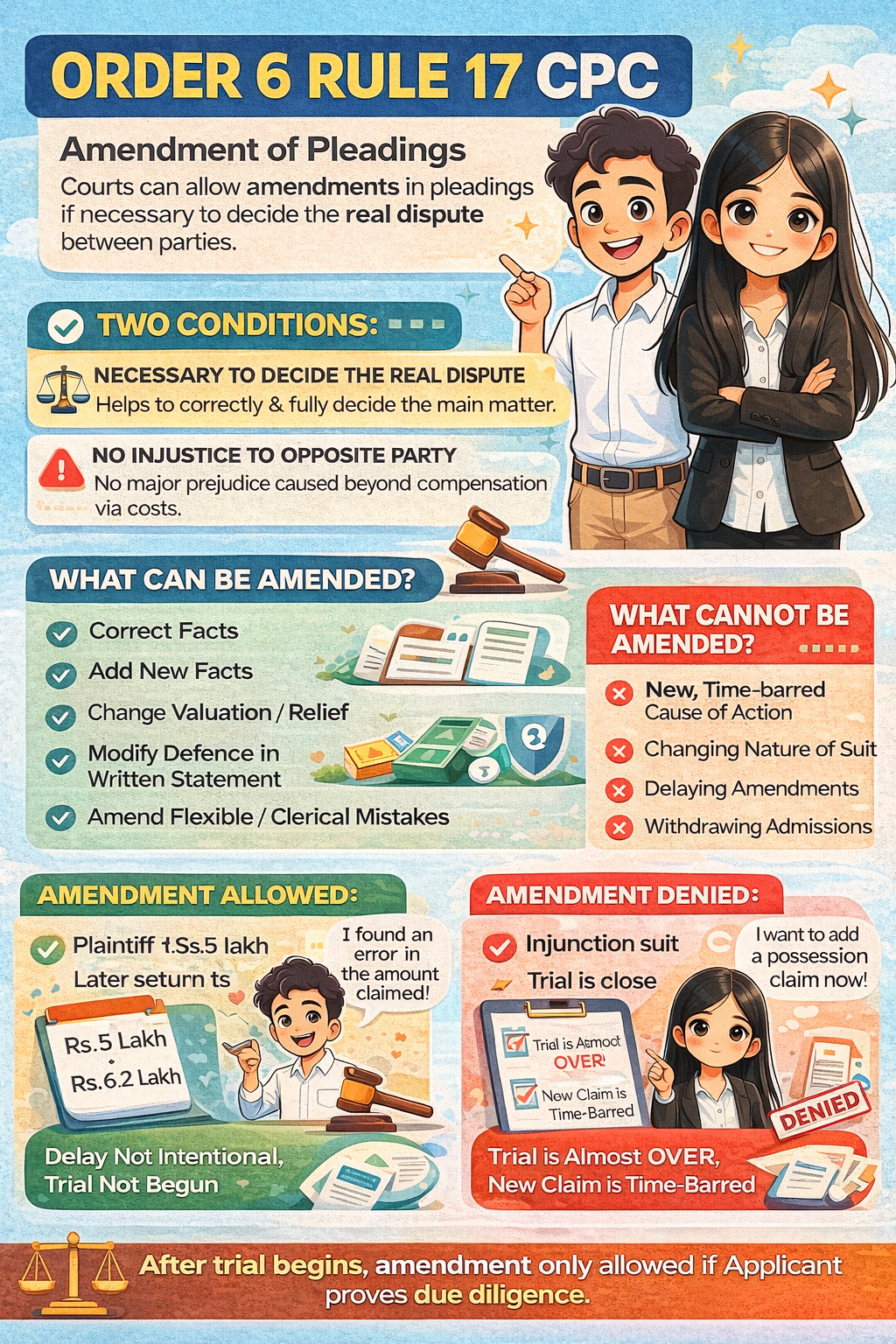
Order 6 Rule 17 empowers the court to allow amendments in pleadings (plaint or written statement) at any stage of the suit, if the amendment is necessary for determining the real questions in controversy.
Two Conditions for Allowing Amendment
1. The amendment must be necessary for deciding the real dispute.
If the original pleadings miss important facts or require correction → court may allow.
2. The amendment should not cause injustice or prejudice to the opposite party.
If prejudice can be compensated with costs → amendment is allowed.
After commencement of trial, the court shall NOT allow amendment unless:
The party proves “due diligence”
Meaning: despite reasonable efforts, the person could not have raised the matter before trial.
Trial begins when issues are framed and evidence begins.
This proviso is the most commonly litigated part today.
What Can Be Amended?
✔️ Correcting wrong facts ✔️ Adding new facts that clarify the cause of action ✔️ Correcting dates, figures, descriptions ✔️ Change in valuation, relief, or prayer clause ✔️ Adding alternative reliefs ✔️ Amendments to written statements are easier (defendant has wider rights)
What Cannot Be Amended?
✘ Introducing an entirely new and inconsistent case ✘ Changing the nature of the suit ✘ Setting up a new cause of action after limitation ✘ Amendments that withdraw admissions ✘ Malicious, delaying, or careless amendments
Important Supreme Court Case Laws
1. Revajeetu Builders v. Narayanaswamy (2009) 10 SCC 84
Court must check:
Whether the amendment is necessary?
Whether it introduces a new cause?
Whether it prejudices the opposite party?
Whether it avoids multiplicity of litigation?
(A golden test widely used in courts)
2. Kailash v. Nanhku (2005) 4 SCC 480
Amendments should not be rejected only because of procedural technicalities.
3. Vidyabai v. Padmalatha (2009) 2 SCC 409
After trial begins → burden on applicant to prove due diligence.
4. Rajkumar Gurawara v. S.K. Sarwagi (2008) 14 SCC 364
An amendment is allowed if it:
Helps avoid multiplicity of suits
Does not change the nature of the dispute
Example 1: Amendment Allowed
Case Situation: A plaintiff files a suit for recovery of ₹5,00,000 from the defendant. Later he discovers that he actually paid ₹6,20,000 due to an overlooked transaction. He applies to amend the plaint to change the amount.
Court Reasoning:
Correcting an amount helps decide the real controversy.
No major prejudice to defendant; can be compensated by costs.
Trial has not started → easier to allow.
Result: Amendment Allowed
Example 2: Amendment NOT Allowed
Situation: In a suit for injunction (possession not claimed), after trial has begun and evidence is recorded, the plaintiff files an amendment to convert the suit into a possession suit.
Court Reasoning:
This changes the nature of the suit.
New cause of action introduced.
Trial is already in advanced stage → no “due diligence”.
Result: Amendment Rejected
Example 3: Amendment Allowed in Written Statement
Situation: Defendant forgot to mention that the cheque was given as security, not a liability, in a recovery suit.
Later he files an amendment to add this defense.
Court Reasoning:
Defendant can raise alternative and even inconsistent pleas.
Helps decide the real issue.
No major prejudice → plaintiff gets chance to rebut.
📌 Result: Amendment Allowed
Example 4: Time-barred Amendment Rejected
Situation: The plaintiff tries to add a completely new cause of action that arose 5 years ago (beyond limitation).
Court:
Amendment introducing a time-barred claim is not allowed.
Result: Amendment Rejected
Short Court-Ready Summary
Order 6 Rule 17 CPC allows amendments if:
It is necessary for deciding the real dispute.
It does not change the nature of the case.
It does not introduce a new cause of action after limitation.
It does not cause prejudice to the other side.
After trial begins → applicant must prove due diligence.
DRAFT APPLICATION UNDER ORDER 6 RULE 17 CPC
(For Amendment of Pleadings – Plaintiff or Defendant)
IN THE COURT OF _________ Civil Suit No. ____ of 20__
ABC ……… Plaintiff/Applicant Versus XYZ ……… Defendant/Respondent
APPLICATION UNDER ORDER 6 RULE 17 READ WITH SECTION 151 CPC FOR AMENDMENT OF THE PLAINT/WRITTEN STATEMENT
Most Respectfully Showeth:
That the present suit is pending before this Hon’ble Court at the stage of ______ (before/after framing of issues / before evidence / during evidence).
That the applicant filed the plaint/written statement on //20__ setting out the relevant facts as then known.
That during the pendency of the suit, the applicant has now discovered certain material facts / clerical mistakes / omissions which could not be incorporated earlier despite exercising due diligence. The proposed amendment is necessary for the purpose of correctly and completely adjudicating the real questions in controversy.
That the proposed amendment does not change the nature of the suit, nor does it introduce any new or time-barred cause of action. The amendment only seeks to bring clarity and avoid multiplicity of proceedings.
That no prejudice will be caused to the opposite party, and in any case, the same can be compensated by costs, if this Hon’ble Court deems fit.
That the amendment is essential to determine the real issue between the parties and to enable this Hon’ble Court to effectively and completely adjudicate upon all matters in dispute.
That the proposed amendments are reproduced below: (Provide here the old paragraph and the proposed amended paragraph in a comparative format) Example format:
Existing Para 5: “___________”
Proposed Para 5: “___________”
That this application is bona fide and in the interest of justice.
PRAYER
In view of the aforesaid facts and circumstances, it is most respectfully prayed that this Hon’ble Court may be pleased to:
Allow the present application and permit the applicant to amend the plaint/written statement as per Para 7 above;
Take the amended pleading on record; and
Pass any other or further order(s) as this Hon’ble Court may deem fit in the interest of justice.
Applicant Through Counsel Name: __________ Date: //20__ Place: _________
DRAFT REPLY / OBJECTION TO ORDER 6 RULE 17 CPC APPLICATION
IN THE COURT OF _________ Civil Suit No. ____ of 20__
ABC ……… Plaintiff/Non-Applicant Versus XYZ ……… Defendant/Applicant
REPLY / OBJECTION TO THE APPLICATION UNDER ORDER 6 RULE 17 CPC FILED BY THE APPLICANT
Most Respectfully Submitted:
That the applicant’s application under Order 6 Rule 17 CPC is misconceived, not maintainable, and liable to be dismissed, as it has been filed with the sole intention to delay the proceedings.
That the suit is already at an advanced stage (state stage: after framing of issues / during evidence / after evidence / at final arguments). As per the second proviso to Order 6 Rule 17 CPC, no amendment can be allowed unless the applicant proves “due diligence”. The applicant has failed to show any diligence whatsoever.
That the facts sought to be added/amended were well within the knowledge of the applicant since the filing of the suit, yet the applicant deliberately chose not to include them. Hence, the application is hit by lack of due diligence, making the amendment impermissible at this stage.
That the proposed amendment introduces a completely new and inconsistent case, which would change the nature of the suit and prejudice the rights of the replying party. Therefore, such amendment cannot be allowed in law.
That the proposed amendment also seeks to introduce a time-barred cause of action, which is expressly prohibited by settled law (SC judgments). Permitting such amendment would defeat the principles of limitation and fairness.
That the application has been filed only to delay the matter and harass the replying party, which is evident from the timing and nature of the amendments.
That allowing such amendment would require reopening of pleadings/evidence, causing irreparable prejudice to the replying party, which cannot be compensated in terms of cost.
That the application is devoid of merits, is mala fide, and is liable to be dismissed with heavy costs.
PRAYER
In view of the above submissions, it is most respectfully prayed that this Hon’ble Court may be pleased to:
Dismiss the application filed under Order 6 Rule 17 CPC,
Impose exemplary costs on the applicant for filing a frivolous and delayed application, and
Pass any other order(s) as the Hon’ble Court may deem fit in the interest of justice.
Non-Applicant / Opposite Party Through Counsel Name: __________ Date: //20__ Place: _________
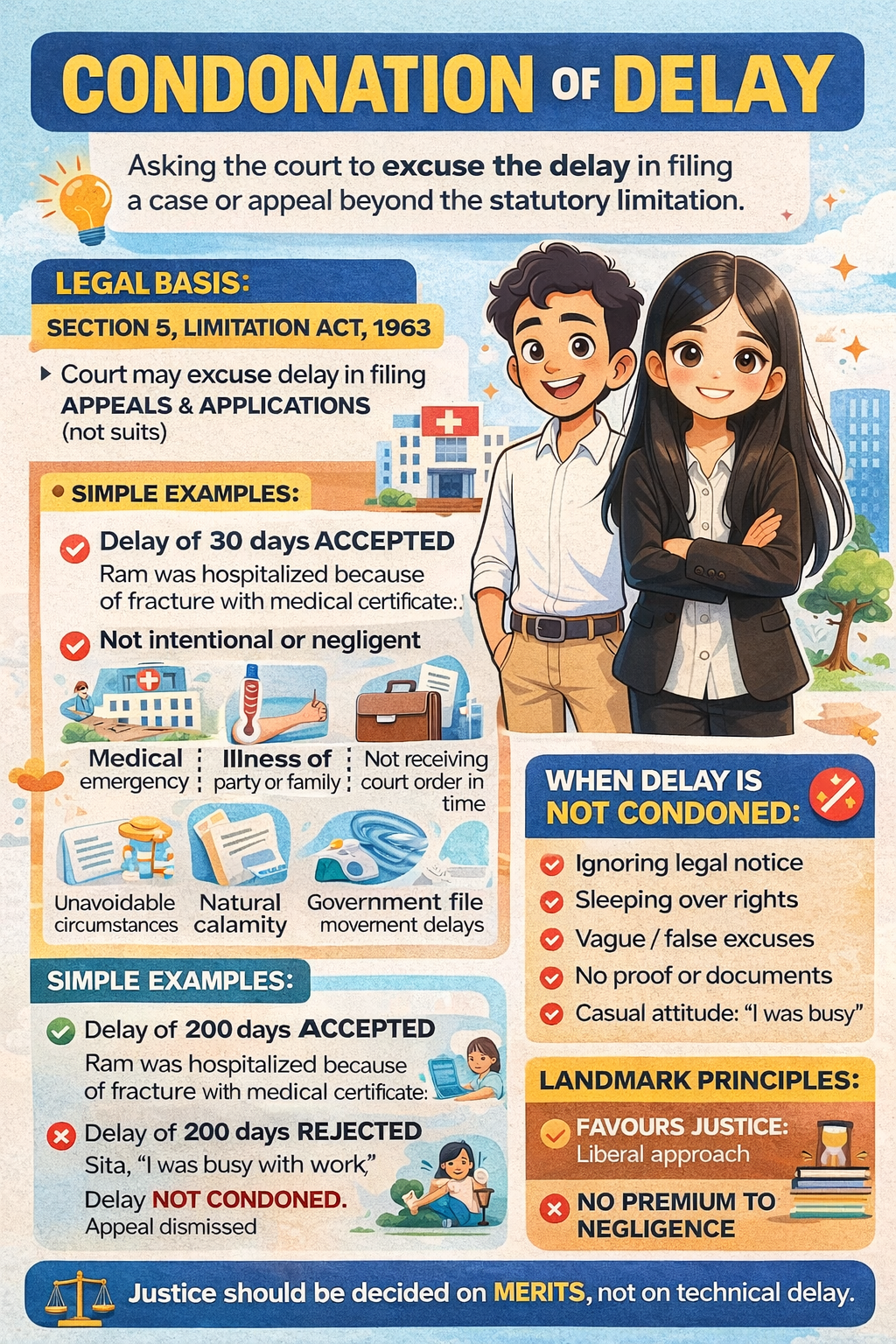
“Condonation of delay” means asking the court to excuse the delay when a party fails to file a case/appeal/application within the statutory limitation period.
The court can forgive the delay if there is a sufficient cause.
Legal Basis
Section 5 – Limitation Act, 1963
Court may condone delay in:
Appeals
Applications (But NOT suits)
Purpose
To ensure justice is not denied merely because a party was late due to circumstances beyond their control.
What Is “Sufficient Cause”?
The cause must be: ✔ Genuine ✔ Reasonable ✔ Beyond the party’s control ✔ Not intentional or negligent
Common accepted reasons:
Medical emergency
Illness of party or family
Not receiving court order in time
Wrong legal advice
Unavoidable circumstances
Natural calamity
Government file movement delays (for govt. departments)
❌ When Delay Is Not Condoned
Ignoring legal notices
Sleeping over rights
Vague or false excuses
Delay caused intentionally
No proof or documents
Casual attitude: “I was busy”
Landmark Principles
1. Liberal Approach (Favours Justice)
Collector, Land Acquisition v. Katiji (1987) ➡ Courts should adopt a liberal approach because refusing condonation may lead to injustice.
2. No Premium to Negligence
➡ But courts do NOT condone when delay is due to carelessness or lack of diligence.
3. Government cases
➡ Some relaxation, but even govt. must show sufficient cause.
Simple Examples
Example 1: Delay Accepted
Ram had to file an appeal within 90 days, but he filed on the 120th day (30 days late).
Reason: He was hospitalised due to a fracture and submitted:
Medical certificate
Hospital record
➡ Court accepts → Delay condoned ➡ Appeal registered and heard on merits.
Example 2: Delay Rejected
Sita filed an appeal 200 days late.
Reason given: “I was busy with work.”
No documents. No sufficient cause.
➡ Court rejects → Delay not condoned ➡ Appeal dismissed as “time-barred.”
Example 3: Wrong Legal Advice
A person files appeal late because lawyer gave wrong date or wrong limitation period.
If supported with details or affidavit:
➡ Courts generally condone such delay.
Example 4: Did Not Receive Copy of Order
Limitation starts from knowledge of order.
If party never received the certified copy:
➡ Delay may be condoned.
Conclusion
Condonation of delay exists to ensure:
“Justice should be decided on merits, not on technical delay.”
But the party seeking condonation must show good cause, proper explanation, and diligence, with documents wherever possible.
1. Draft Application for Condonation of Delay
(U/S 5 of Limitation Act, 1963)**
IN THE COURT OF ____________________
Case Title: ___________________________ Case No.: _____________________________
APPLICATION UNDER SECTION 5 OF THE LIMITATION ACT FOR CONDONATION OF DELAY
Most Respectfully Submitted:
That the applicant is filing the accompanying (appeal/revision/application) against the order dated //____, passed by the learned __________ Court.
That the statutory period of limitation for filing the present proceeding is ____ days, however the applicant could not file it within the prescribed time and there is a delay of ___ days.
That the delay has occurred due to reasons mentioned below, which constitute a sufficient cause:
The applicant was suffering from illness/medical issues from //____ to //____ and was advised complete rest. —OR—
The applicant was out of station due to family emergency. —OR—
The counsel inadvertently misplaced the file / certified copies were supplied late. —OR—
Any other genuine reason (customize).
That the delay is neither intentional nor deliberate, but due to circumstances beyond the control of the applicant.
That if the delay is not condoned, the applicant will suffer irreparable loss, whereas no prejudice will be caused to the opposite party.
That the present application is made bona fide and in the interest of justice.
PRAYER
In the above circumstances, it is most respectfully prayed that this Hon’ble Court may kindly:
a) Condone the delay of ___ days in filing the accompanying (appeal/revision/application), and b) Pass any other order(s) deemed fit in the interest of justice.
Applicant Through Counsel (Name & Signature) Date: Place:
2. Draft Reply / Objections to Application for Condonation of Delay
IN THE COURT OF ____________________
Case Title: ________________________ Case No.: _________________________
REPLY/OBJECTION TO APPLICATION U/S 5 OF THE LIMITATION ACT FOR CONDONATION OF DELAY
Most Respectfully Submitted:
That the Respondent opposes the application for condonation of delay filed by the Applicant.
That the Applicant has failed to show any sufficient cause for the inordinate delay of ___ days. The reasons mentioned in the application are vague, false, and unsupported by any evidence.
That the Applicant has been grossly negligent and careless and has approached this Hon’ble Court only after an adverse order was passed.
That the Applicant has not produced medical documents / travel proofs / certified copy delay slips or any material to justify the delay.
That condoning such delay would defeat the purpose of limitation law, which requires parties to act with diligence.
That the application is filed only to delay the proceedings and harass the Respondent.
PRAYER
Therefore, it is humbly prayed that the application filed by the Applicant under Section 5 of the Limitation Act be dismissed, and the delay may not be condoned.
Respondent Through Counsel (Name & Signature) Date: Place:
3. Oral Arguments (Applicant Side – For Condonation)
“My Lord, the applicant has shown sufficient cause under Section 5 of the Limitation Act.”
“The delay is neither intentional nor deliberate; it occurred due to circumstances beyond control.”
“Courts have repeatedly held that ‘substantial justice must prevail over technicalities.’”
“If delay is not condoned, the applicant will suffer irreparable loss.”
“No prejudice will be caused to the respondent if the delay is condoned.”
4. Oral Arguments (Respondent Side – Against Condonation)
“The applicant has completely failed to establish sufficient cause for delay.”
“The explanation is vague and unsupported by any proof.”
“There is clear negligence and lack of diligence.”
“Limitation laws exist to prevent stale claims; condoning such delay defeats the object of the Act.”
“The application is a misuse of process only to delay proceedings.”
A. Case Laws Supporting Condonation of Delay (Applicant Side)
(When you want the delay to be condoned)
1. Collector, Land Acquisition v. Mst. Katiji (1987) 2 SCC 107
Principle:
Courts must adopt a liberal approach in condonation of delay.
Substantial justice should prevail over technicalities.
A litigant does not gain by filing a delayed appeal.
2. N. Balakrishnan v. M. Krishnamurthy (1998) 7 SCC 123
Principle:
Length of delay is not important; the acceptability of the explanation is what matters.
Unless delay causes real prejudice to the opposite party, it should generally be condoned.
3. State of Nagaland v. Lipok AO (2005) 3 SCC 752
Principle:
A rational, pragmatic, and liberal approach must be followed.
Court should not take “too strict” or “pedantic” views.
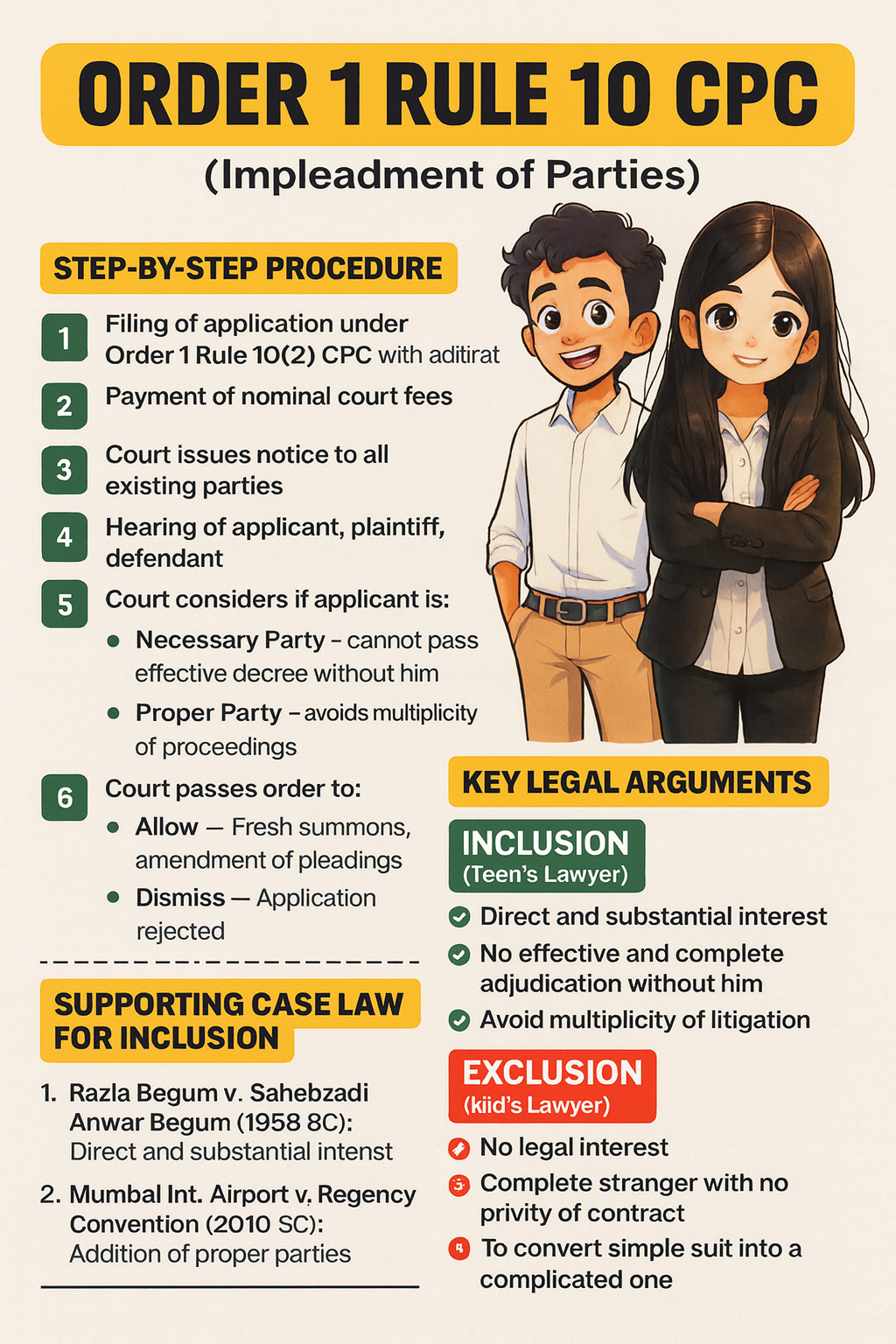
Order 1 Rule 10 CPC empowers the court to add, strike out, or substitute parties so that all real and necessary controversies involved in the suit can be effectively adjudicated.
Relevant Provisions
Order 1 Rule 10(1)
Court may strike out or add parties at any stage of the proceedings.
Can be done without application (suo motu) or on application of a party.
Order 1 Rule 10(2)(Most Important)
Court may add any person:
Who ought to have been joined (necessary party), or
Whose presence is necessary for complete and effective adjudication (proper party).
Step-by-Step Procedure
Step 1: Filing Application
Application under Order 1 Rule 10(2) CPC
Filed by:
Plaintiff, or
Defendant, or
Proposed party (third person)
Supported by an affidavit
Contents of application:
Description of the proposed party
Nature of interest in the suit property/subject matter
Reason why presence is necessary/proper
Stage of the suit
Step 2: Court Fees
Nominal court fee (as per State amendment / court rules)
Step 3: Issuance of Notice
Court issues notice to existing parties
Opportunity of hearing is given to:
Plaintiff
Defendant
Proposed party (if present)
Step 4: Hearing & Consideration by Court
Court examines:
Whether the proposed party is a:
Necessary party (no effective decree possible without him), or
Proper party (helps in complete adjudication)
Whether impleadment will:
Change nature of suit ❌
Cause delay or prejudice ❌
Lead to multiplicity of proceedings ❌
Step 5: Order of the Court
If Allowed:
Party is added as Plaintiff or Defendant
Amendment of plaint/written statement permitted
Fresh summons issued to newly added party
If Rejected:
Application dismissed with reasons
Step 6: Amendment of Pleadings
Plaintiff amends the plaint under Order 6 Rule 17 CPC
Newly added party files Written Statement
Suit proceeds further
Key Legal Principles (For Arguments)
Necessary Party
A person without whom no effective decree can be passed Example: Co-owner in partition suit
Proper Party
A person whose presence enables complete adjudication Example: Subsequent purchaser in property dispute
Important Case Laws
Razia Begum v. Sahebzadi Anwar Begum (1958 SC) → Interest must be direct and substantial
Mumbai International Airport v. Regency Convention Centre (2010 SC) → Distinction between necessary & proper party
Kasturi v. Iyyamperumal (2005 SC) → In specific performance suits, strangers generally not allowed
When Order 1 Rule 10 Application is Rejected
Applicant has no legal interest
Impleadment alters the nature of suit
Application filed only to delay proceedings
Practical Drafting Tip
Always mention:
“To avoid multiplicity of litigation”
“For complete and effective adjudication”
DRAFT APPLICATION
(Under Order 1 Rule 10(2) CPC – Impleadment of Party)
IN THE COURT OF ____________
Civil Suit No. ____ of 20__
A …………………………… Plaintiff Versus B …………………………… Defendant
APPLICATION UNDER ORDER 1 RULE 10(2) CPC
Most Respectfully Submitted:
That the above-mentioned suit is pending adjudication before this Hon’ble Court.
That the present suit relates to (brief description of subject matter / property / transaction).
That the applicant (name of proposed party) has a direct, legal and substantial interest in the subject matter of the suit inasmuch as:
(State how right/title/interest arises)
(Mention documents, if any)
That without the presence of the applicant, no effective and complete adjudication of the issues involved in the suit is possible.
That the applicant is a necessary / proper party and ought to have been impleaded at the time of filing of the suit.
That non-impleadment will result in multiplicity of litigation and conflicting decisions.
That the impleadment will not change the nature of the suit nor cause prejudice to any party.
That this Hon’ble Court is empowered to implead parties at any stage of proceedings under Order 1 Rule 10 CPC.
PRAYER
It is therefore most respectfully prayed that this Hon’ble Court may be pleased to:
a) Allow the present application; b) Implead (name of proposed party) as Plaintiff / Defendant No.__; c) Permit amendment of pleadings; d) Pass any other order deemed fit in the interest of justice.
Applicant Through Counsel Place: Date:
REPLY / OBJECTION
(To Application under Order 1 Rule 10 CPC)
IN THE COURT OF ____________
Civil Suit No. ____ of 20__
Reply on behalf of Defendant / Plaintiff
That the application is false, frivolous, and misconceived and liable to be dismissed.
That the applicant has no legal or enforceable right in the subject matter of the suit.
That the applicant is neither a necessary party nor a proper party as:
Effective decree can be passed without his presence.
His alleged interest is remote and speculative.
That the suit is confined to (specific relief) and the applicant is a stranger to the contract / transaction.
That impleadment will:
Change the nature of the suit
Delay trial
Cause serious prejudice to the replying party
That the application is filed only to delay proceedings and harass the parties.
That Order 1 Rule 10 CPC cannot be used to expand the scope of the suit.
PRAYER
It is therefore prayed that the application under Order 1 Rule 10 CPC be dismissed with costs.
Respondent Through Counsel Place: Date:
ORAL ARGUMENTS (FOR ALLOWING APPLICATION)
May it please Your Honour:
The applicant has a direct and substantial interest in the subject matter.
Without his presence, no effective decree can be passed.
Order 1 Rule 10 CPC empowers the Court at any stage.
The impleadment will avoid multiplicity of litigation.
The nature of the suit remains unchanged.
Supreme Court in Mumbai International Airport case (2010) clearly allows addition of proper parties for complete adjudication.
Hence, the application deserves to be allowed.
ORAL ARGUMENTS (FOR DISMISSAL)
May it please Your Honour:
Applicant is a complete stranger to the suit.
No legal right is disclosed—only a commercial or personal interest.
Effective decree can be passed without the applicant.
Order 1 Rule 10 CPC cannot be used to convert a simple suit into a complex one.
Supreme Court in Kasturi v. Iyyamperumal bars impleadment of strangers.
Application is a delay tactic.
Hence, the application is liable to be dismissed.
PRACTICAL COURT TIP
If you are Plaintiff opposing impleadment, argue dominus litis principle. If you are Applicant, stress complete adjudication + multiplicity avoidance.