
Section 356 of BNSS deals with “Inquiry, Trial, or Judgment in Absence (in Absentia) of a Proclaimed Offender.”
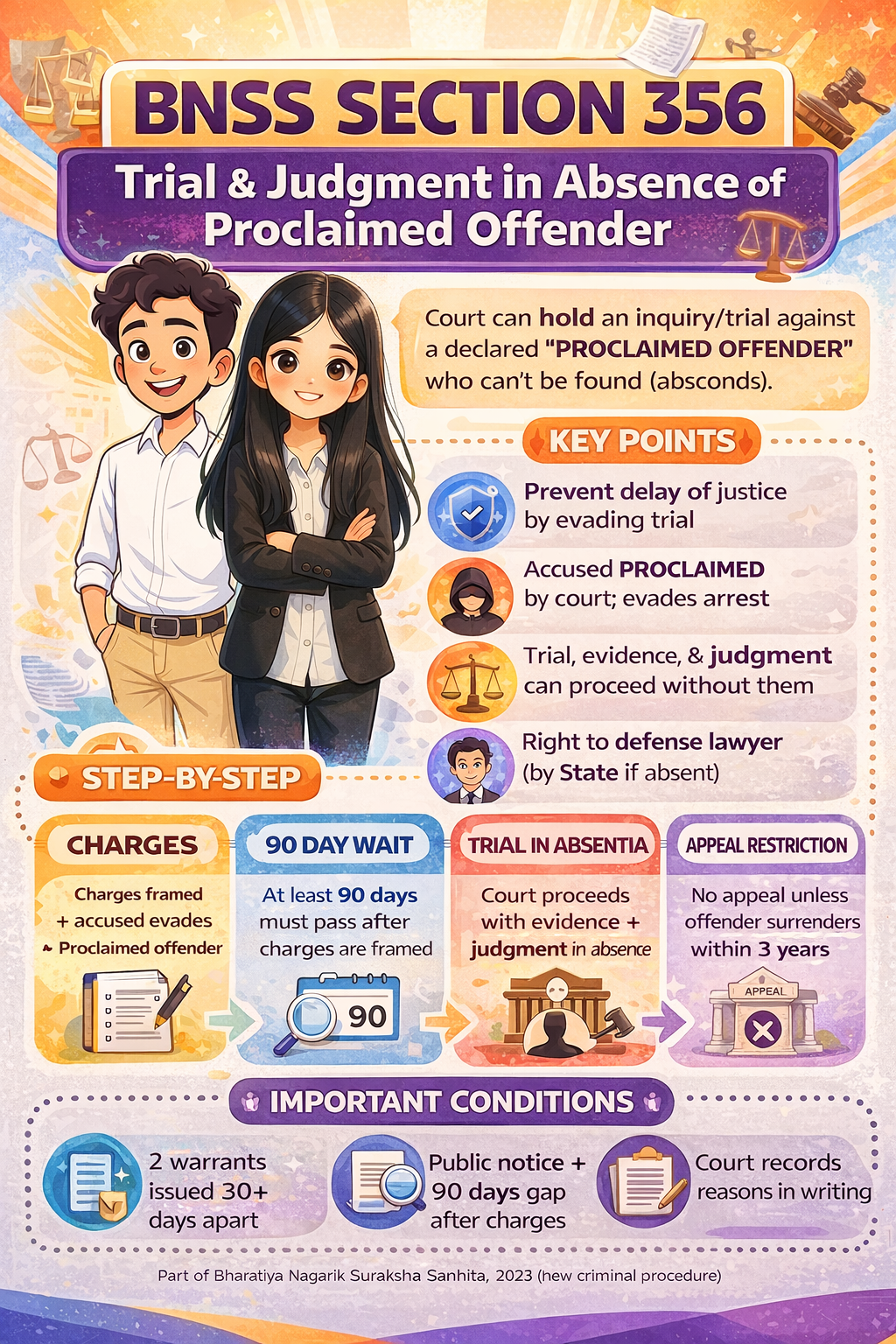
This means if a person is declared a proclaimed offender, evades arrest, and cannot be found, the court may — under this section — proceed with their inquiry, trial, or judgment without their physical presence.
Key Provisions
1️. Who it applies to
- A proclaimed offender — i.e., someone whom the court has officially declared as such because they are evading arrest after charges are framed.
2️. Purpose
- Prevents defendants from delaying justice by escaping trial.
- Allows courts to continue legal proceedings without waiting indefinitely for arrest.
3️. Conditions before trial in absentia
Before proceeding, certain safeguards must be followed:
✔️ Court issues two arrest warrants at least 30 days apart.
✔️ Court gives public notice (e.g., newspaper) and informs relatives/friends.
✔️ 90 days’ gap after framing of charges must pass before trial starts.
✔️ Court records reasons in writing why it is proceeding without the accused.
4️. Right to legal representation
- Even if the accused is absent, the court ensures they are represented by a defense lawyer (appointed by the State if needed).
5️. Appeal restrictions
- No appeal is allowed against a judgment unless the proclaimed offender presents himself before the appellate court within the next three years.
Why BNSS 356 is Important
Under the old CrPC, courts could declare someone a proclaimed offender (CrPC Sections 82–83) but could not conduct a trial and pronounce judgment unless the person was present. BNSS Section 356 fills that gap and ensures justice isn’t stalled by absconders.
Example Scenarios
Example 1 – Absconding Murder Accused
A person accused of murder escapes after charges are framed.
- Police and court issue warrants and publish notices.
- After 90 days and compliance with safeguards, the court proceeds with trial in absence of the accused under BNSS 356.
- Charges are framed and evidence recorded even though the accused isn’t present.
This is a real-world scenario used first time by Delhi Police to prevent trial delay when the accused evaded arrest.
Practical Example — Step by Step
- Charges Framed: Court frames charges against X for a serious offence.
- Accused Evades: X disappears and stops responding to summons.
- Arrest Warrants: Two warrants issued 30 days apart.
- Public Notice: Notices published in local media and police station.
- 90 Days Pass: Enough time is allowed before trial.
- Trial in Absentia: Court proceeds with trial; records evidence.
- Judgment: Court may convict or acquit;
- Appeal: Only possible if X appears before appellate court within 3 years.
Safeguards & Rights
✔️ Court must record written reasons for proceeding without the accused.
✔️ Court must ensure accused’s right to legal counsel is protected.
✔️ Trial shouldn’t begin until procedural safeguards are met.
Summary – Section 356 BNSS
| Aspect | Detail |
| Full Title | Inquiry, Trial or Judgment in Absentia of Proclaimed Offender (BNSS 356) |
| Applies To | Declared Proclaimed Offenders |
| Purpose | Prevent delay of justice; allow trial in absence |
| Key Requirements | Warrants, public notice, 90 days gap, written reasons |
| Rights Protected | Legal representation; appeal on appearance |
| Appeals | Not permitted unless accused appears |
| Legal Impact | Courts can proceed even when accused absconds |
Important
This section is about trial in absentia — not punishment for a specific offence. It’s a procedure provision (BNSS), not a substantive offence like defamation
Our Linkedin
https://www.linkedin.com/in/ushavats/

Add a Comment