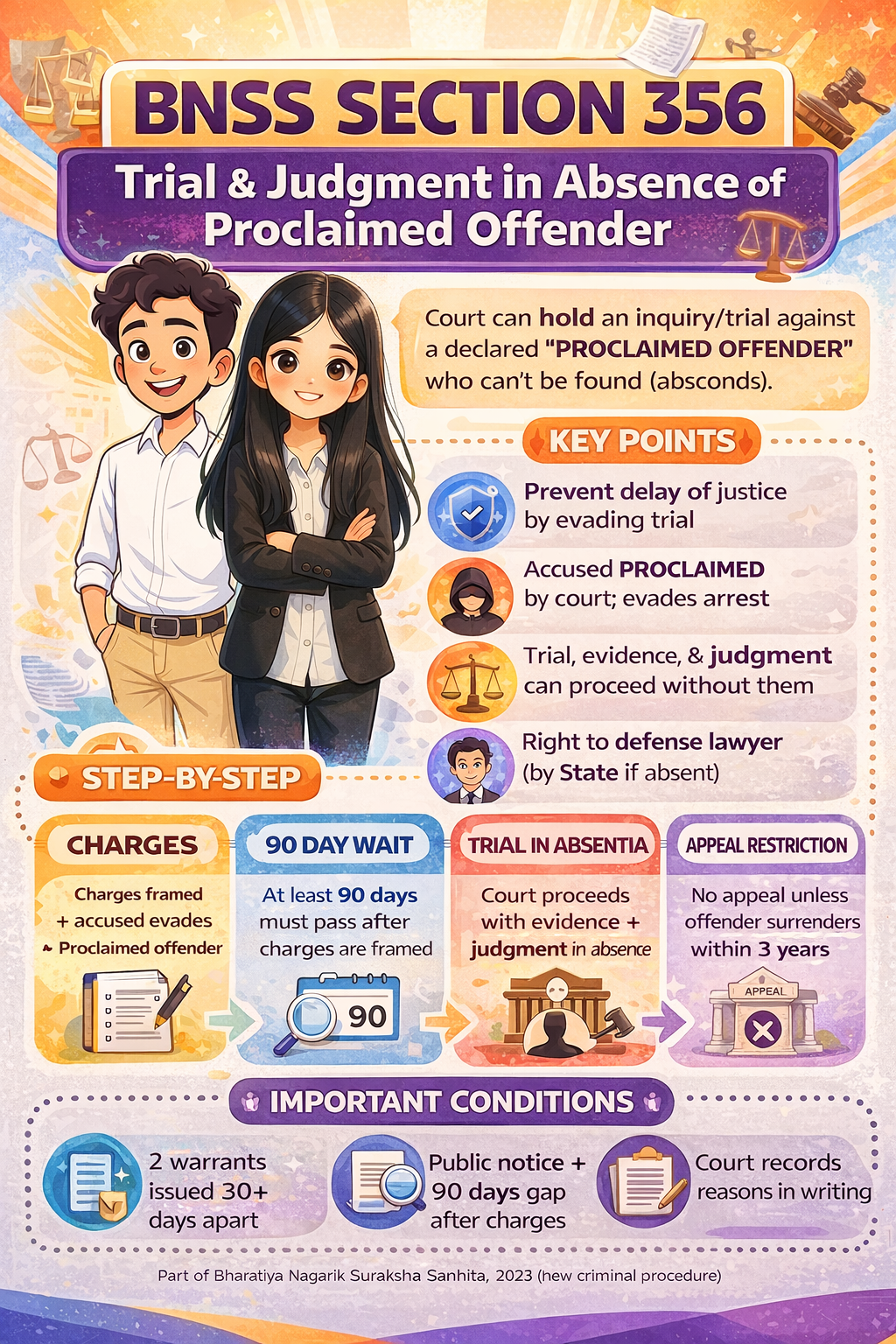
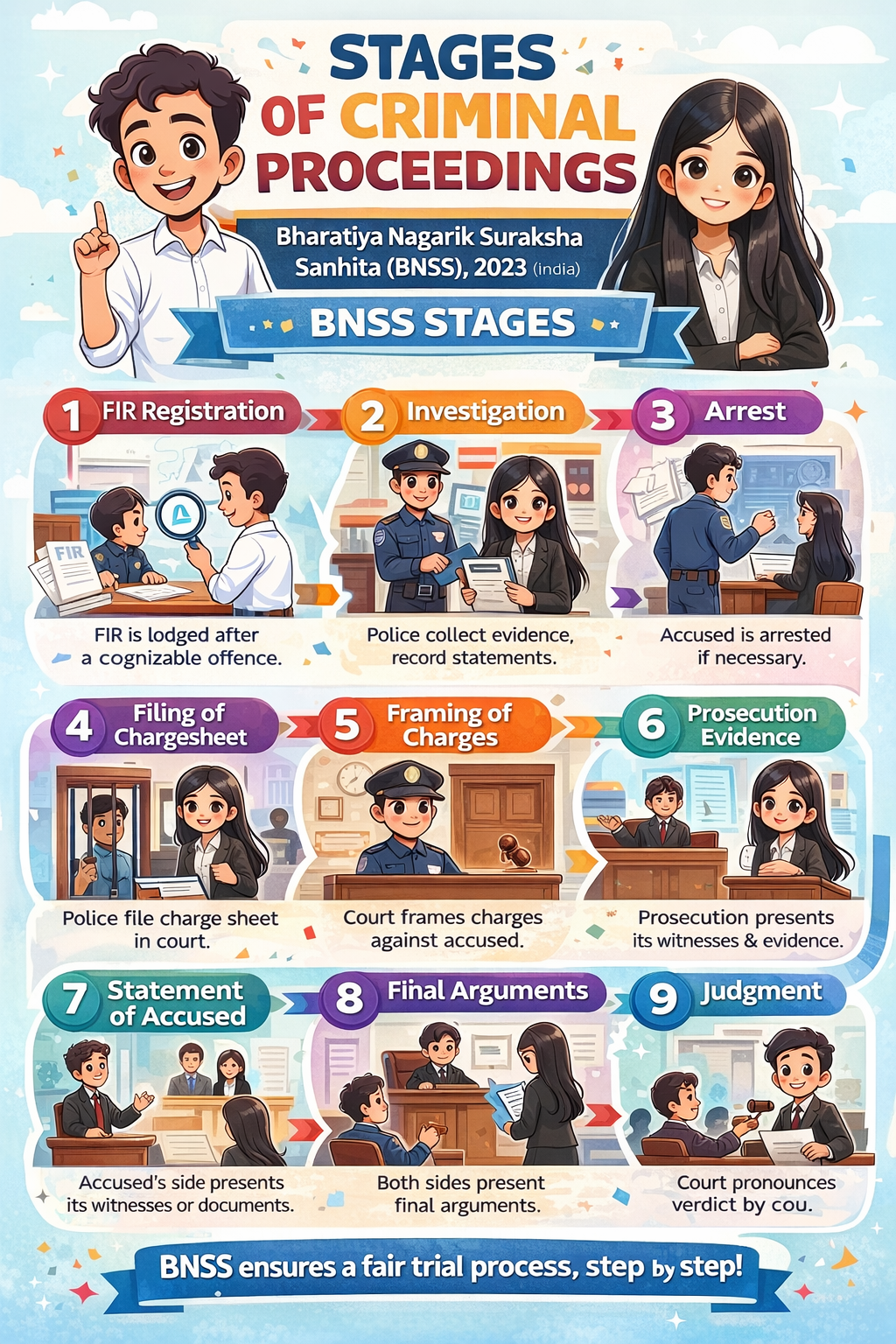
Section 356 of BNSS deals with “Inquiry, Trial, or Judgment in Absence (in Absentia) of a Proclaimed Offender.” This means if a person is declared a proclaimed offender, evades arrest, and cannot be found, the court may — under this section — proceed with their inquiry, trial, or judgment without their physical presence.
Key Provisions
1️. Who it applies to
A proclaimed offender — i.e., someone whom the court has officially declared as such because they are evading arrest after charges are framed.
2️. Purpose
Prevents defendants from delaying justice by escaping trial.
Allows courts to continue legal proceedings without waiting indefinitely for arrest.
3️. Conditions before trial in absentia
Before proceeding, certain safeguards must be followed: ✔️ Court issues two arrest warrants at least 30 days apart. ✔️ Court gives public notice (e.g., newspaper) and informs relatives/friends. ✔️ 90 days’ gap after framing of charges must pass before trial starts. ✔️ Court records reasons in writing why it is proceeding without the accused.
4️. Right to legal representation
Even if the accused is absent, the court ensures they are represented by a defense lawyer (appointed by the State if needed).
5️. Appeal restrictions
No appeal is allowed against a judgment unless the proclaimed offender presents himself before the appellate court within the next three years.
Why BNSS 356 is Important
Under the old CrPC, courts could declare someone a proclaimed offender (CrPC Sections 82–83) but could not conduct a trial and pronounce judgment unless the person was present. BNSS Section 356 fills that gap and ensures justice isn’t stalled by absconders.
Example Scenarios
Example 1 – Absconding Murder Accused
A person accused of murder escapes after charges are framed.
Police and court issue warrants and publish notices.
After 90 days and compliance with safeguards, the court proceeds with trial in absence of the accused under BNSS 356.
Charges are framed and evidence recorded even though the accused isn’t present.
This is a real-world scenario used first time by Delhi Police to prevent trial delay when the accused evaded arrest.
Practical Example — Step by Step
Charges Framed: Court frames charges against X for a serious offence.
Accused Evades: X disappears and stops responding to summons.
Arrest Warrants: Two warrants issued 30 days apart.
Public Notice: Notices published in local media and police station.
90 Days Pass: Enough time is allowed before trial.
Trial in Absentia: Court proceeds with trial; records evidence.
Judgment: Court may convict or acquit;
Appeal: Only possible if X appears before appellate court within 3 years.
Safeguards & Rights
✔️ Court must record written reasons for proceeding without the accused. ✔️ Court must ensure accused’s right to legal counsel is protected. ✔️ Trial shouldn’t begin until procedural safeguards are met.
Summary – Section 356 BNSS
Aspect
Detail
Full Title
Inquiry, Trial or Judgment in Absentia of Proclaimed Offender (BNSS 356)
Applies To
Declared Proclaimed Offenders
Purpose
Prevent delay of justice; allow trial in absence
Key Requirements
Warrants, public notice, 90 days gap, written reasons
Rights Protected
Legal representation; appeal on appearance
Appeals
Not permitted unless accused appears
Legal Impact
Courts can proceed even when accused absconds
Important
This section is about trial in absentia — not punishment for a specific offence. It’s a procedure provision (BNSS), not a substantive offence like defamation
☐ Legally enforceable debt/liability exists ☐ Cheque issued towards discharge of debt ☐ Cheque signed by accused ☐ Cheque presented within 3 months ☐ Cheque dishonoured by bank ☐ Bank return memo available
B. DISHONOUR DETAILS
☐ Reason: Funds Insufficient / Account Closed / Stop Payment ☐ Bank memo date mentioned ☐ Same cheque presented only once (or explain multiple presentations)
C. LEGAL NOTICE (MOST CRITICAL)
☐ Notice issued within 30 days of dishonour ☐ Exact cheque amount demanded ☐ Correct name & address of accused ☐ Sent by valid mode (Speed Post / Courier / Email*) ☐ Postal receipt on record ☐ Tracking / delivery report available
Service presumed if properly dispatched
D. 15 DAYS PAYMENT PERIOD
☐ 15 days given from date of receipt / deemed service ☐ No payment received within 15 days ☐ Cause of action arises on 16th day
E. COMPLAINT FILING (Sec 142)
☐ Complaint filed within 1 month of cause of action ☐ Delay? → Condonation application filed ☐ Territorial jurisdiction clearly pleaded
F. DOCUMENT CHECKLIST (MANDATORY)
☐ Original cheque ☐ Bank return memo ☐ Copy of legal notice ☐ Postal receipt & tracking ☐ Authority letter / POA (if applicable) ☐ Complaint affidavit
G. PRESUMPTION & BURDEN
☐ Presumption u/s 139 invoked ☐ Signature admitted or proved ☐ Burden shifted to accused
✔️ Never read file in court for first time ✔️ Timeline bana ke padho ✔️ Mark admissions, not arguments ✔️ Judge ki previous orders samjho ✔️ Relief ke hisaab se file padho
A caveat is a legal notice filed in court by a person who expects that the opposite party may file an application and wants to ensure that no order is passed without hearing him.
Simple meaning:
“Court, please don’t pass any order without hearing me first.”
CAVEAT IN CIVIL CASES
Statutory Provision
✅ Section 148A – Code of Civil Procedure, 1908 (CPC)
Who Can File a Caveat?
Any person:
who expects an application to be filed against him, and
who has a right to appear and be heard in that matter.
Example:
Defendant expecting stay / injunction
Respondent expecting ex-parte order
Purchaser fearing status-quo order
Where Caveat Can Be Filed?
Civil Court
District Court
High Court
Supreme Court
(Wherever the expected application will be filed)
Validity of Caveat
🕒 90 days from the date of filing (Section 148A(5) CPC)
After 90 days → Fresh caveat required.
Legal Effect (Section 148A CPC)
Once caveat is filed:
Court cannot pass any ex-parte order
Applicant must serve notice to the caveator
Caveator has a right to be heard
Copy of application must be supplied to caveator
Common Civil Matters Where Caveat Is Filed
Temporary injunction (Order 39 Rule 1 & 2 CPC)
Stay application
Execution proceedings
Probate / Succession matters
Property disputes
Family & matrimonial disputes
Civil Example
Example 1 (Property Case): A knows that B will file a suit for injunction to restrain sale of property. A files a caveat under Section 148A CPC. Result: Court cannot grant ex-parte stay without hearing A.
CAVEAT IN CRIMINAL CASES
Important Clarification There is NO express provision for caveat in the CrPC. But courts allow caveats in criminal matters based on principles of natural justice.
Legal Basis (Judicially Recognized)
Section 482 CrPC (Inherent powers of High Court)
Article 21 of Constitution (Right to fair hearing)
High Court Rules & Practice Directions
Where Criminal Caveat Is Commonly Accepted?
✔️ High Court ✔️ Sessions Court (limited cases)
❌ Generally not accepted in Magistrate courts
Criminal Matters Where Caveat Is Filed
Anticipatory bail (Section 438 CrPC)
Quashing petitions (Section 482 CrPC)
Criminal revision
Appeal against acquittal
Suspension of sentence
Criminal Examples
Example 1 – Anticipatory Bail
Complainant anticipates that accused will file anticipatory bail.
Complainant files criminal caveat in High Court Result:
Court issues notice to caveator
Bail not granted ex-parte
Example 2 – FIR Quashing
Victim expects accused will file quashing of FIR under Section 482 CrPC.
Victim files caveat Result: Court hears victim before passing any order.
CAVEAT UNDER SECTION 148A OF THE CODE OF CIVIL PROCEDURE, 1908
MOST RESPECTFULLY SHOWETH:
That the caveator is a necessary and interested party and has a legal right to be heard in respect of any application that may be filed by the proposed applicant in relation to the subject matter described herein.
That the caveator has reason to believe and apprehends that the proposed applicant is likely to file a civil suit / application seeking ex-parte interim relief / injunction / stay / status quo in respect of ________________________________ (brief description of property/dispute).
That if any such application is moved, the caveator shall suffer serious prejudice and irreparable loss if any ex-parte order is passed without giving the caveator an opportunity of being heard.
That this Hon’ble Court has jurisdiction to entertain the proposed suit / application and the present caveat.
That the caveator hereby lodges this caveat under Section 148A CPC and prays that no order on any such application be passed without prior notice and hearing to the caveator.
That the caveator undertakes to supply copies of this caveat to the proposed applicant as required under law.
PRAYER
In view of the facts stated above, it is most respectfully prayed that this Hon’ble Court may be pleased to:
a) Not pass any ex-parte order on any application that may be filed by the proposed applicant without issuing notice to the caveator;
b) Direct the proposed applicant to serve a copy of any such application and documents upon the caveator;
c) Pass any other order(s) as this Hon’ble Court may deem fit and proper in the interest of justice.
DETAILS AS REQUIRED UNDER SECTION 148A CPC
Nature of expected application: __________________________
Subject matter: __________________________
Court where application is expected: _____________________
(In Anticipation of Petition under Section 438 / Section 482 CrPC)
MOST RESPECTFULLY SHOWETH:
That the caveator is the complainant / victim / informant in FIR No. ______ dated ______, registered at Police Station __________, for offences under Sections __________ of IPC / BNS and other applicable laws.
That the caveator has reason to believe and apprehends that the proposed petitioner / accused is likely to file a petition before this Hon’ble Court:
under Section 438 CrPC seeking anticipatory bail; and/or
under Section 482 CrPC seeking quashing of the aforesaid FIR / criminal proceedings.
That if any such petition is taken up and ex-parte relief is granted without notice to the caveator, the caveator shall suffer serious prejudice, and the ends of justice would be defeated.
That the caveator has a legal and vested right to be heard before passing of any order in the above-mentioned anticipated petition(s), particularly when the allegations disclose cognizable and serious offences.
That this Hon’ble Court has the inherent powers under Section 482 CrPC and is also bound by the principles of natural justice, which require that the caveator be heard before passing any order affecting his/her rights.
That the present caveat is being filed in good faith to ensure a fair hearing and to prevent misuse of the process of law by the proposed petitioner / accused.
PRAYER
In view of the facts and circumstances stated above, it is most respectfully prayed that this Hon’ble Court may be pleased to:
a) Issue notice to the caveator before passing any order in any petition filed by the proposed petitioner under Section 438 or Section 482 CrPC;
b) Not grant any ex-parte interim protection / anticipatory bail / stay / quashing without affording an opportunity of hearing to the caveator;
c) Pass such other or further order(s) as this Hon’ble Court may deem fit and proper in the interest of justice.
✔️ Criminal caveat is not statutory, but High Courts routinely accept it ✔️ Mainly effective in:
Anticipatory bail matters
FIR quashing under Section 482 CrPC ✔️ Usually valid till disposal of first hearing (court discretion) ✔️ Attach copy of FIR if required by court practice
SUPPORTING CASE LAW (Mention in Arguments if Required)
Deepak Khosla v. Union of India – Criminal caveat maintainable in HC
Sunita Devi v. State of Bihar – Caveator has right to be heard in AB
Accused explains circumstances Silence cannot be used against accused
8. At Defence Evidence (Optional)
❌ No arguments yet
Sections
233 CrPC / 256 BNSS
Defence proves alibi, chats, documents
9. FINAL ARGUMENTS ⭐⭐⭐
✅ MOST DETAILED & DECISIVE STAGE
Sections
314 CrPC / 337 BNSS
What to argue?
Entire evidence appreciation
Contradictions
Benefit of doubt
Failure of prosecution
Law + facts + precedents
Example (376 IPC)
“Medical report negative, delay unexplained, WhatsApp chats show voluntary relationship — prosecution failed to prove guilt beyond reasonable doubt.”
10. Written Submissions
📌 Section
314(2) CrPC / 337 BNSS
✔️ Helpful in complex cases ✔️ Mandatory in many Delhi courts
QUICK MEMORY TABLE
Stage
Argue?
Purpose
FIR stage
❌
Only quashing
Bail
✅
Liberty
Cognizance
❌
Technical only
Discharge
✅⭐
Case end
Charge
⚠️ Limited
Prima facie
Evidence
❌
Only cross
313
❌
Explanation
Defence
❌
Proof
Final arguments
✅⭐⭐⭐
Acquittal
GOLDEN RULE (Court Wisdom)
Argue law at discharge, facts during trial, and law + facts together at final arguments.
One-Line Court-Ready Submission
“At this stage, this Hon’ble Court is only required to see whether the essential ingredients of the alleged offence are made out, which are completely absent in the present case.”
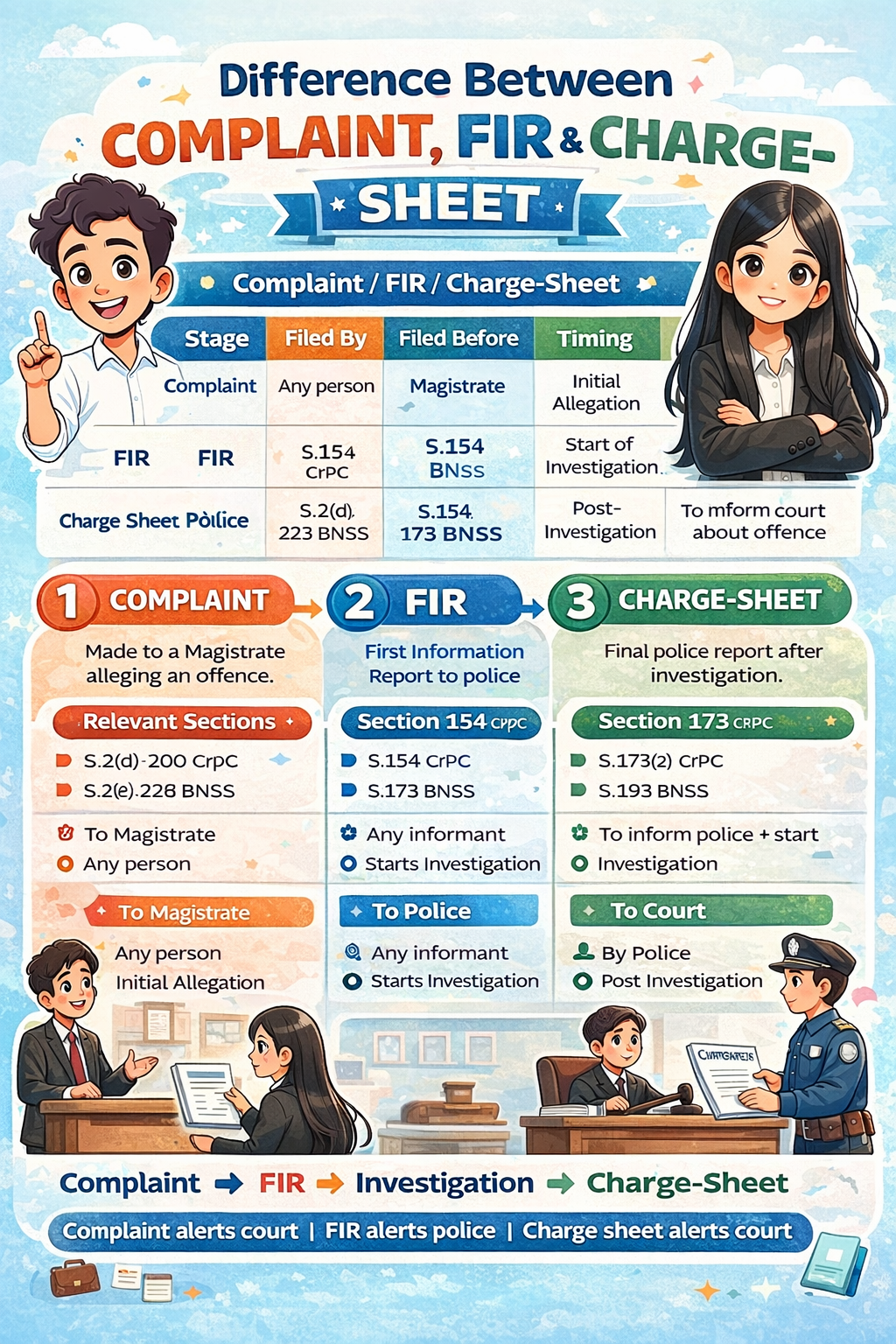
A complaint is an allegation made to a Magistrate (or police in some cases) that an offence has been committed.
Legal Definition
Section 2(d) CrPC / Section 2(e) BNSS
Complaint means any allegation made orally or in writing to a Magistrate, with a view to his taking action, that some person has committed an offence, but does not include a police report (charge-sheet).
Who can file?
Victim
Any private person
Sometimes authorised authority
Filed before whom?
Judicial Magistrate
Sometimes police (for non-cognizable offences)
Types of Complaint
Private Complaint (directly before Magistrate)
Complaint to Police (may or may not convert into FIR)
Relevant Sections
CrPC: Sections 200–203
BNSS: Sections 223–226
Example
A woman files a complaint before Magistrate alleging offence under Section 498A IPC against husband and in-laws.
Magistrate may:
Take cognizance
Order inquiry
Direct police to register FIR (u/s 156(3))
Key Points
✔ Filed before FIR / without FIR ✔ Magistrate applies judicial mind ✔ Evidence may be recorded first
2. FIR (First Information Report)
Definition
FIR is the first information given to police about commission of a cognizable offence.
Legal Provision
CrPC Section 154
BNSS Section 173
Who can lodge FIR?
Victim
Witness
Any person having information
Filed before whom?
Police Station (SHO)
Nature of FIR
Only for cognizable offences
Police can arrest & investigate without court permission
Example
A person goes to police station and reports robbery under Section 392 IPC.
➡ Police registers FIR and starts investigation.
Key Points
✔ Starting point of police investigation ✔ No evidence needed at FIR stage ✔ Delay, contradictions matter later
3. CHARGE-SHEET
Definition
A charge-sheet is the final police report submitted after completion of investigation.
Legal Provision
CrPC Section 173(2)
BNSS Section 193
Filed by whom?
Investigating Officer (Police)
Filed before whom?
Judicial Magistrate / Sessions Court
What does charge-sheet contain?
✔ FIR details ✔ List of accused ✔ List of witnesses ✔ Evidence collected ✔ Opinion of IO ✔ Sections applied
Example
After investigating FIR under Section 376 IPC, police files charge-sheet stating sufficient evidence exists.
➡ Court considers framing of charge.
Key Points
✔ Filed after investigation ✔ Basis for trial ✔ Can be challenged (discharge / quashing)
COMPARATIVE TABLE
Point
Complaint
FIR
Charge-Sheet
Filed by
Any person
Any informant
Police
Filed before
Magistrate
Police
Court
Stage
Initial
Investigation start
Post-investigation
Legal section
S.2(d), 200 CrPC
S.154 CrPC
S.173 CrPC
Police power
No
Yes
Already exercised
Evidence
Minimal
Not required
Compiled
FLOW OF CRIMINAL CASE (EASY TO REMEMBER)
Complaint → FIR → Investigation → Charge-Sheet → Trial
OR
Complaint → Magistrate → FIR u/s 156(3) → Charge-Sheet
PRACTICAL COURT DIFFERENCE
Complaint Case
Evidence starts early
Accused summoned later
Common in DV / NI Act / Defamation
FIR Case
Police driven
Arrest possible
Common in robbery / rape / assault
Charge-Sheet Stage
Defence can:
Seek discharge
Challenge evidence
Apply for quashing
ONE-LINE MEMORY TRICK (EXAM)
Complaint = allegation to Magistrate FIR = information to police Charge-sheet = police conclusion
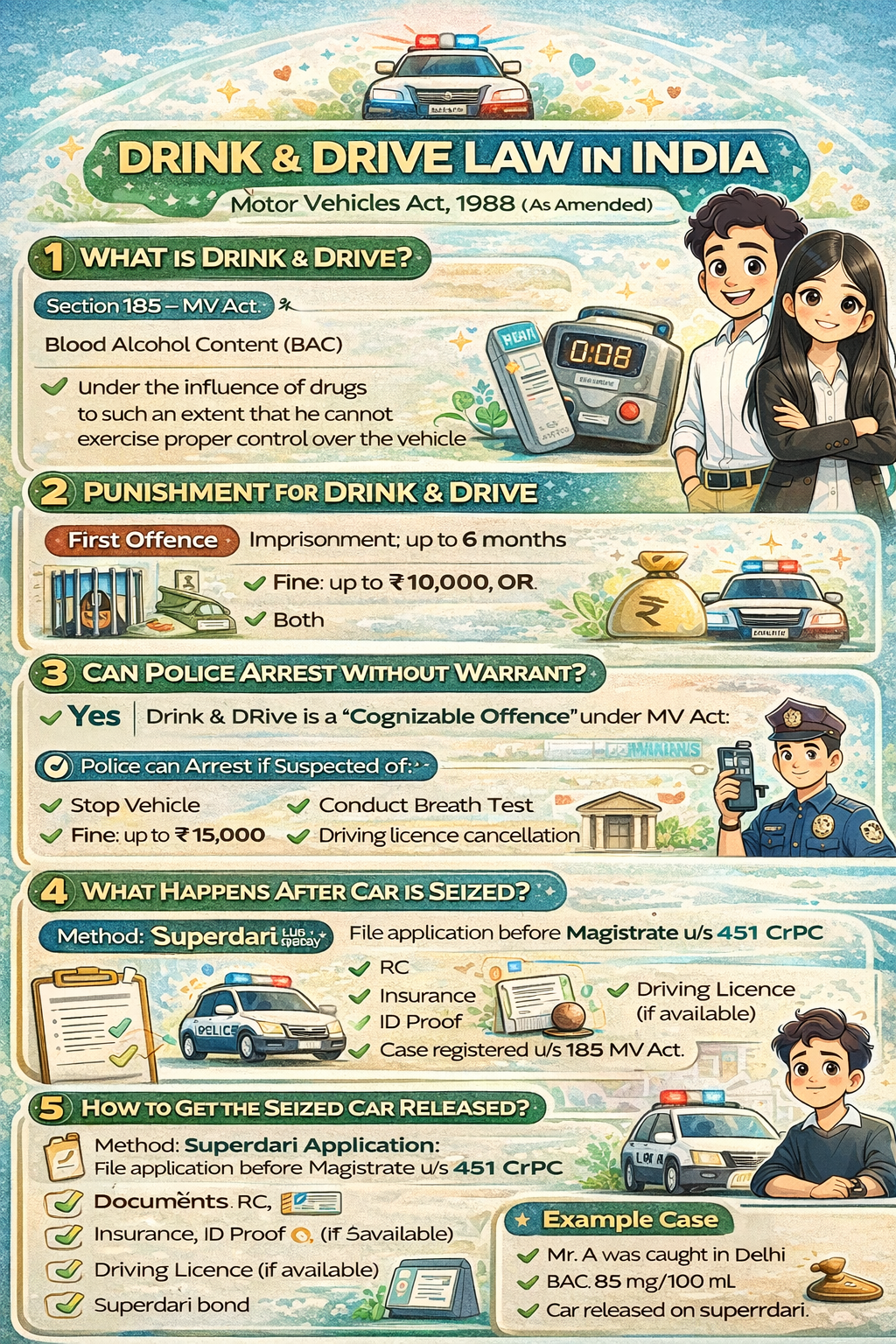
Blood Alcohol Content (BAC) exceeds 30 mg per 100 ml of blood, OR
Is under the influence of drugs to such an extent that he cannot exercise proper control over the vehicle.
✔ Checked by:
Breath Analyzer
Blood test (government hospital)
2. PUNISHMENT FOR DRINK & DRIVE
First Offence
Imprisonment: up to 6 months, OR
Fine: up to ₹10,000, OR
Both
Second or Subsequent Offence (within 3 years)
Imprisonment: up to 2 years
Fine: up to ₹15,000
Driving licence cancellation / suspension
3. CAN POLICE ARREST WITHOUT WARRANT?
✔ Yes
Drink & drive is a cognizable offence under MV Act:
Police can stop vehicle
Conduct breath test
Arrest without warrant
Produce accused before Magistrate
4. VEHICLE SEIZURE – IS IT LEGAL?
YES, police can seize the vehicle if:
Driver is intoxicated
Vehicle is being driven dangerously
Driver is incapable of safe driving
No sober person is available to take charge
Legal Basis:
Section 202 MV Act – Power to arrest
Section 207 MV Act – Power to detain/seize vehicle
5. WHAT HAPPENS AFTER CAR IS SEIZED?
Step-by-Step Process
Vehicle seized by police
Challan prepared (online / manual)
Vehicle taken to police station / impound yard
Driver produced before Magistrate
Case registered under Section 185 MV Act
6. HOW TO GET THE SEIZED CAR RELEASED?
Method: Superdari Application
File application before the concerned Magistrate under:
Section 451 CrPC (or BNSS equivalent)
Documents Required:
RC (Registration Certificate)
Insurance
Driving Licence (if available)
ID Proof
Superdari bond
Court may:
Release vehicle on superdari
Impose conditions
Direct payment of fine
7. EXAMPLE CASE (PRACTICAL SCENARIO)
Example:
Mr. A was stopped at a Delhi police checkpoint at night. Breath analyzer showed BAC = 85 mg/100 ml.
Police Action:
Arrested Mr. A
Seized car
Issued challan under Section 185 MV Act
Court Action:
Magistrate imposed ₹10,000 fine
Licence suspended for 6 months
Car released on superdari after application
8. CAN LICENCE BE SUSPENDED?
✔ Yes Under Section 19 MV Act, Licensing Authority may:
Suspend or cancel driving licence
Especially in repeat offences
9. IMPORTANT COURT OBSERVATIONS
🔹 State of Maharashtra v. Mohd. Yakub
✔ Drunk driving is a serious offence affecting public safety
🔹 Alister Anthony Pareira v. State of Maharashtra (2012)
✔ Driving under influence shows criminal negligence
10. IMPORTANT POINTS TO REMEMBER
✔ Legal limit: 30 mg/100 ml ✔ Even sitting in driver seat with engine ON = offence ✔ Saying “I drank less” is no defence ✔ Vehicle seizure is temporary, not confiscation ✔ First offence often ends in fine, not jail
11. DEFENCES AVAILABLE (LIMITED)
Faulty breath analyzer
No proper calibration
Illegal detention
BAC below permissible limit
Violation of testing procedure
🔚 CONCLUSION
Drink & Drive is treated as a serious public safety offence. Police have wide powers, but vehicle seizure is not permanent and can be challenged through court.