BEST ADVOCATE IN DELHI

CLASSIFICATION OF LAW IN INDIA

The Indian Legal System is primarily derived from English Common Law and is divided into Public Law and Private Law.
Let’s explore each category in detail


1️. Public Law

Meaning:

Public law deals with the relationship between the State and individuals.
It regulates how the government functions and protects public rights.

Sub-Divisions of Public Law:

(a) Constitutional Law

  • Governs the structure of the government, division of powers, and citizens’ fundamental rights.
  • Source: Constitution of India, 1950.
  • Example: Separation of powers between the Union and States (Articles 245–254).

Landmark Case Laws:

  1. Kesavananda Bharati v. State of Kerala (1973) — Basic structure doctrine.
  2. Maneka Gandhi v. Union of India (1978) — Expanded scope of Article 21 (Right to Life).

(b) Administrative Law

  • Governs the actions and powers of administrative authorities (like police, tribunals, commissions, etc.).
  • Ensures that executive power is exercised lawfully and fairly.

Landmark Case Laws:

  1. A.K. Kraipak v. Union of India (1969) — Natural justice principles.
  2. State of Orissa v. Binapani Dei (1967) — Right to be heard before adverse administrative action.

(c) Criminal Law

  • Deals with offenses against the State or society and provides punishment for wrongdoers.
  • Objective: Protection of society, deterrence, and justice.
  • Sources:
    • Bharatiya Nyaya Sanhita (BNS), 2023 (replacing IPC, 1860)
    • Bharatiya Nagarik Suraksha Sanhita (BNSS), 2023 (replacing CrPC, 1973)
    • Bharatiya Sakshya Adhiniyam (BSA), 2023 (replacing Evidence Act, 1872)

Landmark Case Laws:

  1. Lalita Kumari v. Govt. of U.P. (2014) — FIR registration mandatory in cognizable offenses.
  2. State of Haryana v. Bhajan Lal (1992) — Guidelines for quashing FIRs.

2. Private Law

Meaning:

Private law deals with disputes between individuals or organizations, where compensation or enforcement of rights is sought rather than punishment.

Sub-Divisions of Private Law:

(a) Civil Law

  • Protects private rights and remedies.
  • Covers property, contract, torts, family, and succession matters.
  • Procedure: Governed by the Civil Procedure Code (CPC), 1908.

Landmark Case Laws:

  1. Hadley v. Baxendale (1854) — Rule for compensation in breach of contract.
  2. Vishaka v. State of Rajasthan (1997) — Guidelines for sexual harassment at workplace.

(b) Commercial / Corporate Law

  • Governs companies, partnerships, trade, and business activities.
  • Ensures compliance, transparency, and shareholder protection.
  • Key Acts:
    • Companies Act, 2013
    • Insolvency and Bankruptcy Code (IBC), 2016
    • SEBI Act, 1992

Landmark Case Laws:

  1. Salomon v. Salomon & Co. (1897) — Company as a separate legal entity.
  2. Tata Consultancy Services v. Cyrus Investments (2021) — Corporate governance.

(c) Law of Torts

  • Deals with civil wrongs not arising from contract.
  • Purpose: To provide compensation for harm caused by one person to another.

Examples: Negligence, nuisance, defamation, trespass.

Landmark Case Laws:

  1. Donoghue v. Stevenson (1932) — Foundation of negligence law.
  2. M.C. Mehta v. Union of India (Oleum Gas Leak Case, 1987) — Introduced absolute liability principle.

(d) Family Law

  • Governs marriage, divorce, adoption, maintenance, and inheritance.
  • Different personal laws for different religions:
    • Hindu Marriage Act, 1955
    • Muslim Personal Law (Shariat) Application Act, 1937
    • Special Marriage Act, 1954

Landmark Case Laws:

  1. Shah Bano Begum v. Union of India (1985) — Right to maintenance under Section 125 CrPC.
  2. Sarla Mudgal v. Union of India (1995) — Polygamy and uniform civil code.

3. Substantive Law vs. Procedural Law

BasisSubstantive LawProcedural Law
MeaningDefines rights, duties, and liabilities of individuals.Prescribes the process to enforce those rights and liabilities.
ExamplesIPC, Contract Act, Hindu Marriage ActCPC, CrPC, Evidence Act
FunctionEstablishes what constitutes a legal right/wrong.Describes how a case is filed, tried, and adjudicated.
NatureStatic in natureDynamic and changing with reforms

4. Other Important Classifications

(a) Substantive Civil Law

  • Example: Transfer of Property Act, 1882; Indian Contract Act, 1872.

(b) Substantive Criminal Law

  • Example: Bharatiya Nyaya Sanhita, 2023 (earlier IPC, 1860).

(c) Procedural Civil Law

  • Example: Code of Civil Procedure (CPC), 1908.

(d) Procedural Criminal Law

  • Example: Bharatiya Nagarik Suraksha Sanhita (BNSS), 2023 (earlier CrPC, 1973).

Summary Chart:

Type of LawPurposeExample ActsForum / AuthorityFamous Cases
ConstitutionalDefines government structure & citizens’ rightsConstitution of IndiaSupreme Court, High CourtKesavananda Bharati (1973)
AdministrativeControls government powersTribunals ActCAT, SAT, TribunalsA.K. Kraipak (1969)
CriminalPunish offendersBNS, BNSSCriminal Courts, Sessions CourtBhajan Lal (1992)
CivilResolve private disputesCPC, Contract ActCivil Courts, District CourtsVishaka (1997)
CorporateRegulate companiesCompanies ActNCLT, NCLAT, SEBITCS v. Cyrus (2021)
TortsCompensate for private wrongsCommon LawCivil CourtsM.C. Mehta (1987)
FamilyMarriage, divorce, maintenanceHindu Marriage ActFamily CourtShah Bano (1985)

Conclusion

Indian Law is a comprehensive and multi-layered system balancing:

  • Public interest (through public law),
  • Private rights (through civil and personal laws), and
  • Economic regulation (through corporate and commercial laws).

Together, these branches ensure justice, equality, and rule of law in India.

best advocate in delhi

DIFFERENCE BETWEEN CIVIL LAW, CRIMINAL LAW, AND CORPORATE LAW

1. CIVIL LAW

Meaning:

Civil law deals with disputes between individuals, organizations, or both, where one party seeks compensation or enforcement of rights rather than punishment.

Objective:

To protect the private rights of individuals and provide relief or compensation to the aggrieved party.

Examples:

  • Breach of contract
  • Property disputes
  • Divorce or maintenance cases
  • Partition suits
  • Recovery of money

Legal Provisions:

  • Code of Civil Procedure, 1908 (CPC)
  • Indian Contract Act, 1872
  • Specific Relief Act, 1963
  • Transfer of Property Act, 1882

Procedure:

  1. Filing of plaint by plaintiff.
  2. Summons to defendant.
  3. Written statement by defendant.
  4. Framing of issues.
  5. Evidence and arguments.
  6. Judgment and decree.

Standard of Proof:

Preponderance of probabilities — means the version which seems more likely to be true.

Remedy:

  • Compensation
  • Injunction
  • Declaration
  • Specific performance

Landmark Case Laws:

  1. Keshavananda Bharati v. State of Kerala (1973) 4 SCC 225 — Defined the basic structure doctrine in constitutional interpretation (civil rights).
  2. Hadley v. Baxendale (1854) 9 Exch 341 — Classic case on breach of contract and damages.
  3. Maneka Gandhi v. Union of India (1978) 1 SCC 248 — Civil liberty case expanding Article 21.

2. CRIMINAL LAW

Meaning:

Criminal law deals with offences against the State or society and prescribes punishments for offenders.

Objective:

To maintain law and order, ensure public safety, and punish wrongdoers.

Examples:

  • Murder (Sec. 302 IPC)
  • Theft (Sec. 379 IPC)
  • Rape (Sec. 376 IPC)
  • Cheating (Sec. 420 IPC)
  • Assault (Sec. 351 IPC)

Legal Provisions:

  • Bharatiya Nyaya Sanhita (BNS), 2023 (replacing IPC, 1860)
  • Bharatiya Nagarik Suraksha Sanhita (BNSS), 2023 (replacing CrPC, 1973)
  • Bharatiya Sakshya Adhiniyam (BSA), 2023 (replacing Indian Evidence Act, 1872)

Procedure:

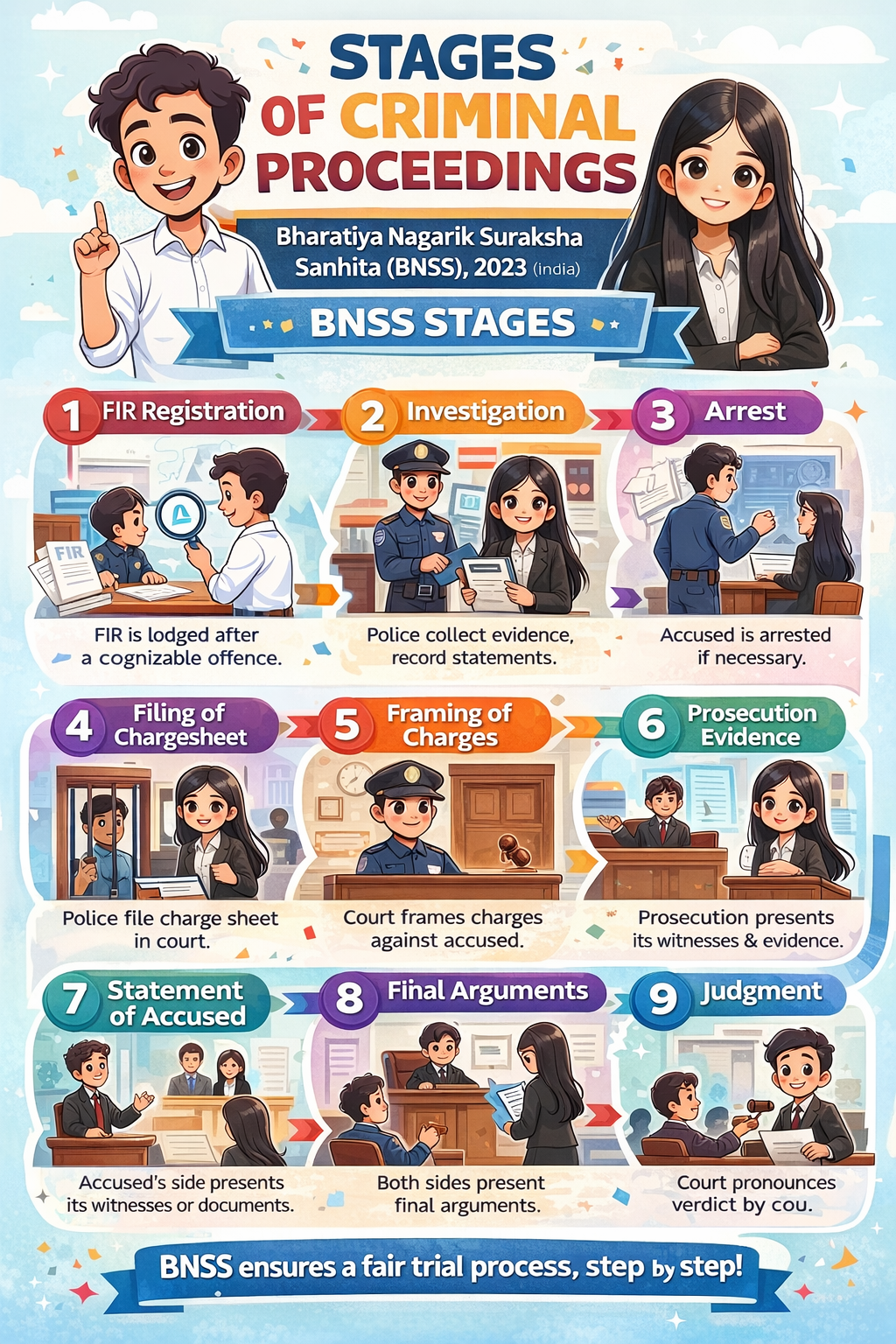
  1. FIR registration (Sec. 154 CrPC/BNSS).
  2. Investigation and charge sheet.
  3. Framing of charges.
  4. Trial and evidence.
  5. Judgment: conviction or acquittal.

Standard of Proof:

Beyond reasonable doubt.

Remedy:

  • Imprisonment
  • Fine
  • Death penalty (in rare cases)
  • Probation or community service

Landmark Case Laws:

  1. State of U.P. v. Ram Swarup (1974) 4 SCC 764 — Defined murder vs. culpable homicide distinction.
  2. State of Haryana v. Bhajan Lal (1992 Supp (1) SCC 335) — Guidelines for quashing FIRs under Section 482 CrPC.
  3. Lalita Kumari v. Govt. of U.P. (2014) 2 SCC 1 — Mandatory registration of FIR in cognizable offences.

3. CORPORATE LAW (Company/Business Law)

Meaning:

Corporate law governs the formation, management, and regulation of companies and their dealings with stakeholders, shareholders, and the public.

Objective:

To regulate business entities, ensure corporate governance, protect shareholders’ interests, and maintain fair trade practices.

Examples:

  • Incorporation of a company
  • Mergers and acquisitions
  • Corporate fraud or insider trading
  • Corporate compliance and governance issues

Legal Provisions:

  • Companies Act, 2013
  • Limited Liability Partnership Act, 2008
  • SEBI Act, 1992
  • Insolvency and Bankruptcy Code (IBC), 2016

Procedure (for disputes):

  1. File case before NCLT (National Company Law Tribunal).
  2. Appeal to NCLAT.
  3. Further appeal to Supreme Court.

Standard of Proof:

Preponderance of probabilities (similar to civil standard).

Remedy:

  • Corporate restructuring
  • Liquidation or insolvency resolution
  • Compensation to shareholders
  • Penal action for fraud or non-compliance

Landmark Case Laws:

  1. Tata Consultancy Services v. Cyrus Investments Pvt. Ltd. (2021) 9 SCC 449 — Landmark on corporate governance and minority shareholder rights.
  2. Vodafone International Holdings BV v. Union of India (2012) 6 SCC 613 — Landmark case on taxation of offshore transactions.
  3. Swiss Ribbons Pvt. Ltd. v. Union of India (2019) 4 SCC 17 — Upheld the constitutional validity of the Insolvency and Bankruptcy Code (IBC).

COMPARATIVE SUMMARY TABLE

FeatureCivil LawCriminal LawCorporate Law
Nature of wrongPrivate wrongPublic wrongCommercial or organizational wrong
ObjectiveCompensation / reliefPunishment / deterrenceRegulation of business and compliance
Parties involvedPlaintiff vs. DefendantState vs. AccusedCompany vs. Shareholders / Regulatory body
Legal basisCPC, Contract Act, etc.IPC/BNS, CrPC/BNSSCompanies Act, IBC, SEBI Act
Standard of proofPreponderance of probabilityBeyond reasonable doubtPreponderance of probability
OutcomeCompensation / injunctionPunishment / fine / imprisonmentRegulation / restructuring / penalty
ForumCivil Courts / District CourtsCriminal Courts / Sessions CourtsNCLT, NCLAT, SEBI, High Court
AppealHigher Civil Courts / HC / SCHigher Criminal Courts / HC / SCNCLAT / SC
Example CaseHadley v. BaxendaleLalita Kumari v. U.P.TCS v. Cyrus Investments

Conclusion

  • Civil Law protects private rights and aims for compensation.
  • Criminal Law protects society and seeks punishment for wrongdoers.
  • Corporate Law ensures orderly business conduct, transparency, and shareholder protection.

Together, these three pillars maintain justice, order, and economic stability in society.


Difference Between Civil, Criminal, and Corporate Law Table

BasisCivil LawCriminal LawCorporate Law
MeaningCivil law deals with disputes between individuals, organizations, or both, where compensation may be awarded to the victim.Criminal law deals with offenses against the state or society, prescribing punishment for the wrongdoer.Corporate law governs the formation, operation, and regulation of companies and corporate entities.
ObjectiveTo resolve private disputes and provide compensation or specific performance.To punish the offender and maintain law and order.To ensure legal compliance, corporate governance, and protect shareholders’ interests.
Parties InvolvedPlaintiff vs. DefendantState (Prosecution) vs. AccusedCompany, shareholders, directors, regulators (like MCA, SEBI)
Burden of Proof“Preponderance of probabilities” (balance of evidence)“Beyond reasonable doubt”Based on corporate statutes and documentary compliance
Governing LawCivil Procedure Code (CPC), 1908Criminal Procedure Code (CrPC), 1973 and Indian Penal Code (IPC), 1860Companies Act, 2013; SEBI Act, FEMA, Insolvency & Bankruptcy Code (IBC), etc.
Nature of WrongPrivate wrongPublic wrongStatutory or regulatory wrong
ExamplesBreach of contract, property disputes, matrimonial disputes, tortsMurder, theft, assault, fraudIncorporation, mergers, director’s duties, shareholder rights
Outcome / RemedyCompensation, injunction, specific performanceImprisonment, fine, or bothCompliance orders, penalties, winding up, restructuring
Court JurisdictionCivil Courts, Family Courts, Consumer ForumsCriminal Courts, Sessions Courts, High CourtNCLT, NCLAT, SEBI, High Court, Supreme Court
ProcedureGoverned by CPC; focuses on evidence and documentsGoverned by CrPC; focuses on investigation and trialGoverned by Companies Act & NCLT Rules
AppealAppeal lies to District Court/High CourtAppeal lies to Sessions Court/High CourtAppeal lies to NCLAT/Supreme Court

Landmark Case Laws

Civil Law Cases

  1. Keshavananda Bharati v. State of Kerala (1973)
    Held: The Constitution’s basic structure cannot be altered by Parliament.
    Principle: Protects citizens’ fundamental rights and property rights.
  2. Hadley v. Baxendale (1854)
    Held: Damages in contract law must be foreseeable.
    Principle: Basis for assessing compensation in breach of contract cases.
  3. Vishaka v. State of Rajasthan (1997)
    Held: Established guidelines for preventing sexual harassment at workplaces.
    Principle: Protection of women’s rights under civil and constitutional law.

Criminal Law Cases

  1. State of Rajasthan v. Kashi Ram (2006)
    Held: Burden of proof in criminal cases lies entirely on the prosecution.
    Principle: Accused presumed innocent until proven guilty.
  2. Maneka Gandhi v. Union of India (1978)
    Held: Expanded the scope of Article 21 (Right to Life and Liberty).
    Principle: Fair trial and due process are essential components of criminal justice.
  3. State of Haryana v. Bhajan Lal (1992)
    Held: Laid down guidelines for quashing FIRs under Section 482 CrPC.
    Principle: Prevents misuse of criminal proceedings.

Corporate Law Cases

  1. Salomon v. Salomon & Co. Ltd. (1897)
    Held: Company has a separate legal entity from its shareholders.
    Principle: Foundation of corporate personality.
  2. Tata Consultancy Services v. State of Andhra Pradesh (2004)
    Held: Software can be treated as “goods” for taxation.
    Principle: Defines corporate transactions under tax and commercial law.
  3. PNB v. Mehul Choksi (2018)
    Held: Strengthened the role of IBC and enforcement agencies in financial frauds.
    Principle: Corporate accountability and creditor protection.

Summary Chart

AspectCivil LawCriminal LawCorporate Law
NatureCompensatoryPunitiveRegulatory
AimPrivate justicePublic justiceCorporate governance
RemedyDamages/reliefPunishmentCompliance/penalty
ExampleContract disputeTheft, murderMerger, fraud
AuthorityCivil CourtsCriminal CourtsNCLT, SEBI, MCA

Conclusion

Civil, Criminal, and Corporate laws are three major branches of the Indian legal system:

  • Civil law protects individual rights.
  • Criminal law ensures societal order and justice.
  • Corporate law governs commercial entities and business compliance.

Together, they form a comprehensive legal framework ensuring justice, accountability, and economic discipline.

BEST ADVOCATE IN DWARKA, DELHI

Legal Remedies When Police Refuse to Register FIR

If the police refuse to register an FIR, the law provides several clear remedies under the Criminal Procedure Code (CrPC), 1973 and supported by landmark judgments.
Here’s a step-by-step guide.

 Legal Remedies When Police Refuse to Register FIR

1. Approach the Senior Police Officer (Section 154(3) CrPC)

  1. Provision: Section 154(3) CrPC
  2. Remedy: Write a complaint to the Superintendent of Police (SP) or Deputy Inspector General (DIG).
  3. Process: 
    1. Submit a written application explaining that the local police refused to register your FIR.
    1. The SP can investigate the matter himself or direct a subordinate officer to do so.

2. File a Complaint Before the Magistrate (Section 156(3) CrPC)

  1. Provision: Section 156(3) CrPC empowers the Judicial Magistrate to direct the police to register and investigate the case.
  2. Process: 
    1. File a written criminal complaint before the Magistrate.
    1. Attach evidence or any supporting material (if available).
    1. The Magistrate can order the police to register the FIR and conduct investigation.

3. File a Private Complaint (Section 200 CrPC)

  • If both police and higher officers fail to act, you can file a private complaint under Section 200 CrPC before the Magistrate.
  • The Magistrate can:
    • Record your statement and witnesses, and
    • Take cognizance of the offence directly.

4. Approach Human Rights or Vigilance Authorities

  • For serious misconduct or corruption, complaint can be made to:
    • State Human Rights Commission (SHRC) or National Human Rights Commission (NHRC)
    • State Police Complaints Authority

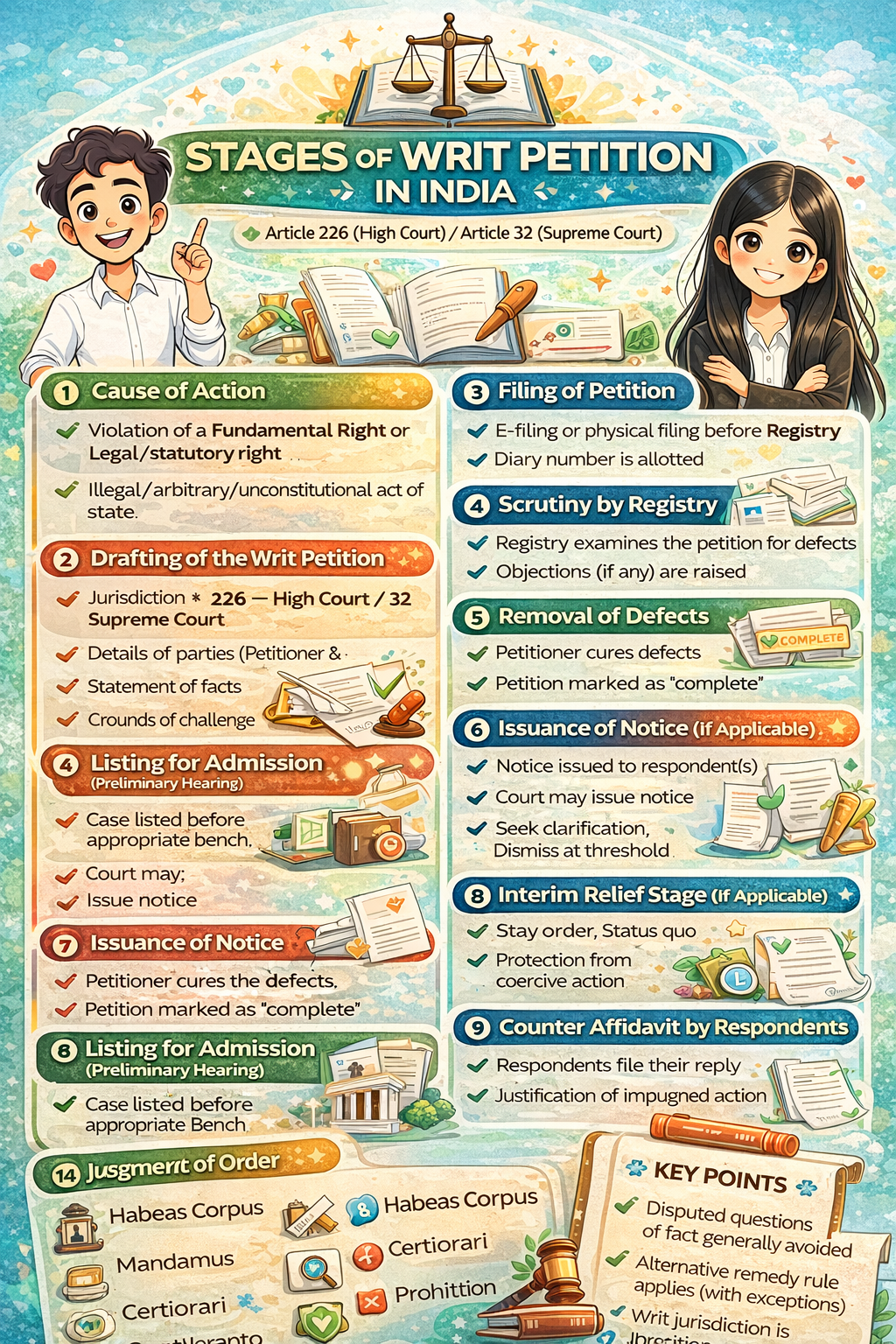
5. File a Writ Petition (Article 226, Constitution of India)

  • As a last resort, file a writ petition (Mandamus) in the High Court seeking directions for:
    • Registration of FIR, and
    • Proper investigation.

Landmark Judgments

Case NamePrinciple / Ruling
Lalita Kumari v. Govt. of U.P. (2014) 2 SCC 1Registration of FIR is mandatory if information discloses a cognizable offence.
Sakiri Vasu v. State of U.P. (2008) 2 SCC 409If police don’t register FIR, remedy lies under Section 156(3) CrPC, not directly before High Court.
Aleque Padamsee v. Union of India (2007) 6 SCC 171High Court can direct police to perform their statutory duty to register FIR.
Prakash Singh v. Union of India (2006) 8 SCC 1Established Police Reforms and accountability mechanisms.

Summary Table

StepLegal ProvisionAuthorityOutcome
Step 1Sec. 154(3) CrPCSuperintendent of PoliceSP can order FIR registration
Step 2Sec. 156(3) CrPCJudicial MagistrateMagistrate can order police to register and investigate
Step 3Sec. 200 CrPCMagistrateFile private complaint directly
Step 4Administrative remedyNHRC/Police AuthorityDisciplinary action possible
Step 5Article 226High CourtWrit of mandamus to ensure FIR registration
best advocate in delhi

Which path you should choose law:

Comparison to help you decide between Litigation and Corporate Law

Litigation

Nature of Work:

  • Represents clients in court (civil, criminal, or constitutional matters)
  • Conducts arguments, cross-examinations, and filings
  • Involves regular court appearances and drafting petitions

Skills Required:

  • Strong oral advocacy
  • In-depth legal research
  • Quick thinking and confidence

Work Environment:

  • Courtrooms, chambers, or independent practice
  • Unpredictable schedules and deadlines

Pros:

  • Opportunity to argue cases and build courtroom reputation
  • High independence once established

Cons:

  • Initial years may have lower income
  • Stressful and long working hours

Corporate Law

Nature of Work:

  • Advises companies on compliance, mergers, contracts, and policies
  • Drafts and reviews agreements and legal documents
  • Works closely with business teams

Skills Required:

  • Strong drafting and negotiation
  • Business and commercial understanding
  • Analytical and detail-oriented mindset

Work Environment:

  • Offices or law firms with structured hours
  • Collaborative, team-based setting

Pros:

  • Stable income and work hours
  • Exposure to business strategy

Cons:

  • Less courtroom experience
  • Can be monotonous for those who enjoy argumentation

Which Should You Choose?

If you enjoy…Choose…
Arguing and public speakingLitigation
Business and corporate structureCorporate Law
Independence and courtroom thrillLitigation
Stability and teamworkCorporate Law

BRST ADVOCATE IN DELHI

Landmark judgments on the remedy when police freeze a bank account under Section 102 CrPC.

Landmark Judgments on Freezing of Bank Accounts by Police (Remedy & Principles)

1. Teesta Atul Setalvad v. State of Gujarat, (2018) 2 SCC 372

Court: Supreme Court of India
Principle:

  • Police cannot freeze a bank account without proper justification and recorded reasons under Section 102 CrPC.
  • It is mandatory to inform the Magistrate immediately.
  • Freezing affects the right to livelihood; it must be proportionate and fair.
    Remedy: Certain accounts were ordered to be de-frozen as the police failed to justify the freeze.

2. Swaran Sabharwal v. Commissioner of Police, 1988 Cri LJ 241 (Delhi HC)

Principle:

  • Freezing of a bank account is permissible only if the money is directly linked to the alleged offence.
  • Freezing the entire account without evidence violates Article 300A (Right to Property).
    Remedy: Court ordered de-freezing.

3. M.T. Enrica Lexie v. Doramma, (2012) 13 SCC 780

Principle:

  • The Supreme Court clarified that property (including bank accounts) can be seized under Section 102 CrPC only if it is suspected to be connected with an offence.
  • Freezing beyond that scope violates due process.

4. Rajesh Kumar v. State of Haryana, 2019 SCC OnLine P&H 1691

Court: Punjab & Haryana High Court
Principle:

  • Police must report the freezing to the Magistrate and give notice to the account holder.
  • The person should be given a chance to explain the source of funds.
    Remedy: Freezing was quashed for non-compliance with Section 102 CrPC.

5. Jayant v. State of Madhya Pradesh, (2021) SCC OnLine MP 3167

Principle:

  • Freezing of a bank account without an FIR or link to an investigation is illegal.
  • The investigating officer must record reasons in writing and report them to the Magistrate.
    Remedy: Freeze order set aside.

6. Axis Bank v. State of Maharashtra, 2017 SCC OnLine Bom 9102

Court: Bombay High Court
Principle:

  • Power under Section 102 CrPC must be exercised strictly and with caution.
  • Freezing the entire account merely on suspicion is unlawful; only offence-related funds can be held.
    Remedy: Partial release of frozen accounts ordered.

7. Kaushalya Bai v. State of Maharashtra, 2018 SCC OnLine Bom 1815

Principle:

  • The investigating officer cannot freeze joint or family accounts without establishing a nexus to the offence.
    Remedy: De-freezing of unrelated accounts directed.

8. ICICI Bank Ltd. v. State of Maharashtra, 2020 SCC OnLine Bom 248

Principle:

  • A bank cannot freeze accounts without a lawful written order from a competent authority.
  • Police must follow due process and proportionality.
    Remedy: Directions issued for de-freezing.

9. T. Subbulakshmi v. State of Tamil Nadu, 2017 SCC OnLine Mad 24679

Court: Madras High Court
Principle:

  • Freezing a bank account without prior notice or copy of FIR/order is a violation of natural justice.
    Remedy: De-freezing ordered; compensation recommended.

10. Om Prakash Sharma v. State of Uttar Pradesh, 2020 SCC OnLine All 1019

Principle:

  • If freezing is disproportionate or not reported to the Magistrate, it is illegal and liable to be set aside.
    Remedy: Court quashed the freezing order.

Summary Table

CaseCourtKey PrincipleRemedy
Teesta Setalvad (2018)Supreme CourtMagistrate report mandatoryDe-freezing ordered
Swaran Sabharwal (1988)Delhi HCOnly offence-linked money can be frozenDe-freezing ordered
Axis Bank (2017)Bombay HCProportional freezing onlyPartial release
Rajesh Kumar (2019)Punjab & Haryana HCNotice + report to Magistrate requiredDe-freezing ordered
Jayant (2021)MP HCNo FIR or nexus = illegalFreeze set aside
T. Subbulakshmi (2017)Madras HCNo notice = natural justice violationDe-freezing ordered

 Key Takeaways

  • Section 102 CrPC allows freezing only if property is linked to an offence.
  • Police must report to the Magistrate immediately after freezing.
  • Notice and opportunity must be given to the account holder.
  • Courts can order de-freezing or limited access if freezing is arbitrary or disproportionate.
  • Violation of due process amounts to infringement of Article 300A (Right to Property) and Article 21 (Right to Livelihood).
ApplicationBnss2023

Type of Application in BNSS

Types of Applications under the Bharatiya Nagarik Suraksha Sanhita (BNSS), 2023 — including summary, purpose, and general formats for each type.


Types of Applications under BNSS, 2023 (with Summary & Format)

S.No.Type of ApplicationRelevant Section (BNSS, 2023)Purpose / SummaryBasic Format / Template
1Application for BailSec. 478–483Filed by an accused seeking release during investigation or trial.Format below ↓
2Application for Anticipatory BailSec. 484Filed when a person anticipates arrest in a non-bailable offence.Format below ↓
3Application for Police Custody / Judicial CustodySec. 187, 188Request for custody during investigation by prosecution.Filed by police/prosecution
4Application for DischargeSec. 250Filed by accused seeking discharge before framing of charge.Format below ↓
5Application for Summoning Additional Witness / DocumentSec. 349To call additional witnesses or documents necessary for justice.Format below ↓
6Application for Recall of WitnessSec. 350To re-examine a witness for clarification or contradiction.Filed by defence/prosecution
7Application for Compounding of OffenceSec. 360Filed by complainant or accused for compromise in compoundable offences.Format below ↓
8Application for AdjournmentSec. 343Filed when a party seeks postponement of proceedings.Format below ↓
9Application for Exemption from Personal AppearanceSec. 285Filed by accused seeking exemption from court appearance.Format below ↓
10Application for Return of Property / Release of Seized PropertySec. 523Filed to retrieve seized property or vehicle.Format below ↓
11Application for Restoration of Case / Recalling OrderSec. 482Filed when case dismissed in default or to recall an ex-parte order.Format below ↓
12Application under Section 457 for FIR Copy or Case Diary InspectionSec. 193(3), 214Filed to obtain certified copies for defence or investigation use.Format below ↓
13Application for Plea BargainingSec. 290–294Filed by accused seeking lesser punishment by negotiation.Filed before trial
14Application for Withdrawal of ProsecutionSec. 362Filed by Public Prosecutor with court’s permission to withdraw case.Format below ↓
15Application for Compensation to VictimSec. 395Filed by victim or legal heir seeking compensation after conviction.Format below ↓

Sample Formats

1️⃣ Application for Bail (Sec. 478–483 BNSS)

IN THE COURT OF [JURISDICTION]
Application No. ___ of 20__

Applicant: [Name of Accused]
Versus
State of [State Name]

APPLICATION FOR BAIL UNDER SECTION 478 OF BNSS, 2023

The applicant respectfully submits:
1. That the applicant has been falsely implicated in FIR No. ___ dated ___ u/s ___ of BNS.
2. That the applicant is a law-abiding citizen and undertakes to cooperate in investigation.
3. That no purpose will be served by keeping the applicant in custody.

PRAYER:
It is therefore prayed that this Hon’ble Court may kindly grant bail to the applicant in the interest of justice.

Place: ___________  
Date: ___________  
(Signature)  
[Name of Applicant / Advocate]

2️⃣ Application for Anticipatory Bail (Sec. 484 BNSS)

IN THE COURT OF SESSIONS JUDGE / HIGH COURT AT ________

APPLICATION UNDER SECTION 484 BNSS, 2023 FOR ANTICIPATORY BAIL

Applicant: [Name, Address]
FIR No.: ___ dated ___ under Section ___ of BNS

The applicant humbly submits:
1. That the applicant apprehends arrest in the above matter.
2. That the applicant is ready to cooperate with the investigation.
3. That the applicant is willing to comply with all conditions imposed by the Hon’ble Court.

PRAYER:
Grant anticipatory bail to the applicant in the interest of justice.

(Signature)

Application for Discharge (Sec. 250 BNSS)

APPLICATION UNDER SECTION 250 BNSS, 2023 FOR DISCHARGE

The applicant respectfully submits:
1. That the prosecution has not produced any prima facie evidence.
2. That continuation of proceedings would amount to abuse of process.

PRAYER:
It is therefore prayed that the applicant may kindly be discharged from the present case.

(Signature)

Application for Exemption from Personal Appearance (Sec. 285 BNSS)

APPLICATION UNDER SECTION 285 BNSS, 2023 FOR EXEMPTION FROM PERSONAL APPEARANCE

The applicant submits:
1. That the applicant is unable to appear due to [reason].
2. That the applicant has authorized his counsel to appear on his behalf.

PRAYER:
Kindly exempt the applicant from personal appearance for the day.

(Signature)

Application for Return of Property (Sec. 523 BNSS)

APPLICATION UNDER SECTION 523 BNSS, 2023 FOR RELEASE OF SEIZED PROPERTY

The applicant respectfully submits:
1. That the property/vehicle bearing No. ______ was seized in connection with FIR No. ______.
2. That the applicant is the lawful owner of the said property.

PRAYER:
Kindly direct the police to release the property on Supurdnama.

(Signature)

Tips for Drafting Applications

✅ Use clear, polite, and factual language.
✅ Always mention relevant section and case number.
✅ Attach supporting documents / affidavits when necessary.
✅ Mention a short prayer at the end clearly stating relief sought.


ARBITATOR CONCILIATION DIFFER

DIFFERENCE BETWEEN ARBITRATION, CONCILIATION AND MEDIATION

Here’s a clear and concise comparison of Arbitration, Conciliation, and Mediation — three important Alternative Dispute Resolution (ADR) methods under Indian law:

1. Meaning & Nature

BasisArbitrationConciliationMediation
MeaningA formal, quasi-judicial process where a neutral third party (Arbitrator) gives a binding decision.A less formal process where a neutral third party (Conciliator) helps parties reach a mutually acceptable settlement.A voluntary and informal process where a Mediator facilitates communication to help parties arrive at their own agreement.
Governing Law (India)Arbitration and Conciliation Act, 1996 (Part I)Arbitration and Conciliation Act, 1996 (Part III)Section 89 of CPC, 1908 and Mediation Rules, 2023 (now codified as Mediation Act, 2023)

2. Role of the Third Party

BasisArbitratorConciliatorMediator
RoleActs like a judge – hears both sides and passes an award.Acts as a facilitator and advisor – may propose settlement terms.Acts as a neutral facilitator – encourages negotiation and communication.
AuthorityHas decision-making power.Has no binding power; can only assist.Has no decision-making power; only facilitates.

3. Outcome & Binding Nature

BasisArbitrationConciliationMediation
OutcomeArbitral AwardSettlement AgreementMediation Settlement Agreement
Binding NatureLegally binding and enforceable as a court decree.Binding once signed by parties (under Sec. 74 of the Act).Binding when signed by parties (under Mediation Act, 2023).
Appeal / ChallengeLimited grounds under Sec. 34 of the Arbitration Act.Can’t be challenged except on limited grounds like fraud.Binding unless challenged under limited procedural defects.

 4. Procedure & Flexibility

BasisArbitrationConciliationMediation
FormalityFormal (like a court proceeding)InformalVery informal and flexible
ConfidentialityYesYesYes
Voluntary NatureOnce agreed, parties must participateEntirely voluntaryEntirely voluntary

 5. Examples / Use

ArbitrationConciliationMediation
Used in commercial, contractual disputes, construction, trade, etc.Used in employment, consumer, and business disputes.Used in family, matrimonial, property, and community disputes.

 Summary Table

PointArbitrationConciliationMediation
Decision byArbitratorParties with help of ConciliatorParties with help of Mediator
BindingYesYes (after agreement)Yes (after agreement)
NatureAdjudicatoryFacilitative + AdvisoryPurely Facilitative
Third Party RoleJudge-likeSettlement AdvisorNeutral Facilitator
BEST ADVOCATE IN DWARKA COURT

WHERE A PERSON ISSUED A SECURITY CHEQUE FOR A PERSONAL LOAN, AND WHETHER DISHONOUR OF SUCH A SECURITY CHEQUE ATTRACTS LIABILITY UNDER SECTION 138 OF THE NI ACT

Here’s a summary of the recent important ruling by the Delhi High Sure — let’s go through this carefully.

You’re referring to landmark judgments under the Negotiable Instruments Act, 1881 (NI Act), particularly Section 138, which deals with the dishonour of cheques (commonly called cheque bounce cases).

Your query is about cases where a person issued a security cheque for a personal loan, and whether dishonour of such a security cheque attracts liability under Section 138 of the NI Act.

Key Principle

A security cheque can still attract liability under Section 138, if it is found that:

  • The cheque was issued towards an existing enforceable debt or liability, or
  • The liability crystallized by the time the cheque was presented.

However, if the cheque was purely for security with no existing liability at the time of presentation, Section 138 may not apply.

 Landmark Judgments

1. ICDS Ltd. v. Beena Shabeer & Anr.

(2002) 6 SCC 426 — Supreme Court of India
Key point:
Even a cheque issued as security can fall within Section 138 if, when presented, it represents a legally enforceable debt or liability.

“The cheque was issued by the respondent not for any gift, but for discharge of an existing or future liability. Thus, Section 138 would be attracted.”

2. Sampelly Satyanarayana Rao v. Indian Renewable Energy Development Agency Ltd.

(2016) 10 SCC 458 — Supreme Court
Facts: Post-dated cheques issued as security for repayment of a loan.
Held: Even if cheques are described as security, if they were issued towards repayment installments under a loan agreement, dishonour attracts Section 138.

“If on the date of the cheque there was a debt or liability, Section 138 is attracted. Mere description of the cheque as ‘security’ does not change its legal character.”

3. Sripati Singh (since deceased) through his son Gaurav Singh v. State of Jharkhand & Anr.

(2021) SCC OnLine SC 1002 — Supreme Court
Key point:
If a cheque issued as security is presented after the debt becomes due, its dishonour will attract Section 138.

“A cheque issued as security cannot be considered as a worthless piece of paper. If the loan is not repaid and the cheque is presented, Section 138 is attracted.”

4. Indus Airways Pvt. Ltd. v. Magnum Aviation Pvt. Ltd.

(2014) 12 SCC 539 — Supreme Court
Key point:
If a cheque is issued for an advance payment or a contingent event (not for an existing liability), Section 138 does not apply.

“For Section 138 to apply, there must be a legally enforceable debt or liability on the date of the cheque.”

5. Sunil Todi & Ors. v. State of Gujarat & Anr.

(2021) 11 SCC 486 — Supreme Court
Key point:
If at the time of cheque presentation, there exists a legally enforceable liability, dishonour of even a post-dated or “security” cheque attracts Section 138.

Summary Table

CaseYearPrinciple
ICDS Ltd. v. Beena Shabeer2002Security cheques can attract S.138 if they relate to an enforceable debt
Sampelly Satyanarayana Rao v. IREDA2016Labeling a cheque as ‘security’ doesn’t exempt liability if debt existed
Sripati Singh v. State of Jharkhand2021Security cheque presented after loan due = S.138 applies
Indus Airways v. Magnum Aviation2014No S.138 if cheque for advance or contingent liability
Sunil Todi v. State of Gujarat2021Liability at time of presentation = S.138 applies

 Application to Personal Loan and Security Cheque

If someone gave a cheque as security for a personal loan, and:

  • The loan was not repaid, and
  • The cheque was presented after default,
    then the cheque represents an enforceable liability, and dishonour attracts Section 138.

But if:

  • The loan was repaid, or
  • The cheque was presented before the loan became due,
    then Section 138 may not apply, as there was no subsisting debt.

Below, I’ll give you two sample legal drafts related to security cheques for a personal loan under Section 138 of the Negotiable Instruments Act (NI Act) — one for the complainant (who gave the loan) and one for the accused/defence (who gave the security cheque).

These are illustrative formats, to help you understand how courts approach such cases.

 1. Sample Complaint Format under Section 138 (Complainant Side)

IN THE COURT OF THE METROPOLITAN MAGISTRATE AT [CITY]
Complaint under Section 138 of the Negotiable Instruments Act, 1881

Complainant:
[Name],
[Address],
[Occupation].

Versus

Accused:
[Name],
[Address],
[Occupation].

Complaint under Section 138 of the Negotiable Instruments Act

1. The complainant and accused are known to each other. On [date], the complainant advanced a personal loan of ₹[amount] to the accused for his personal needs.

2. In discharge of the said legally enforceable liability, the accused issued a cheque bearing No. [xxxxxx] dated [date] drawn on [Bank Name, Branch] for ₹[amount], in favour of the complainant.

3. The said cheque was presented by the complainant for encashment on [date], but it was returned unpaid with the endorsement “Insufficient Funds” vide bank memo dated [date].

4. Thereafter, the complainant issued a legal demand notice dated [date] to the accused by registered post, calling upon him to make payment of the cheque amount within 15 days of receipt. The notice was duly served on [date], but the accused failed to comply.

5. The accused has thus committed an offence under Section 138 of the Negotiable Instruments Act, 1881.

6. The cause of action arose on [date] when the cheque was returned unpaid and continues to subsist.

PRAYER

The complainant therefore prays that this Hon’ble Court may be pleased to:

  1. Take cognizance of the offence under Section 138 of the NI Act against the accused;
  2. Issue process and summon the accused to stand trial;
  3. Punish the accused as per law and direct him to pay compensation under Section 357 CrPC.

Place: [City]
Date: [Date]
Complainant’s Signature

Supporting Documents

  1. Copy of the loan agreement or proof of loan transfer
  2. Original dishonoured cheque
  3. Bank return memo
  4. Legal notice & postal receipt
  5. Proof of service of notice

 2. Sample Defence Reply (Accused Side)

IN THE COURT OF THE METROPOLITAN MAGISTRATE AT [CITY]

Case No.: [Number]
Accused: [Name]
Complainant: [Name]

WRITTEN STATEMENT / DEFENCE

1. The accused admits that a cheque bearing No. [xxxxxx] was issued in favour of the complainant; however, the said cheque was given only as a security at the time of obtaining a personal loan, and not towards any existing or legally enforceable debt on the date of issuance.

2. The complainant has misused the security cheque despite the fact that the loan was either duly repaid or that the cheque was not due for presentation.

3. It is settled law (see Indus Airways Pvt. Ltd. v. Magnum Aviation Pvt. Ltd., (2014) 12 SCC 539) that a cheque issued as security, when no legally enforceable debt existed on the date of its presentation, does not attract Section 138 of the NI Act.

4. The complainant has not proved the existence of a subsisting debt as on the date the cheque was presented, hence the basic ingredients of Section 138 are not fulfilled.

5. Therefore, the complaint is false, frivolous, and liable to be dismissed.

PRAYER

It is therefore most respectfully prayed that this Hon’ble Court may be pleased to:

  1. Dismiss the complaint filed by the complainant;
  2. Acquit the accused of the offence under Section 138 NI Act; and
  3. Pass such further orders as may be deemed just and proper.

Place: [City]
Date: [Date]
(Signature of Accused/Advocate)

Supporting Case Law Citations for Each Side

For ComplainantFor Accused
ICDS Ltd. v. Beena Shabeer (2002) 6 SCC 426Indus Airways Pvt. Ltd. v. Magnum Aviation Pvt. Ltd. (2014) 12 SCC 539
Sampelly Satyanarayana Rao v. IREDA (2016) 10 SCC 458M.S. Narayana Menon v. State of Kerala (2006) 6 SCC 39
Sripati Singh v. State of Jharkhand (2021) SCC OnLine SC 1002Shanku Concretes Pvt. Ltd. v. State of Gujarat 2000 Cri LJ 1988 (Guj.)