
Consumer Protection Act, 2019

New Rights Of Consumers Under Latest Consumer Protection Act, 2019

The Consumer Protection Act, 2019, which replaced the Consumer Protection Act of 1986, strengthened consumer rights and introduced several new provisions to address modern marketplace challenges, including e-commerce and misleading advertisements. Here are the key new rights and protections provided to consumers under this Act:

1. Right to Protection Against Unfair Trade Practices

  • The Act broadens the definition of unfair trade practices, including misleading advertisements, false product information, and failure to issue a bill or receipt.
  • Celebrity endorsements are now regulated, holding endorsers accountable for misleading advertisements.

2. Right to Establishment of the Central Consumer Protection Authority (CCPA)

  • The CCPA has been introduced to investigate violations of consumer rights, initiate class-action lawsuits, and impose penalties on misleading advertisements.
  • It has the power to recall defective goods, cancel licenses, and impose penalties on manufacturers, sellers, and service providers.

3. Right to Protection from Unfair Contracts

  • The Act introduces the concept of unfair contracts, which are one-sided contracts that disadvantage consumers, such as imposing excessive security deposits, unilateral termination, or unreasonable penalties.
  • Consumers can now challenge such unfair contracts in consumer courts.

4. Right to E-Commerce Protection

  • The law extends to online transactions, ensuring that e-commerce platforms disclose complete product information, refund policies, and grievance redressal mechanisms.
  • It mandates that e-commerce platforms must not engage in unfair trade practices, such as manipulating consumer reviews or imposing hidden charges.

5. Right to Alternative Dispute Resolution (Mediation)

  • A Mediation Mechanism is introduced to allow consumers to resolve disputes quickly and cost-effectively without going to court.
  • This reduces the burden on consumer courts and speeds up conflict resolution.

6. Right to Seek Compensation for Defective Products (Product Liability)

  • The Act introduces product liability, making manufacturers, service providers, and sellers liable for harm caused by defective goods or services.
  • Consumers can claim compensation for injury, property damage, or even psychological harm caused by defective products.

7. Right to Expedited Consumer Dispute Resolution

  • Consumer dispute redressal commissions at District, State, and National levels have revised pecuniary jurisdiction:
    • District Commission: Up to ₹1 crore (earlier ₹20 lakhs)
    • State Commission: ₹1 crore to ₹10 crore (earlier ₹1 crore)
    • National Commission: Above ₹10 crore
  • Consumers can file complaints electronically and from their place of residence, making access to justice easier.

8. Right to Protection Against False and Misleading Advertisements

  • Strict action can be taken against false and misleading advertisements, including penalties up to ₹50 lakh and imprisonment up to 5 years for manufacturers and endorsers.

9. Right to File Complaints from Anywhere

  • Unlike the previous Act, which required filing complaints at the seller’s location, consumers can now file complaints from their place of residence or online.

10. Right to Class-Action Suits

  • Consumers can file complaints as a group, enhancing protection against fraudulent business practices.

These enhanced rights under the Consumer Protection Act, 2019, provide better safeguards and empower consumers against modern marketplace malpractices, particularly in the digital and e-commerce space.

Any Type Of Consultation Or Suggestion Call Us On +91 9211732039 / +91 9891045644.

For Educational & Legal Awareness
Website: www.ushavatsassociates.in

SESSION

WHAT IS THE POWER OF ADDITIONAL SESSIONS JUDGE?

An Additional Sessions Judge (ASJ) in India is a judicial officer appointed under the Bharatiya Nagrik Suraksha Santhita, 2023 (BNSS) and functions under the jurisdiction of a Sessions Court. Their powers and responsibilities include:

1. Criminal Jurisdiction:

  • An Additional Sessions Judge can preside over sessions trials involving serious offenses such as murder, rape, dacoity, kidnapping, and other heinous crimes.
  • They have the power to award any sentence, including the death penalty (subject to confirmation by the High Court under Section 407 BNSS).
  • They hear criminal appeals and revisions from judgments passed by Magistrate courts.

2. Civil Jurisdiction:

  • In some states, an ASJ may have civil jurisdiction to hear appeals from subordinate courts.

3. Appellate and Revisional Powers:

  • Can hear criminal appeals from decisions of Magistrates.
  • Can revise orders of Magistrates to ensure justice and legality.

4. Special Jurisdictions:

  • May be designated as a Special Judge to hear cases under special laws like:
    • Prevention of Corruption Act
    • Narcotic Drugs and Psychotropic Substances (NDPS) Act
    • Protection of Children from Sexual Offences (POCSO) Act
    • SC/ST (Prevention of Atrocities) Act

5. Power to Grant or Reject Bail:

  • Has the power to grant or reject bail in serious offenses, including those triable by the Sessions Court.

6. Supervision and Administrative Functions:

  • Helps the District & Sessions Judge in managing judicial work in the district.

Conclusion:

An Additional Sessions Judge is a powerful judicial officer with the authority to handle serious criminal cases, hear appeals, and ensure justice. However, they function under the overall supervision of the Sessions Judge in the district.

For Educational & Legal Awareness
Website: www.ushavatsassociates.in

WhatsApp Image 2025-02-10 at 23.05.08_d4adccbd

HOW CAN A ACCUSED PERSON SEEK RELIEF IN DOWRY DEATH?

If a person is accused in a dowry death case under Section 304B ( 80 BNS) of the Indian Penal Code (IPC), they can seek relief through legal means, including anticipatory bail, regular bail, quashing of FIR, and defense during trial. Below are the possible legal remedies:

1. Anticipatory Bail (Section 438 CrPC) NOW IS 482 BNSS

  • If a person fears arrest, they can apply for anticipatory bail in the Sessions Court or High Court.
  • The court considers factors like prima facie evidence, past criminal record, and possibility of misuse of dowry laws before granting bail.

2. Regular Bail (Section 439 CrPC) (NOW IS 483 BNSS)

  • If already arrested, the accused can apply for regular bail before the Sessions Court or High Court.
  • The court examines the gravity of offense, evidence available, and witness statements before granting bail.

3. Filing for Quashing of FIR (Section 482 CrPC) (NOW IS 528 BNSS)

  • If the case is false or fabricated, the accused can approach the High Court under Section 528 BNSS to quash the FIR.
  • Grounds for quashing include lack of evidence, false implications, and abuse of legal process.

4. Defense During Trial

  • The accused can challenge prosecution evidence and present a strong defense during trial.
  • Key defense strategies:
    • No cruelty or harassment: Prove that the accused never demanded dowry or harassed the deceased.
    • No direct involvement: Show lack of involvement in the alleged offense.
    • Medical and forensic reports: Challenge the cause of death based on forensic evidence.
    • Eyewitness testimony: Present witnesses who can support the accused’s innocence.

5. Appeal Against Conviction

  • If convicted, the accused can appeal in High Court or Supreme Court for relief based on errors in judgment or lack of evidence.

6. Human Rights and Constitutional Remedies

  • The accused can also approach the National Human Rights Commission (NHRC) or file a writ petition in the High Court or Supreme Court if fundamental rights are violated.

Key Takeaways

  • Seeking anticipatory bail can prevent immediate arrest.
  • Quashing of FIR is possible if there is no substantial evidence.
  • A strong legal defense is crucial to prove innocence.
  • Appeal options are available if wrongly convicted.

or Any Type Of Consultation Or Suggestion Call Us On +91 9211732039 / +91 9891045644. This Suggestion is Absolutely Free.

For Educational & Legal Awareness
Website: www.ushavatsassociates.in

PAAROLE

HOW CAN A PERSON OBTAIN PAROLE IN CRPC

In India, parole is a temporary release granted to a prisoner under specific conditions. It is governed by prison rules of individual states and not explicitly covered under the Code of Criminal Procedure (CrPC), 1973. However, CrPC does provide for suspension, remission, and commutation of sentences under Sections 432, 433, and 433A, which may be relevant in some cases.

How Can a Person Obtain Parole?

A prisoner can apply for parole by following these steps:

1. Filing an Application

  • The prisoner or their legal representative must submit a parole application to the prison authorities.
  • The application is usually addressed to the Inspector General of Prisons or State Home Department, depending on state laws.

2. Grounds for Parole

Parole is generally granted on valid grounds such as:

  • Serious illness or death of a close family member (parents, spouse, children, siblings).
  • Marriage of a close relative (sibling, child).
  • Medical treatment (if unavailable in prison).
  • Humanitarian reasons (e.g., natural disasters affecting family).
  • Reintegration into society (for long-term prisoners).

3. Verification by Police & Jail Authorities

  • Authorities verify the prisoner’s conduct, background, and risk to society.
  • The police confirm the genuineness of the reason stated in the parole application.

4. Decision by the Competent Authority

  • The state government or prison authorities review the request.
  • If approved, the prisoner is granted parole for a specific period (usually 15 days to 1 month).

5. Conditions of Parole

  • The prisoner must report to the police station at regular intervals.
  • Cannot leave the designated jurisdiction without permission.
  • Must return to prison on time.
  • Parole can be revoked for misuse or violation of terms.

Types of Parole in India

  1. Regular Parole – Granted for specific, justified reasons.
  2. Emergency Parole – Given in extreme situations (death of a family member, critical illness).

Key Legal Points

  • Parole does not reduce the sentence; it is just a temporary release.
  • It is not a right but a privilege granted at the discretion of the authorities.
  • Undertrial prisoners cannot apply for parole as they are not yet convicted.
  • Prisoners convicted of serious offenses (like terrorism, rape, multiple murders) may not be eligible for parole.

or Any Type Of Consultation Or Suggestion Call Us On +91 9211732039 / +91 9891045644.

For Educational & Legal Awareness
Website: www.ushavatsassociates.in

regular-

What is the procedure for obtaining regular bail under the Code of Criminal Procedure, 1973 (CrPC)?

The procedure for obtaining regular bail under the Code of Criminal Procedure, 1973 (CrPC) in India is as follows:

1. Regular Bail under CrPC

Regular bail is granted under Section 437 (for non-bailable offenses in Magistrate’s Court) and Section 439 (for Sessions Court or High Court). It is applicable when the accused is already in custody.


2. Procedure for Filing a Regular Bail Application

Step 1: Filing the Bail Application

  • The accused (or their lawyer) files a bail application before the appropriate court:
    • Magistrate’s Court (for offenses triable by Magistrate)
    • Sessions Court or High Court (for serious/non-bailable offenses)
  • The application should contain:
    • Name and details of the accused
    • Details of the offense (FIR number, police station, sections under IPC, etc.)
    • Grounds for seeking bail (e.g., weak evidence, no criminal history, etc.)
    • Assurance of cooperation in the investigation
    • Any conditions the court may impose (e.g., surrendering passport, not leaving jurisdiction)

Step 2: Hearing on the Bail Application

  • The court hears arguments from both sides:
    • Defense Lawyer: Argues why bail should be granted
    • Public Prosecutor (PP): May oppose bail citing severity of the crime, evidence, or risk of absconding
  • The court considers factors such as:
    • Nature and seriousness of the offense
    • Whether the accused is a flight risk
    • Criminal history of the accused
    • Chances of tampering with evidence or influencing witnesses

Step 3: Court’s Decision

  • If the court is satisfied, bail is granted with conditions such as:
    • Furnishing a bail bond and surety
    • Appearing before the police/court as required
    • Not leaving the country without permission
  • If the court rejects bail, the accused must stay in custody, but they can appeal to a higher court.

3. Appeal in Case of Rejection

  • If bail is denied by the Magistrate, the accused can apply to the Sessions Court.
  • If the Sessions Court rejects the bail, the accused can approach the High Court under Section 439 CrPC.
  • If rejected by the High Court, an appeal can be made to the Supreme Court under Article 136 of the Constitution.

4. Important Legal Provisions

  • Section 436 CrPC – Bail in bailable offenses (as a matter of right).
  • Section 437 CrPC – Bail in non-bailable offenses (at the discretion of the Magistrate).
  • Section 439 CrPC – Bail in Sessions Court/High Court (wider discretionary powers).
  • Section 438 CrPCAnticipatory Bail (before arrest, not regular bail).

Key Considerations for Bail Granting

  • Gravity of offense (serious crimes like murder, terrorism may have strict conditions)
  • Past criminal record of the accused
  • Likelihood of tampering with evidence
  • Cooperation with the investigation
  • Health and age of the accused (special considerations for minors, elderly, or sick individuals)

or Any Type Of Consultation Or Suggestion Call Us On +91 9211732039 / +91 9891045644. This Suggestion is Absolutely Free.

For Educational & Legal Awareness
Website: www.ushavatsassociates.in

digital-arrest

The Digital Arrest & Awareness in the IT Act, 2000

Digital Arrest & Awareness in the IT Act, 2000

What is Digital Arrest?

Digital arrest is not a legally defined term in Indian law but can refer to situations where law enforcement agencies detain or restrict an individual’s access to digital devices, online accounts, or internet services due to suspected cybercrimes. This can include:

  • Seizing digital devices like computers and mobile phones.
  • Restricting access to online platforms or websites.
  • Tracking or surveilling individuals through digital means.
  • Detaining individuals based on their online activities.

Awareness of Digital Arrest in the IT Act, 2000

The Information Technology (IT) Act, 2000, along with the Indian Penal Code (IPC), governs cybercrimes in India. Here are key sections related to digital arrests:

  1. Section 66 – Covers computer-related offenses like hacking, identity theft, and data theft.
  2. Section 66A (Struck down by Supreme Court in 2015) – Previously criminalized sending offensive messages online but was misused for digital arrests.
  3. Section 66C & 66D – Punishes identity theft and cheating by impersonation using digital resources.
  4. Section 67 – Deals with publishing obscene or sexually explicit content online.
  5. Section 69 – Allows government agencies to monitor, intercept, or decrypt digital information in the interest of national security.
  6. Section 79 – Deals with the liability of intermediaries (social media platforms, ISPs) regarding content posted on their platforms.

Legal Protection Against Wrongful Digital Arrest

  • Right to Privacy (Article 21 of the Constitution) protects individuals from unlawful digital surveillance.
  • Judicial Orders Required – Law enforcement generally needs a warrant to seize digital devices unless national security is at risk.
  • Landmark Cases like Shreya Singhal v. Union of India (2015) struck down Section 66A, preventing misuse of digital arrests.
  • or Any Type Of Consultation Or Suggestion Call Us On +91 9211732039 / +91 9891045644. This Suggestion is Absolutely Free.

For Educational & Legal Awareness
Website: www.ushavatsassociates.in

defult-bail

How can a person get default bail?

Default bail (also known as statutory bail) is a legal right granted to an accused person when the investigating agency fails to complete the investigation within a prescribed time limit. This right is provided under Section 167(2) of the Code of Criminal Procedure (CrPC), 1973 in India. Here’s how a person can get default bail:

1. When Can Default Bail Be Claimed?

  • If the police fail to file a charge sheet within:
    • 90 days for offences punishable with death, life imprisonment, or imprisonment of at least 10 years.
    • 60 days for other offences.
    • 45 days in certain special cases under laws like NDPS (for minor offences).

2. Steps to Obtain Default Bail

  1. Verify the Time Limit
    • The accused (or their lawyer) must check whether the prescribed period for investigation has expired without a charge sheet being filed.
  2. File an Application
    • The accused should file a bail application before the Magistrate or the relevant court, citing the delay in filing the charge sheet.
  3. Magistrate Grants Bail
    • If the court finds that the prescribed period has expired, it must grant bail as a matter of right.
  4. Furnish Bail Bond
    • The accused must execute a bail bond and fulfill conditions set by the court (such as providing sureties, appearing for hearings, etc.).

3. Key Points to Remember

  • Default bail is a legal right and cannot be denied once the accused applies for it before the charge sheet is filed.
  • If the accused does not apply for default bail before the charge sheet is filed, they lose this right.
  • The prosecution can still oppose bail on other grounds (such as flight risk, tampering with evidence, etc.).
  • Special laws (like UAPA, PMLA, NDPS) may have different timelines or stricter conditions for default bail.

or Any Type Of Consultation Or Suggestion Call Us On +91 9211732039 / +91 9891045644. This Suggestion is Absolutely Free.

For Educational & Legal Awareness
Website: www.ushavatsassociates.in

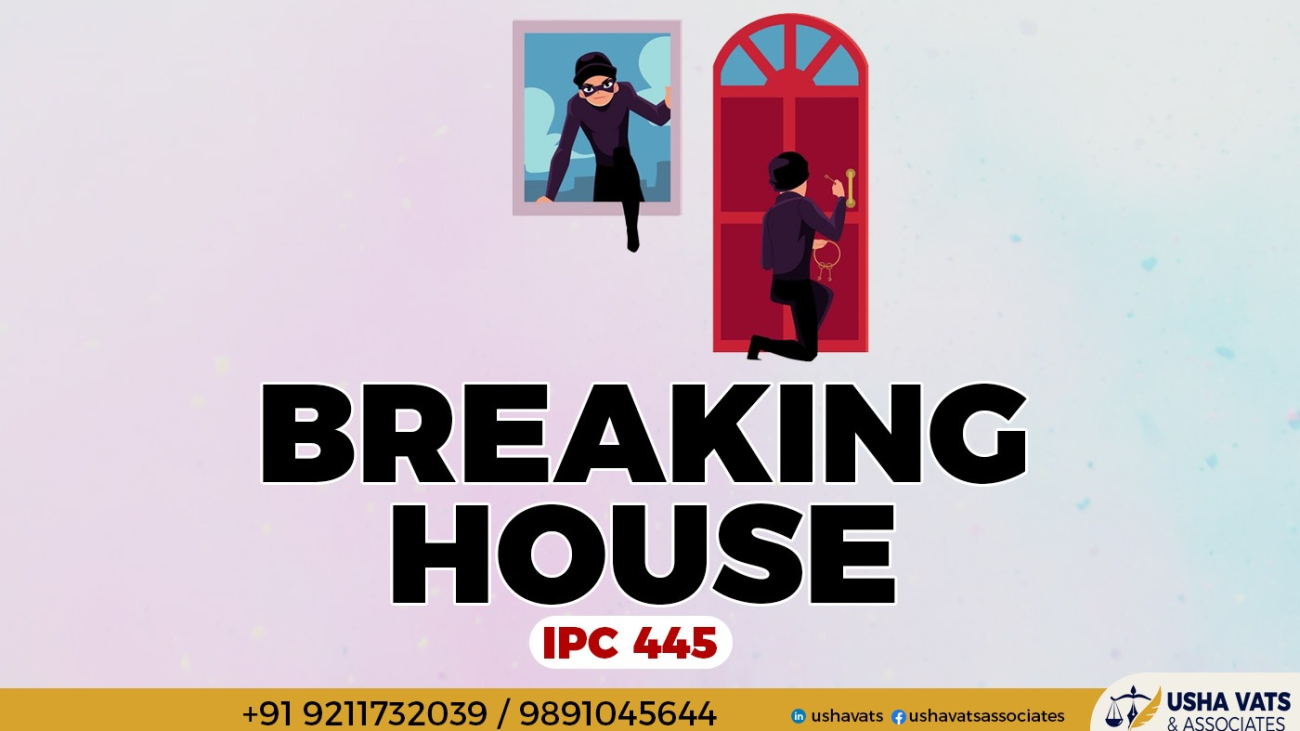
house breaking

What is the Procedure of house -breaking in Code of Criminal Procedure (CrPC)?

In the Code of Criminal Procedure (CrPC), 1973, the procedure for handling house-breaking (also referred to as “lurking house-trespass” or “house-trespass”) is primarily covered under provisions related to search, seizure, and arrest. House-breaking itself is an offense under the Indian Penal Code (IPC), 1860, but CrPC provides the procedural framework for investigation and prosecution.

Relevant Provisions in CrPC Regarding House-Breaking:

1. Investigation and Arrest Procedure

  • When a case of house-breaking is reported, the police initiate an investigation under Section 154 (FIR registration) and Section 156 (investigation by the officer-in-charge of the police station).
  • If necessary, the police may arrest the suspect under Section 41 (arrest without a warrant) if the offense is cognizable.
  • The accused may also be arrested with a warrant under Section 73.

2. Search of Premises:

  • If the police suspect stolen property or evidence related to house-breaking is hidden in a particular house, they can search the premises under Section 93 (search warrant).
  • If urgent, a police officer can conduct a search without a warrant under Section 165, provided he records the reasons in writing.

3. Seizure of Stolen Property:

  • Under Section 102, a police officer has the authority to seize any property suspected to be stolen during house-breaking.
  • The seized property is produced before a Magistrate under Section 451 or 457, depending on whether the case is still under trial or concluded.

4. Confession and Statements:

  • Statements of witnesses are recorded under Section 161.
  • If the accused confesses, it must be recorded under Section 164 CrPC before a Magistrate.

5. Trial Process:

  • House-breaking offenses are generally tried in a Magistrate’s Court, depending on the severity of the offense.
  • The trial follows Section 238-250 (trial procedures for warrant cases or summons cases as applicable).

Relevant IPC Sections for House-Breaking:

House-breaking is covered under the following sections of the Indian Penal Code (IPC), 1860:

  • Section 441 – Criminal Trespass
  • Section 445 – Definition of House-breaking
  • Section 446 – House-breaking by night
  • Section 448 – Punishment for House-trespass
  • Section 457 – House-breaking with intent to commit an offense
  • Section 458 – Lurking house-trespass with preparation for hurt, assault, or wrongful restraint

or Any Type Of Consultation Or Suggestion Call Us On +91 9211732039 / +91 9891045644. This Suggestion is Absolutely Free.

For Educational & Legal Awareness
Website: www.ushavatsassociates.in
quashing-fir

How can a person quash an FIR under the Code of Criminal Procedure (CrPC)?

To quash an FIR under the Code of Criminal Procedure (CrPC) in India, a person can file a petition under Section 482 CrPC before the High Court. Here’s the process in detail:

1. Understanding Quashing of FIR

  • Quashing of an FIR means nullifying the FIR and stopping further investigation or legal proceedings.
  • The High Court has inherent powers under Section 482 CrPC to prevent abuse of the legal process or to secure justice.

2. Grounds for Quashing an FIR

A person can approach the High Court for quashing an FIR on the following grounds:

  1. No Prima Facie Case – If the FIR does not disclose a cognizable offense.
  2. Malicious Intent – If the FIR is filed with malicious intent or to harass the accused.
  3. Civil Dispute Camouflaged as Criminal Case – If the issue is civil in nature (e.g., property disputes, breach of contract).
  4. Settlement Between Parties – In non-heinous cases (e.g., Section 420 IPC – cheating, Section 498A IPC – dowry harassment), if both parties reach a settlement.
  5. Lack of Evidence – If there is no substantial evidence to support the allegations.
  6. Jurisdictional Errors – If the case is filed in the wrong jurisdiction.
  7. Violation of Fundamental Rights – If the FIR violates fundamental rights (e.g., false implication).

3. Procedure to Quash an FIR

  1. Hire a Lawyer – Engage a criminal lawyer who specializes in quashing FIRs.
  2. Draft a Petition – File a petition under Section 482 CrPC in the High Court with all supporting documents.
  3. Attach Supporting Documents – Submit copies of the FIR, charge sheet (if filed), settlement agreement (if any), and other relevant evidence.
  4. Hearing in High Court – The court will review the petition and may issue a stay on the investigation.
  5. Decision by High Court – If the court is satisfied, it will quash the FIR; otherwise, it may allow the case to proceed.

4. Important Case Laws on Quashing FIR

  • State of Haryana v. Bhajan Lal (1992) – Laid down principles for quashing FIRs.
  • Gian Singh v. State of Punjab (2012) – Allowed quashing of FIRs in cases of private disputes with settlement.

5. Alternative Remedies

  • Filing a Discharge Application – If the FIR is not quashed, the accused can seek discharge from the trial court.
  • Filing a Writ Petition (Article 226 of the Constitution) – The accused can also approach the High Court under Article 226.

or Any Type Of Consultation Or Suggestion Call Us On +91 9211732039 / +91 9891045644. This Suggestion is Absolutely Free.

For Educational & Legal Awareness
Website: www.ushavatsassociates.in

OUTRAGE-OF-MODESTY

What is the Procedure for outrage modesty under Section 354 IPC?

Section 354 of the Indian Penal Code (IPC) deals with the assault or use of criminal force on a woman with the intent to outrage her modesty. The procedure for handling an offense under this section involves the following steps:

1. Filing of FIR (First Information Report)

  • The victim or any witness can file a complaint at the nearest police station.
  • The police register an FIR under Section 354 IPC since it is a cognizable offense.

2. Investigation by Police

  • The police conduct an investigation, which includes:
    • Recording statements of the victim and witnesses (under Section 161 CrPC).
    • Collection of evidence such as CCTV footage, medical reports, or any physical evidence.
    • If necessary, a medical examination of the victim may be conducted.
    • The accused may be arrested, depending on the circumstances.

3. Arrest of the Accused

  • Section 354 IPC is a cognizable and non-bailable offense, meaning the police can arrest the accused without a warrant.
  • The accused can apply for anticipatory bail or regular bail, depending on the stage of the case.

4. Filing of Charge Sheet

  • Once the investigation is complete, the police file a charge sheet in the appropriate court under Section 173 CrPC.
  • If sufficient evidence is found, the case proceeds to trial.

5. Trial in Court

  • The case is tried before a Magistrate (usually a Sessions Court or a Metropolitan Magistrate Court).
  • The prosecution presents evidence and witnesses.
  • The accused has the right to defend themselves and present their evidence.
  • The court examines the evidence and hears arguments from both sides.

6. Judgment and Punishment

  • If the court finds the accused guilty, they may be punished with:
    • Imprisonment for 1 to 5 years AND
    • Fine
  • If the accused is found not guilty, they are acquitted.

7. Appeal Process

  • The convicted person can appeal to a higher court against the conviction.
  • The victim/prosecution can also appeal if dissatisfied with the verdict.

Key Points to Note:

  • Bail: The offense under Section 354 IPC is non-bailable, meaning bail is not granted as a matter of right but at the discretion of the court.
  • Cognizable offense: The police can arrest without prior court approval.
  • Court Jurisdiction: The case is usually heard by a Magistrate, but if severe, it may be transferred to a Sessions Court.

or Any Type Of Consultation Or Suggestion Call Us On +91 9211732039 / +91 9891045644. This Suggestion is Absolutely Free.

For Educational & Legal Awareness
Website: www.ushavatsassociates.in