


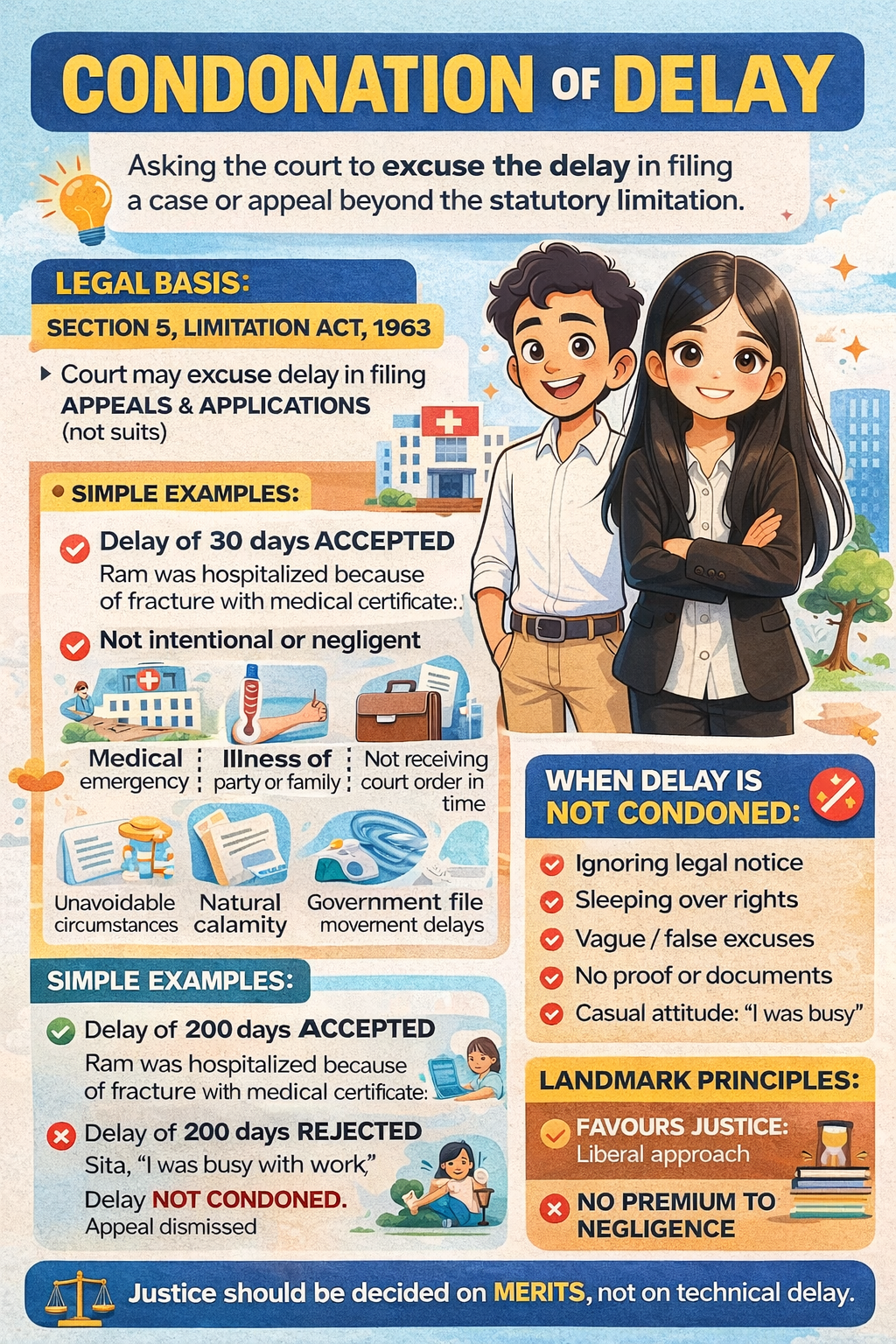
Meaning
“Condonation of delay” means asking the court to excuse the delay when a party fails to file a case/appeal/application within the statutory limitation period.
The court can forgive the delay if there is a sufficient cause.
Legal Basis
Section 5 – Limitation Act, 1963
Court may condone delay in:
- Appeals
- Applications
(But NOT suits)
Purpose
To ensure justice is not denied merely because a party was late due to circumstances beyond their control.
What Is “Sufficient Cause”?
The cause must be:
✔ Genuine
✔ Reasonable
✔ Beyond the party’s control
✔ Not intentional or negligent
Common accepted reasons:
- Medical emergency
- Illness of party or family
- Not receiving court order in time
- Wrong legal advice
- Unavoidable circumstances
- Natural calamity
- Government file movement delays (for govt. departments)
❌ When Delay Is Not Condoned
- Ignoring legal notices
- Sleeping over rights
- Vague or false excuses
- Delay caused intentionally
- No proof or documents
- Casual attitude: “I was busy”
Landmark Principles
1. Liberal Approach (Favours Justice)
Collector, Land Acquisition v. Katiji (1987)
➡ Courts should adopt a liberal approach because refusing condonation may lead to injustice.
2. No Premium to Negligence
➡ But courts do NOT condone when delay is due to carelessness or lack of diligence.
3. Government cases
➡ Some relaxation, but even govt. must show sufficient cause.
Simple Examples
Example 1: Delay Accepted
Ram had to file an appeal within 90 days, but he filed on the 120th day (30 days late).
Reason:
He was hospitalised due to a fracture and submitted:
- Medical certificate
- Hospital record
➡ Court accepts → Delay condoned
➡ Appeal registered and heard on merits.
Example 2: Delay Rejected
Sita filed an appeal 200 days late.
Reason given:
“I was busy with work.”
No documents. No sufficient cause.
➡ Court rejects → Delay not condoned
➡ Appeal dismissed as “time-barred.”
Example 3: Wrong Legal Advice
A person files appeal late because lawyer gave wrong date or wrong limitation period.
If supported with details or affidavit:
➡ Courts generally condone such delay.
Example 4: Did Not Receive Copy of Order
Limitation starts from knowledge of order.
If party never received the certified copy:
➡ Delay may be condoned.
Conclusion
Condonation of delay exists to ensure:
“Justice should be decided on merits, not on technical delay.”
But the party seeking condonation must show good cause, proper explanation, and diligence, with documents wherever possible.
1. Draft Application for Condonation of Delay
(U/S 5 of Limitation Act, 1963)**
IN THE COURT OF ____________________
Case Title: ___________________________
Case No.: _____________________________
APPLICATION UNDER SECTION 5 OF THE LIMITATION ACT FOR CONDONATION OF DELAY
Most Respectfully Submitted:
- That the applicant is filing the accompanying (appeal/revision/application) against the order dated //____, passed by the learned __________ Court.
- That the statutory period of limitation for filing the present proceeding is ____ days, however the applicant could not file it within the prescribed time and there is a delay of ___ days.
- That the delay has occurred due to reasons mentioned below, which constitute a sufficient cause:
- The applicant was suffering from illness/medical issues from //____ to //____ and was advised complete rest.
—OR— - The applicant was out of station due to family emergency.
—OR— - The counsel inadvertently misplaced the file / certified copies were supplied late.
—OR— - Any other genuine reason (customize).
- The applicant was suffering from illness/medical issues from //____ to //____ and was advised complete rest.
- That the delay is neither intentional nor deliberate, but due to circumstances beyond the control of the applicant.
- That if the delay is not condoned, the applicant will suffer irreparable loss, whereas no prejudice will be caused to the opposite party.
- That the present application is made bona fide and in the interest of justice.
PRAYER
In the above circumstances, it is most respectfully prayed that this Hon’ble Court may kindly:
a) Condone the delay of ___ days in filing the accompanying (appeal/revision/application), and
b) Pass any other order(s) deemed fit in the interest of justice.
Applicant
Through Counsel
(Name & Signature)
Date:
Place:
2. Draft Reply / Objections to Application for Condonation of Delay
IN THE COURT OF ____________________
Case Title: ________________________
Case No.: _________________________
REPLY/OBJECTION TO APPLICATION U/S 5 OF THE LIMITATION ACT FOR CONDONATION OF DELAY
Most Respectfully Submitted:
- That the Respondent opposes the application for condonation of delay filed by the Applicant.
- That the Applicant has failed to show any sufficient cause for the inordinate delay of ___ days. The reasons mentioned in the application are vague, false, and unsupported by any evidence.
- That the Applicant has been grossly negligent and careless and has approached this Hon’ble Court only after an adverse order was passed.
- That the Applicant has not produced medical documents / travel proofs / certified copy delay slips or any material to justify the delay.
- That condoning such delay would defeat the purpose of limitation law, which requires parties to act with diligence.
- That the application is filed only to delay the proceedings and harass the Respondent.
PRAYER
Therefore, it is humbly prayed that the application filed by the Applicant under Section 5 of the Limitation Act be dismissed, and the delay may not be condoned.
Respondent
Through Counsel
(Name & Signature)
Date:
Place:
3. Oral Arguments (Applicant Side – For Condonation)
- “My Lord, the applicant has shown sufficient cause under Section 5 of the Limitation Act.”
- “The delay is neither intentional nor deliberate; it occurred due to circumstances beyond control.”
- “Courts have repeatedly held that ‘substantial justice must prevail over technicalities.’”
- “If delay is not condoned, the applicant will suffer irreparable loss.”
- “No prejudice will be caused to the respondent if the delay is condoned.”
4. Oral Arguments (Respondent Side – Against Condonation)
- “The applicant has completely failed to establish sufficient cause for delay.”
- “The explanation is vague and unsupported by any proof.”
- “There is clear negligence and lack of diligence.”
- “Limitation laws exist to prevent stale claims; condoning such delay defeats the object of the Act.”
- “The application is a misuse of process only to delay proceedings.”
A. Case Laws Supporting Condonation of Delay (Applicant Side)
(When you want the delay to be condoned)
1. Collector, Land Acquisition v. Mst. Katiji (1987) 2 SCC 107
Principle:
- Courts must adopt a liberal approach in condonation of delay.
- Substantial justice should prevail over technicalities.
- A litigant does not gain by filing a delayed appeal.
2. N. Balakrishnan v. M. Krishnamurthy (1998) 7 SCC 123
Principle:
- Length of delay is not important; the acceptability of the explanation is what matters.
- Unless delay causes real prejudice to the opposite party, it should generally be condoned.
3. State of Nagaland v. Lipok AO (2005) 3 SCC 752
Principle:
- A rational, pragmatic, and liberal approach must be followed.
- Court should not take “too strict” or “pedantic” views.
4. Improvement Trust, Ludhiana v. Ujagar Singh (2010) 6 SCC 786
Principle:
- Refusing condonation may lead to meritorious matters being thrown out.
- Justice-oriented approach required.
5. Ram Nath Sao v. Gobardhan Sao (2002) 3 SCC 195
Principle:
- Courts should not give undue importance to “technical” delays when substantial rights are involved.
6. State of Haryana v. Chandra Mani (1996) 3 SCC 132
Principle:
- Government litigation often faces procedural delays; courts should adopt a justice-oriented view.
B. Case Laws Opposing Condonation of Delay (Respondent Side)
(When you want the delay not to be condoned)
1. P.K. Ramachandran v. State of Kerala (1997) 7 SCC 556
Principle:
- Law of limitation must be applied strictly.
- Delay cannot be condoned merely on sympathy or equity.
- “Sufficient cause” must be proved, not assumed.
2. Office of the Chief Post Master General v. Living Media India Ltd. (2012) 3 SCC 563
Principle:
- The government does not enjoy special status in law of limitation.
- Delay due to “bureaucratic inefficiency” is not a valid explanation.
3. Basawaraj v. Special Land Acquisition Officer (2013) 14 SCC 81
Principle:
- If the explanation is unsatisfactory, delay cannot be condoned.
- Court cannot act on equity against the express provisions of limitation.
4. Lanka Venkateswarlu v. State of A.P. (2011) 4 SCC 363
Principle:
- Delay caused by negligence, inaction, or lack of bona fides must not be condoned.
5. Manindra Land & Building Corporation v. Bhutnath Banerjee AIR 1964 SC 1336
Principle:
- Court must examine whether the applicant had acted with due diligence.
- Unexplained delay → condonation must be rejected.
6. Ramlal v. Rewa Coalfields Ltd., AIR 1962 SC 361
Principle:
- Once limitation expires, a valuable right accrues to the opposite party.
- This right should not be lightly taken away.
Summary Table (Easy for Court Use)
| For Condonation | Against Condonation |
|---|---|
| Katiji (1987) – Liberal approach | P.K. Ramachandran (1997) – Limitation strict |
| N. Balakrishnan (1998) – Length irrelevant | Living Media (2012) – Govt. can’t excuse delay |
| Lipok AO (2005) – Practical view | Basawaraj (2013) – No equity against limitation |
| Improvement Trust (2010) – Merits over technicality | Lanka Venkateswarlu (2011) – Negligence fatal |
| Ram Nath Sao (2002) – Avoid injustice | Ramlal (1962) – Opposite party gains right |
Find Us On Linkedin
https://www.linkedin.com/in/ushavats/

Thank you for this informative wfite-up.
Arshana Shyam
Welcome