
Type of Appeals Under CPC -1908

TYPES OF APPEALS UNDER THE CIVIL PROCEDURE CODE, 1908 (CPC)

(Summary + Examples + Key Judgments)

Under CPC, appeals are of several kinds depending on who is appealing, from which order, and at which stage. Appeals are a statutory right, not automatic — meaning they exist only when provided in CPC.


1. FIRST APPEAL (Section 96 CPC)

✔ What it is

A full appeal on facts + law filed against a decree passed by a trial court.

✔ When filed?

  • Against any final decree or preliminary decree
  • Appeals allowed even if decree is ex-parte
  • Not allowed when decree is passed with consent of parties

✔ Court

Usually from:

  • Civil Judge → District Court / High Court
  • District Judge → High Court

✔ Example

A suit for partition is dismissed by the Trial Court. The plaintiff files a First Appeal challenging evidence, witnesses, documents, and legal errors.

✔ Important Case Law

Santosh Hazari v. Purushottam Tiwari (2001)
→ First appeal is a valuable right; appellate court must re-appreciate evidence completely.


2. SECOND APPEAL (Section 100 CPC)

✔ What it is

A further appeal ONLY on substantial question of law.

✔ When filed?

Only after:

  1. Trial Court judgment
  2. First Appellate Court judgment

Appeal lies to the High Court only.

✔ What is NOT allowed:

  • Re-assessment of evidence
  • Questions of facts

✔ Example

Two courts hold that a property belongs to X based on evidence. Y files a second appeal alleging:
“Whether unregistered family settlement is admissible?”
→ This is a substantial question of law, so the High Court may admit.

✔ Key Judgment

Kondiba Dagadu v. Savitribai (1999)
→ High Court cannot interfere with concurrent findings of fact unless there is perversity.


3. APPEAL FROM ORDERS (Section 104 & Order 43 CPC)

✔ What it is

Appeal against specific orders listed in CPC.

✔ Example Orders Appealable

  • Order returning plaint (Order 7 Rule 10)
  • Order granting/refusing temporary injunction (Order 39 Rule 1 & 2)
  • Order appointing receiver (Order 40)
  • Order rejecting application under Order 9 Rule 13
  • Order refusing to set aside sale (Order 21)

✔ Example

Court refuses to grant temporary injunction in a property dispute → party can file Appeal from Order under Order 43 Rule 1(r).

✔ Judgment

Shah Babulal Khimji v. Jayaben (1981)
→ Some interlocutory orders amount to “judgment” and are appealable.


4. APPEALS TO THE SUPREME COURT (Civil Appeals)

Two main types:


A. Appeal by Special Leave (Article 136)

✔ Nature

Discretionary remedy. Not a matter of right.

✔ Example

High Court upholds eviction order. Tenant seeks SLP before Supreme Court for relief.

Key Case

Pritam Singh v. State (1950)
→ SC will interfere only when there is grave injustice or exceptional circumstances.


B. Appeal Under Article 133 (Civil Appeal as a matter of right)

✔ When?

Where a case involves a substantial question of law of general importance and High Court certifies it.


5. LETTERS PATENT APPEAL (LPA)

(Only where High Court’s Letters Patent allows)

✔ What it is

An intra-court appeal:
Single Judge decision → Division Bench of the same High Court.

✔ Not available when:

  • Matter decided by a Single Judge in second appeal
  • Filing against certain statutory tribunals

✔ Example

Single Judge of High Court dismisses a writ petition. Petitioner files LPA before Division Bench.


6. MISCELLANEOUS APPEALS

Examples include:

A. Appeal under Order 21 (Execution Appeals)

Filed against orders passed in execution proceedings.

B. Appeal in Small Causes

Where the Provincial Small Causes Courts Act applies.

Example

Judgment-debtor challenges an execution order attaching his salary.


7. APPEAL UNDER SECTION 96(4) – EX-PARTE DECREE

A specific appeal against an ex-parte decree.

Example:
Defendant did not get notice and the decree is passed → He can file Appeal or Order 9 Rule 13 application.


8. APPEAL BY INDIGENT PERSON (Order 44 CPC)

If a person cannot pay court fees, they can appeal as an indigent person.


COMPARISON TABLE (Quick Revision)

Type of AppealLies ToAgainstScope
First AppealDistrict Court / High CourtDecreeFacts + Law
Second AppealHigh CourtFirst Appellate DecreeOnly Substantial Law
Appeal from OrdersDistrict Court / High CourtSpecific OrdersLegal Points
LPADivision BenchSingle Judge OrderFacts + Law
SLP/SC AppealSupreme CourtHC JudgmentWhole matter (discretionary)
Best Advocate For Cheque Bounce Cases in Delhi

CHEQUE BOUNCE WHERE TO SUE?

SUPREME COURT CLERIFICATION ABOUT S.142(2)(A) NI ACT:

Supreme Court of India (SC) has clarified regarding where to sue (“where to file”) when a cheque bounces under Section 142(2)(a) of the Negotiable Instruments Act, 1881 — i.e. the “bounce / cheque-dishonour” scenario under Section 138 of the Negotiable Instruments Act, 1881.

What SC clarified: Where to file cheque-bounce case

  • The Court held that for an “account payee” cheque (i.e. cheque deposited for collection through a bank account), the complaint must be filed only at the court which has jurisdiction over the branch of the bank where the payee maintains their bank account.
  • It does not matter where the cheque was physically deposited or presented. Even if the cheque was deposited at a different branch (for convenience) — the law treats it as “deemed delivered” to the payee’s “home branch” (i.e. branch where payee’s account actually is) for the purposes of territorial jurisdiction.
  • The Court reiterated that this is the effect of the 2015-amendment to Section 142 (sub-section 2(a)). The amendment was introduced to prevent forum-shopping and put beyond doubt that territorial jurisdiction depends on the payee’s home branch, not the place of presentation.

Key Statutory Rule — Section 142(2)(a)

After the 2015 amendment, the relevant provision reads broadly as: if a cheque is delivered for collection through an account, “the offence under Section 138 shall be inquired into and tried only by a court within whose local jurisdiction the branch of the bank where the payee or holder … maintains the account is situated.”

Hence, even if you deposit the cheque somewhere else, the “home branch” matters.

 Implications / What this means in practice

  • If you — as payee/holder — receive a bounced cheque and you maintain your bank account in, say, Gurugram (or any branch), then you must file the complaint in the court having jurisdiction over that bank-branch’s area.
  • You cannot file the complaint simply where you deposit the cheque (if that is a different branch), just because you dropped it there. That branch’s court will not have proper territorial jurisdiction under Section 142(2)(a).
  • This removes ambiguity and stops “forum-shopping” (i.e. pick whichever court gives you convenience), ensuring a fixed, objective jurisdiction rule.

Recent Case: What triggered the Clarification

  • Recently (judgement dated 28 Nov 2025), SC bench of Justices J. B. Pardiwala and R. Mahadevan delivered this ruling, reaffirming that cheque-bounce complaints under Section 138 must be filed at the payee’s home-branch court, regardless of where cheque was deposited.
  • In the related earlier case, though the cheque was deposited in Mumbai branch, payee’s operative account was in Mangalore; SC held Mangalore court had jurisdiction and directed the case be heard there.

What you should check/apply (if you want to sue)

When preparing to file a cheque-bounce complaint:

  • Identify the bank branch where your (payee’s) account is maintained — that is your “home branch”.
  • Ensure you file the complaint in a court whose territorial jurisdiction covers that branch.
  • Don’t file in a court just based on where cheque was deposited/presented; that would likely be dismissed for lack of jurisdiction.
  • Act in accordance with other procedural requirements under Section 142 & Section 138 (notice period, etc.).

Checklist for “Where to file a cheque-bounce case (S.138 NI Act) after Supreme Court’s clarification on Section 142(2)(a)”.

Cheque Bounce – Where to Sue?

Supreme Court Clarification on Section 142(2)(a) NI Act

1. File the Case ONLY at the Payee’s Home-Branch Court

Home-branch = the bank branch where YOU (the payee/complainant) maintain your account.

  • Even if you deposit the cheque at another branch for convenience —
    you must file the case only at the court having jurisdiction over the branch where your bank account actually exists.

2. Territorial Jurisdiction Rule

Under Section 142(2)(a):

If the cheque is presented through an account, the complaint shall be filed only in the court within whose jurisdiction the payee’s bank branch is located.

This rule is mandatory, not optional.

3. What Does NOT Matter Anymore

  • It does not matter where the cheque was physically deposited.
  • It does not matter where the drawer (accused) has an account.
  • It does not matter where the dishonour memo was issued.
  • It does not matter where the payee lives or works if different from bank-branch area.

Only the payee’s home-branch decides jurisdiction.

4. Court Examples

Example 1

Your bank account: Axis Bank, Rajouri Garden Branch (Delhi)
You deposit cheque at: Connaught Place Branch
→ Case must be filed at the court having jurisdiction over Rajouri Garden, not CP.

Example 2

Your home branch: HDFC Bank, Gurugram Sector 14
Cheque dishonoured in: Delhi
Drawer lives in: Noida

→ You must file in Gurugram court (Sector 14 jurisdiction)
because that’s where your account is maintained.

5. Documents Required (Checklist)

  • Cheque copy
  • Original bank return memo (dishonour memo)
  • Legal demand notice
  • Proof of sending notice (speed-post receipt + tracking)
  • Complaint under Section 138 read with Section 142 NI Act
  • Affidavit of evidence
  • Cognizance application

6. Time Limits you must follow

  • Cheque validity: 3 months
  • Notice period: Within 30 days of dishonour
  • Waiting period: 15 days after notice
  • Filing complaint: Within 30 days after expiry of 15-day notice period

 7. Basic Steps to File Case

  • Send legal notice within 30 days
  • Wait 15 days
  • If no payment → prepare Section 138 complaint
  • File it at your home-branch court
  • Court will issue summons to accused

8. Supreme Court’s Purpose Behind This Rule

  1. Avoid “forum shopping”
  2. Uniform rule across India
  3. Fix a single, clear jurisdiction
  4. Prevent harassment of accused by filing cases in distant places

https://www.linkedin.com/in/ushavats


cheque-bounce-where-to-sueFinal
best advocate in delhi

What a F.I.R.?

Here is a clear, simple, and complete explanation about FIR:

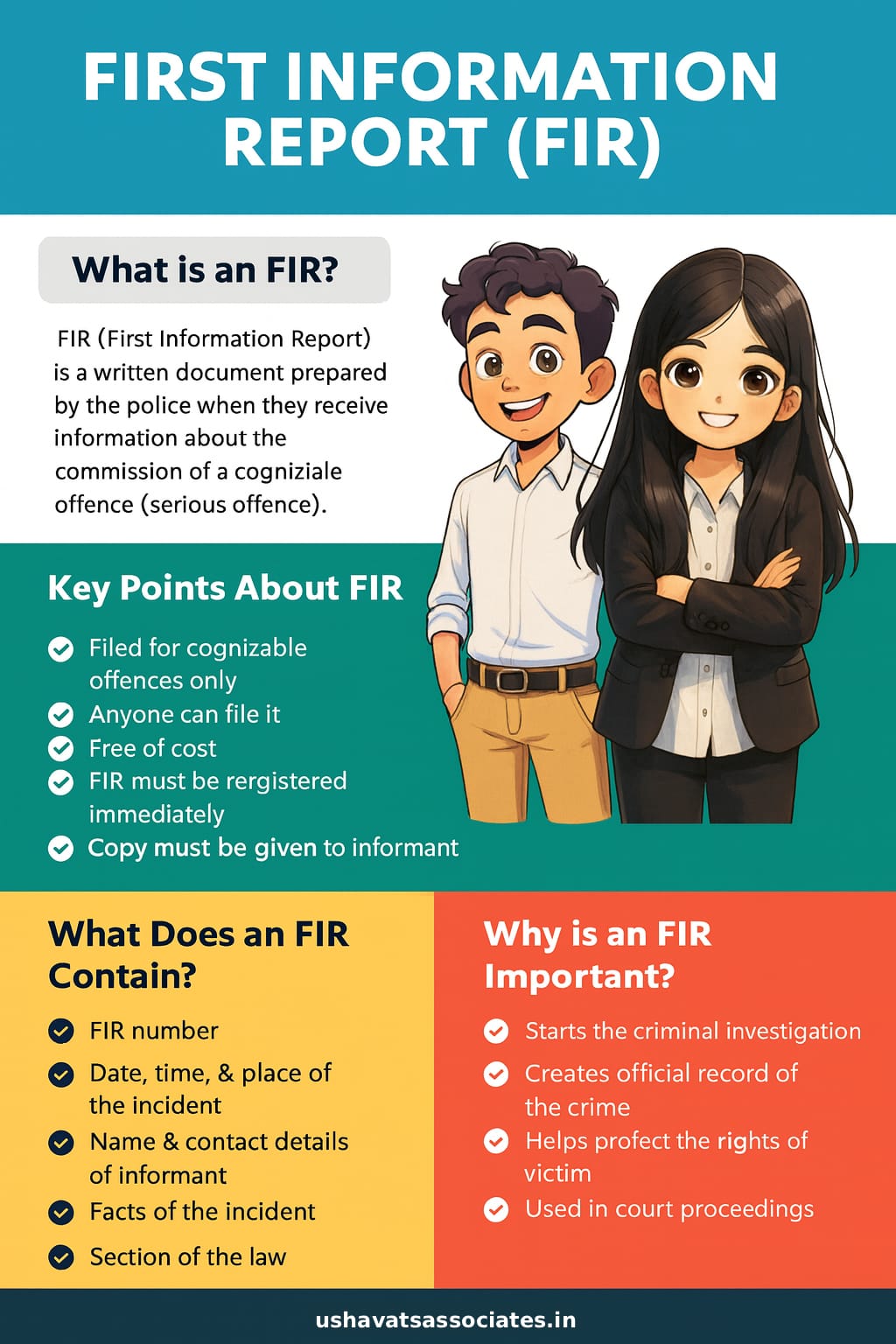
What Is an FIR?

FIR (First Information Report) is a written document prepared by the police when they receive information about the commission of a cognizable offence (serious offences where police can arrest without a warrant and start investigation).

It is the first step to start a criminal investigation.

Key Points About FIR

 1. Filed for Cognizable Offences Only

Police register FIR only when the offence is serious (like theft, murder, rape, kidnapping, cheating, causing hurt, etc.).

2. Anyone Can File It

Victim, witness, relative or even a person who knows about the crime can file an FIR.

 3. Free of Cost

Police cannot charge any money to file an FIR.

4. FIR Must Be Registered Immediately

Police must record it without delay once a cognizable offence is reported.

5. Copy Must Be Given to Informant

A free copy of the FIR must be given to the person who filed it.

6. FIR Number & Police Station Details

Every FIR has a unique number and the name of the police station.

What Does an FIR Contain?

An FIR usually includes:

  • FIR Number
  • Date, Time & Place of the incident
  • Date & Time of reporting
  • Name, address & contact of the complainant
  • Facts of the incident (What happened?)
  • Description of accused (if known)
  • Names of witnesses (if any)
  • Sections of law applicable
  • Signature of the complainant
  • Signature/seal of the duty officer

Why Is an FIR Important?

1. Starts the Criminal Investigation

Police cannot investigate a cognizable offence without registering an FIR.

2. Creates an Official Record of the Crime

It becomes the first official record in the criminal justice process.

3. Helps in Protecting Rights of the Victim

Once FIR is filed, the victim gets the right to:

  • Investigation
  • Arrest of accused
  • Protection orders (if needed)
  • Speedy action by police

4. It Is Used in Court

The FIR is used as an important document in court proceedings.

 5. Helps Prevent Manipulation

Once written and signed, it cannot be changed except with court permission.
This prevents false alterations.

best advocate in delhi

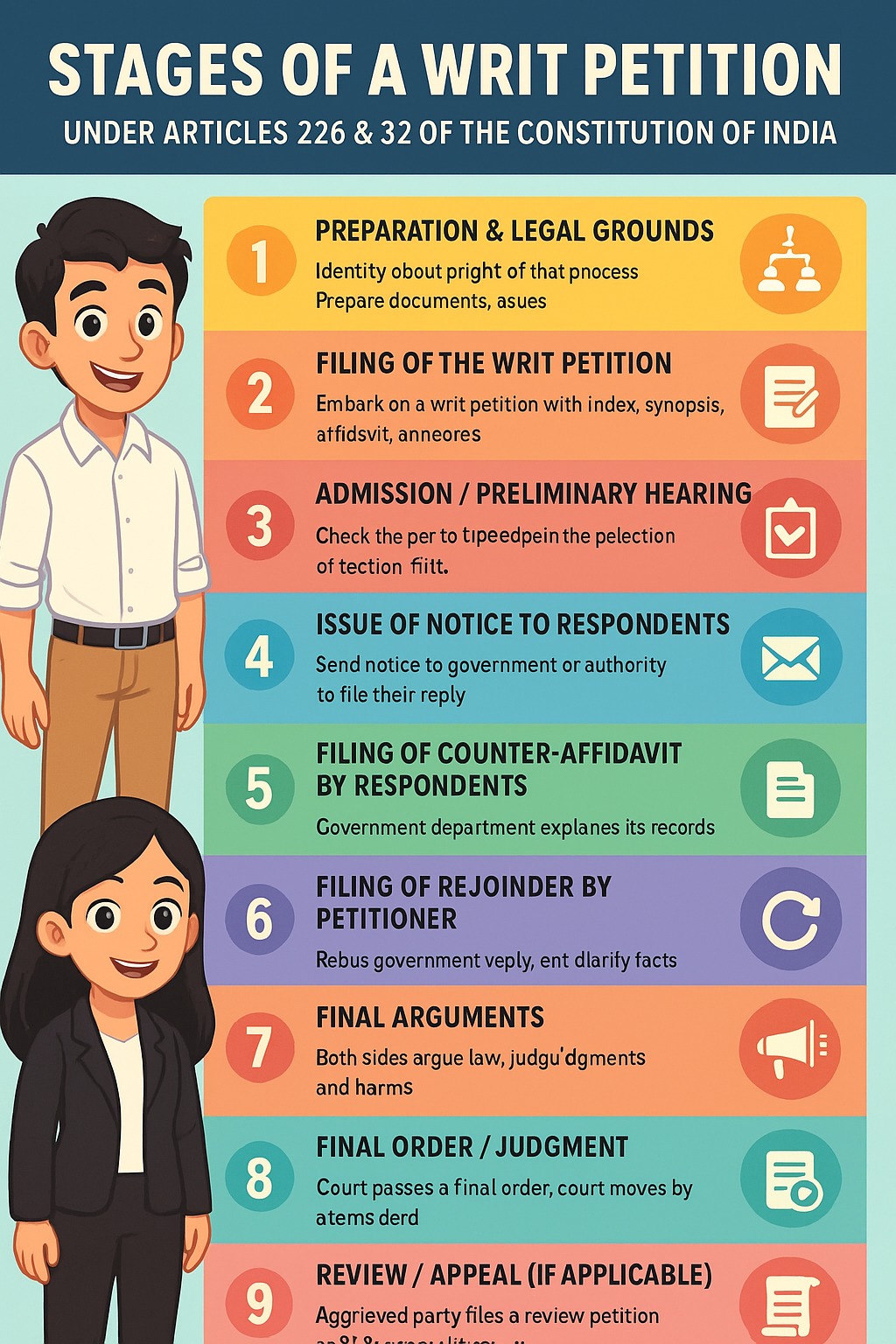
STAGES OF A WRIT PETITION (HIGH COURT / SUPREME COURT

Preparation & Legal Grounds

Summary:

The petitioner must identify which fundamental or legal right is violated. Proper documents, affidavits, and annexures are prepared.

Example:

A government officer is transferred as punishment without reason → violation of Article 14.

Judgment:

D.K. Basu v. State of West Bengal (1997) → Court stressed that violation of fundamental rights justifies writ jurisdiction.


2️. Filing of the Writ Petition

Summary:

Petition is filed along with index, synopsis, affidavit, vakalatnama, annexures, and court fees.

Example:

Writ of Mandamus seeking direction to police to register FIR.

Judgment:

Lalita Kumari v. State of U.P. (2013) → Mandatory registration of FIR for cognizable offence.


3️. Admission / Preliminary Hearing

Summary:

Court checks whether the petition has merit and falls under writ jurisdiction.

Court may:

  • Issue Notice
  • Dismiss the petition
  • Give interim relief

Example:

High Court stays demolition notice on first hearing.

Judgment:

State of Uttar Pradesh v. Visheshwar (1995) → Admission stage is for prima-facie assessment.


4️. Issue of Notice to Respondents

Summary:

Court sends notice to government department/authority to file their reply.

Example:

Municipal Corporation is asked to explain illegal sealing order.

Judgment:

A.K. Kraipak v. Union of India (1969) → Principles of natural justice mandatory.


5️. Filing of Counter-Affidavit by Respondents

Summary:

Government department explains its actions with records.

Example:

Police files reply showing reasons for inaction or delay.

Judgment:

Maneka Gandhi v. Union of India (1978) → Government must justify actions affecting personal liberty.


6️. Filing of Rejoinder by Petitioner

Summary:

Petitioner rebuts the government’s reply and clarifies facts.

Example:

Petitioner denies allegations about incomplete documents.

Judgment:

S.P. Gupta v. Union of India (1981) → Transparency & counter replies essential for fair hearing.


7️. Final Arguments

Summary:

Both sides argue law, judgments, rights violations, and factual issues.

Example:

Petitioner argues that the transfer order is mala fide and violates Article 14.

Judgment:

R.D. Shetty v. International Airport Authority (1979) → Administrative actions must be fair and non-arbitrary.


8️. Final Order / Judgment

Summary:

Court passes final orders:

  • Allow the petition
  • Dismiss it
  • Give directions
  • Order compensation
  • Transfer case to another authority

Example:

HC directs the university to declare withheld exam results within 7 days.

Judgment:

Nilabati Behera v. State of Orissa (1993) → Compensation for violation of fundamental rights.


9️. Review / Appeal (If applicable)

Summary:

Aggrieved party can file:

  • Review Petition – same court
  • SLP (Special Leave Petition) – Supreme Court under Article 136

Judgment:

P. Nalla Thampy Thera v. Union of India (1983) → Review permissible only on error apparent on record.


Summary Chart

StageWhat HappensExampleLandmark Case
1. GroundsRights violation identifiedIllegal transferD.K. Basu
2. FilingPetition filed with documentsMandamus for FIRLalita Kumari
3. AdmissionCourt checks meritInterim stayVisheshwar
4. NoticeGovt notifiedSealing caseA.K. Kraipak
5. CounterGovt replyPolice explains delayManeka Gandhi
6. RejoinderPetitioner rebutsDenial of allegationsS.P. Gupta
7. ArgumentsFinal hearingArbitrary actionR.D. Shetty
8. JudgmentFinal orderExam resultsNilabati Behera
9. Review/SLPAppealErrorNalla Thampy