Judicial Separation Vs Divorce - Best Female Advocate In Delhi

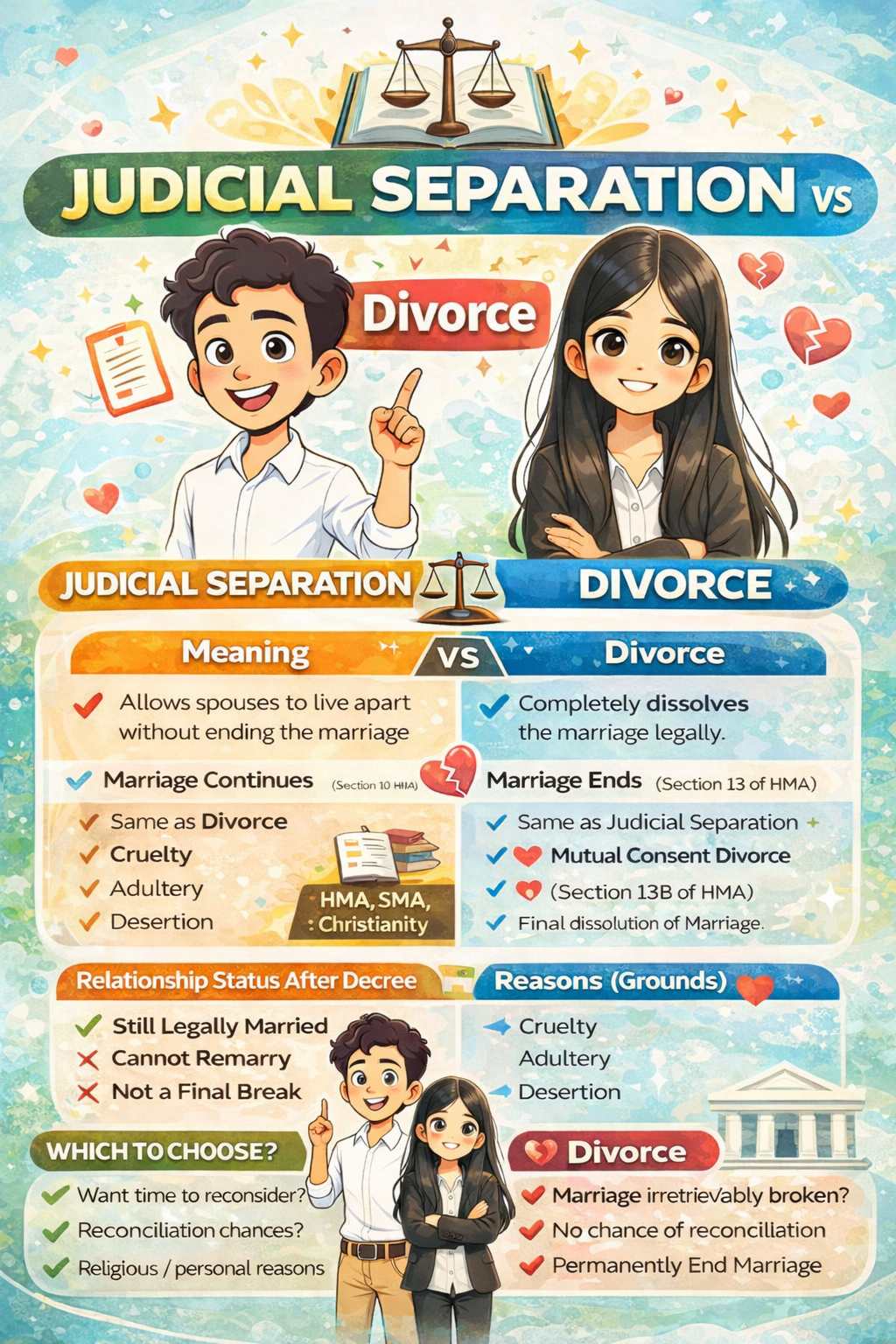
Judicial Separation vs Divorce

1. Meaning

Judicial Separation

Judicial Separation means:

Court permits husband and wife to live separately, but marriage is not dissolved.

➡ Marriage continues legally.

Divorce

Divorce means:

Complete dissolution of marriage by a decree of court.

➡ Marriage ends permanently.


2. Relevant Legal Provisions

LawJudicial SeparationDivorce
Hindu Marriage Act, 1955Section 10Sections 13 & 13B
Special Marriage ActSection 23Section 27
Christian LawAvailableAvailable
Muslim LawConcept exists (Faskh)Talaq / Khula / Mubarat

3. Nature of Relationship After Decree

PointJudicial SeparationDivorce
Marriage statusContinuesDissolved
Husband & WifeStill legally marriedNot husband & wife
Right to remarry❌ Not allowed✅ Allowed
Cohabitation dutySuspendedEnds forever

4. Grounds

Judicial Separation

  • Same grounds as divorce
  • Cruelty
  • Desertion
  • Adultery
  • Mental disorder etc.

Court can grant judicial separation even if divorce is not sought.


Divorce

  • Same grounds
  • Plus Mutual Consent (Section 13B)

5. Time Factor

AspectJudicial SeparationDivorce
Cooling periodNo fixed periodMandatory in 13B
Can convert?YesNot applicable

If no cohabitation for 1 year after judicial separation → Divorce can be sought


6. Maintenance & Custody

IssueJudicial SeparationDivorce
Maintenance✔ Allowed✔ Allowed
Child custody✔ Decided✔ Decided
AlimonyInterim onlyInterim + Permanent

Purpose / Intention

Judicial Separation is preferred when:

✔ Parties want time to reconsider
✔ Religious or personal reasons
✔ Divorce not immediately desired

Divorce is preferred when:

✔ Marriage has irretrievably broken down
✔ No chance of reconciliation
✔ Parties want final closure


8. Important Case Laws

Savitri Pandey v. Prem Chandra Pandey (2002) 2 SCC 73

Supreme Court held:

Judicial separation gives parties time to reflect and reconcile before final divorce.


Lachman Utamchand Kirpalani v. Meena (1964)

SC observed:

Judicial separation does not end marriage but suspends marital obligations.


9. One-Line Difference (For Court Use)

Judicial separation suspends marital rights without dissolving marriage, whereas divorce permanently dissolves the marital bond.


Quick Comparison Table

BasisJudicial SeparationDivorce
MarriageExistsEnds
Living togetherNot compulsoryEnds
RemarriageNot allowedAllowed
FinalityTemporaryPermanent

Conclusion

  • Judicial Separation = Pause Button
  • Divorce = Stop Button

DRAFT – PETITION FOR JUDICIAL SEPARATION

(Under Section 10, Hindu Marriage Act, 1955)


IN THE COURT OF THE PRINCIPAL JUDGE, FAMILY COURT AT _______

HMA Petition No. ___ of 20__

IN THE MATTER OF:

Smt. ____________
W/o Sh. ____________
Age: ___ years
R/o ______________________
Petitioner

VERSUS

Sh. ____________
S/o Sh. ____________
Age: ___ years
R/o ______________________
Respondent


PETITION UNDER SECTION 10 OF THE HINDU MARRIAGE ACT, 1955 FOR JUDICIAL SEPARATION

MOST RESPECTFULLY SHOWETH:

  1. Marriage
    That the marriage between the petitioner and the respondent was solemnized on //_____ at __________ according to Hindu rites and ceremonies.
  2. Status & Jurisdiction
    That both parties are Hindus governed by the Hindu Marriage Act, 1955 and this Hon’ble Court has jurisdiction as the parties last resided together at __________.
  3. Cohabitation
    After marriage, the parties cohabited at __________ and one child was born out of the wedlock, namely __________ (if applicable).
  4. Cruelty / Grounds
    That after marriage, the respondent subjected the petitioner to mental and/or physical cruelty, including:
    • (brief facts: abuse, neglect, harassment, threats, etc.)
  5. Living Separately
    That due to the respondent’s conduct, the petitioner has been living separately since //_____.
  6. No Collusion
    That this petition is not filed in collusion with the respondent.
  7. Cause of Action
    That the cause of action arose on //_____ and continues till date.

PRAYER

It is, therefore, most respectfully prayed that this Hon’ble Court may be pleased to:

a) Pass a decree of Judicial Separation under Section 10 of the Hindu Marriage Act, 1955;
b) Grant any other relief(s) deemed fit in the interest of justice.


PETITIONER

Through Counsel
Place: ______
Date: ______


DRAFT – DIVORCE PETITION (CONTESTED)

(Under Section 13, Hindu Marriage Act, 1955)


IN THE COURT OF THE PRINCIPAL JUDGE, FAMILY COURT AT _______

HMA Petition No. ___ of 20__

IN THE MATTER OF:

Smt./Sh. ____________
Petitioner

VERSUS

Smt./Sh. ____________
Respondent


PETITION UNDER SECTION 13 OF THE HINDU MARRIAGE ACT, 1955 FOR DISSOLUTION OF MARRIAGE

MOST RESPECTFULLY SHOWETH:

  1. Marriage details (date/place)
  2. Jurisdiction facts
  3. Acts of cruelty/desertion/adultery (as applicable)
  4. Separation period
  5. No collusion
  6. No previous petition pending

PRAYER

a) Pass a decree of Divorce dissolving the marriage;
b) Grant permanent alimony / custody (if prayed);
c) Any other relief deemed fit.


PETITIONER
Through Counsel


DRAFT – MUTUAL CONSENT DIVORCE (13B – FIRST MOTION)

(Under Section 13B, Hindu Marriage Act, 1955)


IN THE COURT OF THE PRINCIPAL JUDGE, FAMILY COURT AT _______

HMA Petition No. ___ of 20__

IN THE MATTER OF:

Petitioner No.1: Smt. ____________
Petitioner No.2: Sh. ____________


JOINT PETITION UNDER SECTION 13B(1) OF THE HINDU MARRIAGE ACT, 1955

MOST RESPECTFULLY SHOWETH:

  1. Marriage solemnized on //_____ at ______.
  2. Parties living separately since //_____.
  3. No cohabitation possible.
  4. All disputes settled voluntarily.
  5. Permanent alimony of ₹______ paid/settled (details).
  6. Child custody with ______ (if applicable).
  7. No coercion or undue influence.

PRAYER

That this Hon’ble Court may be pleased to record statements and grant permission for Second Motion.


PETITIONERS


SECOND MOTION (13B(2)) – SHORT FORMAT

Parties reaffirm consent, settlement complied with, and pray for decree of divorce by mutual consent.


PRACTICE NOTE (IMPORTANT)

  • Judicial Separation → Can be converted to Divorce after 1 year
  • Mutual Divorce → Cooling period may be waived (Amardeep Singh case)
Best Female Advocate In Delhi

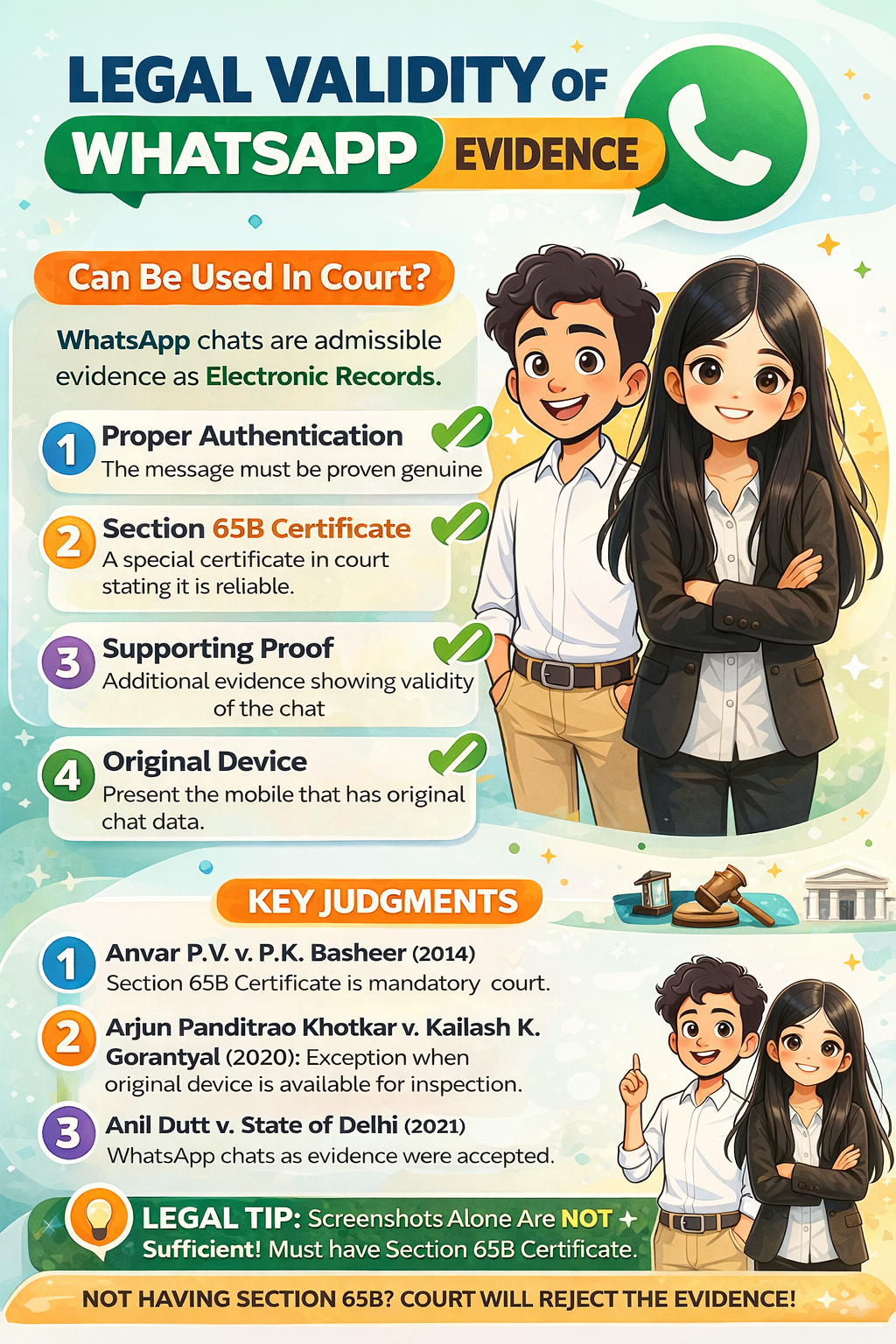
Legal Validity of Whatsapp Evidence - Usha Vats & Associates

Legal Validity of WhatsApp Evidence

1. WhatsApp Messages as Evidence

WhatsApp chats are admissible as electronic records under Indian law.

Statutory Basis

Information Technology Act, 2000

  • Section 3: Definitions of electronic record
  • Section 65A: Electronic records are admissible
  • Section 65B: Admissibility of electronic records with certificate

➡ WhatsApp messages are covered because they are:

  • Stored electronically
  • Transmitted electronically

2. Requirement of Authentication

To use WhatsApp chats as evidence, you must prove:
✅ The message was sent by the person claimed
✅ The content was not tampered with
✅ Chain of custody is maintained

This is usually done through:

  • Sender/receiver testimony
  • Metadata (logs/time)
  • WhatsApp backup/export
  • Mobile phone forensic report

3. Mandatory Certificate under Section 65B

Any electronic record (like WhatsApp chat) must be accompanied by a 65B Certificate or equivalent compliance.

What the certificate must state:
✔ The record was produced from a computer/mobile
✔ The process of retrieval was regular
✔ The device/system was in proper working condition

Without a valid 65B certificate, courts routinely reject WhatsApp evidence.


Key Judgments on WhatsApp Evidence


Anvar P.V. v. P.K. Basheer (2014) 10 SCC 473

Supreme Court clearly held:

  • Electronic records are admissible only if Section 65B is complied with
  • No electronic evidence can be read into record without Section 65B certificate
  • Even if the evidence is spoken to by witness, it must still satisfy 65B

Ratio:

No evidence of electronic record without 65B certificate.


Arjun Panditrao Khotkar v. Kailash Kushanrao Gorantyal (2020) 3 SCC 343

Supreme Court refined the rule:
✔ If the original device is in physical custody of court/police, then a certified copy may be admitted without 65B in law
✔ Default rule still requires 65B where device is not available

Key Takeaway:

When the original machine is available for inspection, such evidence may be read without 65B.


Anil Dutt vs. The State of NCT Delhi (2021)

Delhi High Court held:

  • WhatsApp audio messages and chats are admissible
  • WhatsApp messages were read as part of evidence after proper certification

State vs. Navjot Sandhu (2005)

Though before WhatsApp era, the Supreme Court held:

Confessions to a police officer are inadmissible
– This affects WhatsApp confession messages too if they are not voluntary admissions.


Triloki Nath vs. State of Delhi (1998)

Supreme Court set out the principles of admissibility:

  • Relevance
  • Authenticity
  • Non-suspicious conditions of reporting

These are applied to WhatsApp evidence too.


How Courts Treat WhatsApp Evidence (Practical Principles)

1. Authentication

Court looks for:

  • Who sent the message?
  • How it was extracted?
  • Were there tampering signs?

Usually done through:
✔ witness testimony
✔ metadata
✔ screenshots + export


2. 65B Certificate

Absolutely necessary unless:
✔ original device is produced in court
✔ and entire chat log is examined by court expert


3. Screenshots Alone Are Not Enough

Screenshots are not primary evidence.
They must have:
✔ export with timestamps, OR
✔ forensic extraction


4. Forwarded Messages

Forwarded messages are weak evidence unless:
✔ originator is identified
✔ circumstance proves its relevance


5. WhatsApp Voice Notes

Also admissible with same principles:
✔ metadata confirmation
✔ 65B compliance
✔ witness recognition


6. Screenshot vs Real Chat

Courts prefer:
✔ Exported chat with timestamp & phone info
✔ WhatsApp backup file
✔ Forensic report from mobile

Screenshot alone is weak but can form part of evidence with 65B & supporting proof.


Checklist for Using WhatsApp Evidence in Court

RequirementRequired?
WhatsApp messageYes
65B CertificateYes
Authenticity proofYes
Metadata/Forensic evidenceHighly Recommended
Device inspectionIf possible
Witness to confirmYes

Sample 65B Certificate Format (Quick Idea)

I, ____________________, do hereby certify that:

1. The electronic record (WhatsApp chat) was produced from the digital device ___________ belonging to __________.
2. The device was in proper working condition at all relevant times.
3. The record was extracted using regular process.
4. The attached electronic record is a true and correct copy of the original stored in the device memory.
Place:
Date:
Signature:

Important Case Law Summary (for citations)

CaseCourtKey Principle
Anvar P.V. v. P.K. Basheer (2014)SC65B compliance is mandatory for electronic evidence
Arjun Panditrao Khotkar (2020)SCException when original device is available for inspection
Anil Dutt v. State (2021)Delhi HCWhatsApp chats + audio admissible with proper certification
Triloki Nath v. State (1998)SCCore principles of relevance & authenticity

Practical Scenarios (Examples)

Example 1 – Civil Matter

WhatsApp chat between parties about settlement →
✔ Export chats + 65B → Admissible


Example 2 – Criminal Case

WhatsApp confession: “I did it” →
✔ If authenticated + not coerced + 65B → Admissible

✖ But if just screenshot shown → Weak


Example 3 – Family Matter

WhatsApp message about maintenance or threats →
✔ Section 65B + witness confirmation → Admissible


Conclusion

WhatsApp messages and voice notes are admissible legal evidence in Indian courts if:

  • Authenticated properly
  • Supported by 65B certificate
  • Original device is available or process is proven

Supreme Court has repeatedly emphasized 65B compliance as the primary condition.

STAGES OF CRIMINAL PROCEEDING (UNDER BNS + BNSS) - Usha Vats

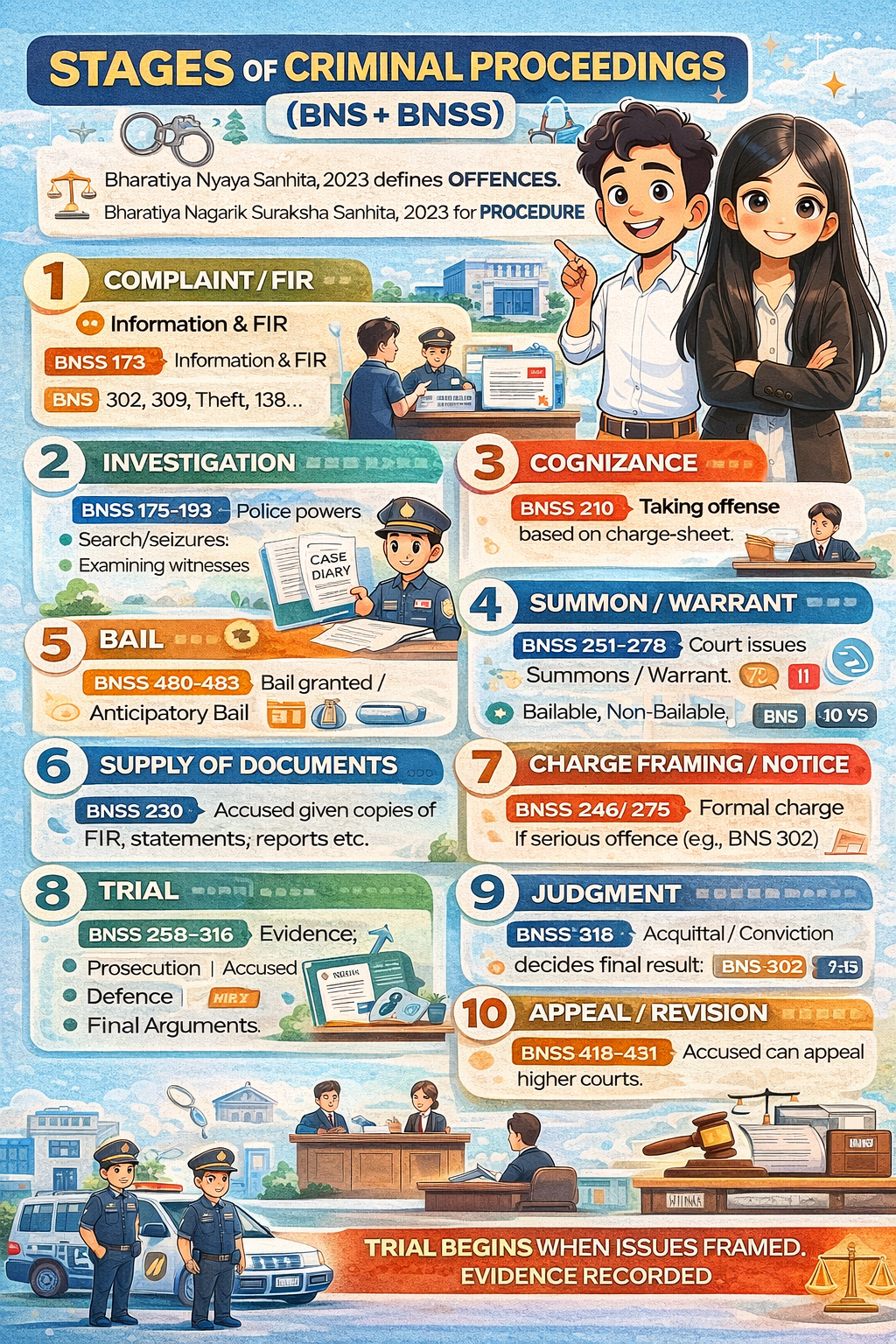
STAGES OF CRIMINAL PROCEEDING (UNDER BNS + BNSS)

(Complete — From FIR to Final Conviction/Appeal)


1. Complaint / Information Stage

A. Information of offence → FIR

  • BNSS Section 173 – Information to Police & Registration of FIR
  • BNS contains the offence definitions, e.g.:
  • BNS 101 – Murder
  • BNS 99 – Culpable Homicide
  • BNS 106 – Dowry Death
  • BNS 115 – Hurt
  • BNS 117 – Grievous Hurt
  • BNS 303 – Theft

…etc.

Murder

  • BNS Section 101 – Murder
    (IPC 302 → BNS 101)

Culpable Homicide Not Amounting to Murder

  • BNS Section 99 – Culpable Homicide
    (IPC 299–304 → BNS 99–100)

Dowry Death

  • BNS Section 106 – Dowry Death
    (IPC 304B → BNS 106)

Hurt

  • BNS Section 115 – Causing Hurt
    (IPC 323 → BNS 115)

Grievous Hurt

  • BNS Section 117 – Causing Grievous Hurt
    (IPC 325 → BNS 117)

Theft

  • BNS Section 303 – Theft
    (IPC 378 → BNS 303)

B. Cognizable vs Non-cognizable

  • BNS Schedule + BNSS Section 175

2. Investigation Stage (Police)

Governed mainly by BNSS, but based on BNS offences.

BNSS Sections Relevant:

  • S. 175 – Police powers for cognizable offences
  • S. 176 – Procedure for non-cognizable offences
  • S. 179 – Spot inspection
  • S. 180 – Examination of witnesses
  • S. 183 – Search & seizure
  • S. 185 – Medical examination of accused
  • S. 193 – Police custody
  • S. 193(3) – Max police custody = 15 days (can be split)

End Product of Investigation:

  • Charge-sheet (Police Report) – BNSS 193(8)
  • Or Closure Report

3. Magistrate Takes Cognizance

BNSS Section 210 – Taking cognizance of offences

Magistrate examines:
✔ FIR
✔ Case diary
✔ Charge-sheet
✔ Statements

Offence again taken from BNS provisions (e.g., BNS 302, 356 etc.).


4. Issuance of Process (Summons/Warrant)

  • BNSS 251–267 – Summons
  • BNSS 268–278 – Warrants

Court decides whether to call accused via:

  • Summons
  • Bailable warrant
  • Non-bailable warrant

5. Appearance of Accused & Bail Stage

A. Bail

  • BNSS 480 – Bail in bailable offences
  • BNSS 482 – Anticipatory bail
  • BNSS 483 – Bail in non-bailable offences

B. Offence classification under BNS matters to bail:

  • If punishment ≤ 3 years → generally bailable
  • If > 3 years → generally non-bailable
    (Refer BNS Schedule)

6. Supply of Documents (Mandatory)

  • BNSS 230 – All documents from police to be supplied to accused
    (including FIR, statements, seizure memos, medical reports etc.)

7. Charge Framing / Notice

A. Warrant Cases (Serious Offences):

  • BNSS 246 – Charge framing
    (e.g., offences under BNS 302, 307, 376, 309, 303…)

B. Summons Cases (Minor Offences):

  • BNSS 275 – Notice of accusation
    (e.g., BNS 140 – simple theft, BNS 115 – wrongful restraint)

After charges → Accused pleads:
✔ Guilty
or
✔ Not guilty


8. Trial Stage

A. Prosecution Evidence

  • BNSS 258 – Examination-in-chief
  • BNSS 260 – Cross-examination
  • BNSS 261 – Re-examination
    Supported by offences under BNS.

B. Statement of Accused

  • BNSS 313 – Statement of accused (same as old S. 313 CrPC)

C. Defence Evidence

  • BNSS 314

D. Final Arguments

  • BNSS 316

9. Judgment

  • BNSS 318 – Judgment of acquittal or conviction
  • Offence under BNS determines the sentence, e.g.:
    • BNS 101 – Life imprisonment/death

10. Sentencing Stage

  • BNSS 319 – Hearing on sentence
  • Court considers:
    ✔ Nature of offence (from BNS)
    ✔ Aggravating/mitigating circumstances
    ✔ Previous convictions

11. Appeal / Revision

Appeals

  • BNSS 419–427

Revisions

  • BNSS 430–431

One-Page Court-Ready Summary

StageBNS (Offence)BNSS (Procedure)
FIRDefines offence173
InvestigationOffence nature175–193
CognizanceBased on BNS offence210
Summons/WarrantBased on seriousness251–278
BailBailable/non-bailable (BNS)480–483
Supply of documents230
ChargeNature of offence246 / 275
EvidenceOffence defines punishment258–261
Accused statement313
Defence314
Arguments316
JudgmentSentence per BNS318
SentenceBNS penalty319
Appeals419–427

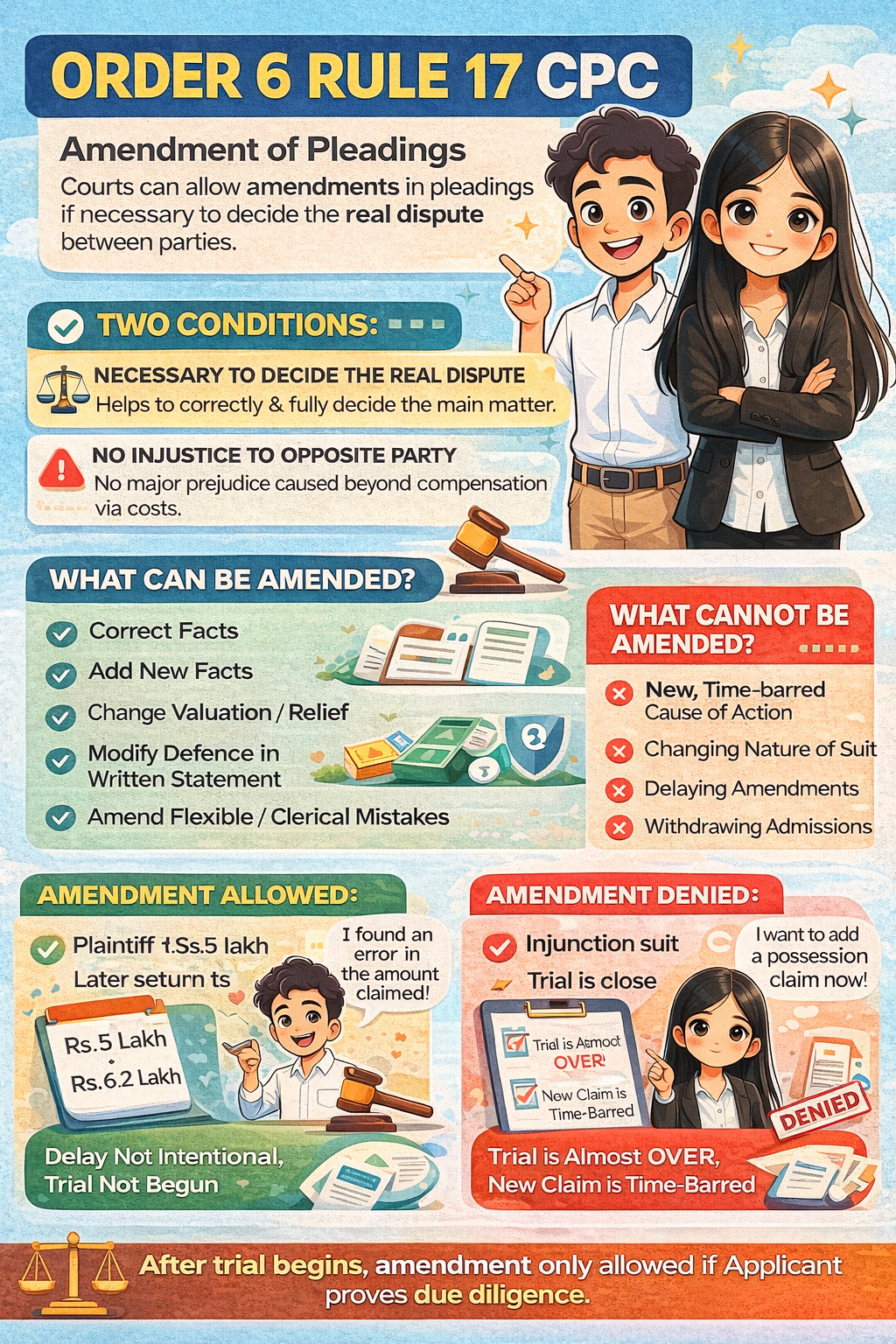
Amendment of Pleadings

Order 6 Rule 17 CPC — Amendment of Pleadings

Order 6 Rule 17 empowers the court to allow amendments in pleadings (plaint or written statement) at any stage of the suit, if the amendment is necessary for determining the real questions in controversy.


Two Conditions for Allowing Amendment

1. The amendment must be necessary for deciding the real dispute.

If the original pleadings miss important facts or require correction → court may allow.

2. The amendment should not cause injustice or prejudice to the opposite party.

If prejudice can be compensated with costs → amendment is allowed.


Proviso (After 2002 Amendment): Stricter Condition

After commencement of trial, the court shall NOT allow amendment unless:

The party proves “due diligence”

Meaning: despite reasonable efforts, the person could not have raised the matter before trial.

Trial begins when issues are framed and evidence begins.

This proviso is the most commonly litigated part today.


What Can Be Amended?

✔️ Correcting wrong facts
✔️ Adding new facts that clarify the cause of action
✔️ Correcting dates, figures, descriptions
✔️ Change in valuation, relief, or prayer clause
✔️ Adding alternative reliefs
✔️ Amendments to written statements are easier (defendant has wider rights)


What Cannot Be Amended?

✘ Introducing an entirely new and inconsistent case
✘ Changing the nature of the suit
✘ Setting up a new cause of action after limitation
✘ Amendments that withdraw admissions
✘ Malicious, delaying, or careless amendments


Important Supreme Court Case Laws

1. Revajeetu Builders v. Narayanaswamy (2009) 10 SCC 84

Court must check:

  • Whether the amendment is necessary?
  • Whether it introduces a new cause?
  • Whether it prejudices the opposite party?
  • Whether it avoids multiplicity of litigation?

(A golden test widely used in courts)


2. Kailash v. Nanhku (2005) 4 SCC 480

Amendments should not be rejected only because of procedural technicalities.


3. Vidyabai v. Padmalatha (2009) 2 SCC 409

After trial begins → burden on applicant to prove due diligence.


4. Rajkumar Gurawara v. S.K. Sarwagi (2008) 14 SCC 364

An amendment is allowed if it:

  • Helps avoid multiplicity of suits
  • Does not change the nature of the dispute


Example 1: Amendment Allowed

Case Situation:
A plaintiff files a suit for recovery of ₹5,00,000 from the defendant.
Later he discovers that he actually paid ₹6,20,000 due to an overlooked transaction.
He applies to amend the plaint to change the amount.

Court Reasoning:

  • Correcting an amount helps decide the real controversy.
  • No major prejudice to defendant; can be compensated by costs.
  • Trial has not started → easier to allow.

Result: Amendment Allowed


Example 2: Amendment NOT Allowed

Situation:
In a suit for injunction (possession not claimed), after trial has begun and evidence is recorded, the plaintiff files an amendment to convert the suit into a possession suit.

Court Reasoning:

  • This changes the nature of the suit.
  • New cause of action introduced.
  • Trial is already in advanced stage → no “due diligence”.

Result: Amendment Rejected


Example 3: Amendment Allowed in Written Statement

Situation:
Defendant forgot to mention that the cheque was given as security, not a liability, in a recovery suit.

Later he files an amendment to add this defense.

Court Reasoning:

  • Defendant can raise alternative and even inconsistent pleas.
  • Helps decide the real issue.
  • No major prejudice → plaintiff gets chance to rebut.

📌 Result: Amendment Allowed


Example 4: Time-barred Amendment Rejected

Situation:
The plaintiff tries to add a completely new cause of action that arose 5 years ago (beyond limitation).

Court:

  • Amendment introducing a time-barred claim is not allowed.

Result: Amendment Rejected


Short Court-Ready Summary

Order 6 Rule 17 CPC allows amendments if:

  1. It is necessary for deciding the real dispute.
  2. It does not change the nature of the case.
  3. It does not introduce a new cause of action after limitation.
  4. It does not cause prejudice to the other side.
  5. After trial begins → applicant must prove due diligence.

DRAFT APPLICATION UNDER ORDER 6 RULE 17 CPC

(For Amendment of Pleadings – Plaintiff or Defendant)


IN THE COURT OF _________
Civil Suit No. ____ of 20__

ABC ……… Plaintiff/Applicant
Versus
XYZ ……… Defendant/Respondent


APPLICATION UNDER ORDER 6 RULE 17 READ WITH SECTION 151 CPC FOR AMENDMENT OF THE PLAINT/WRITTEN STATEMENT

Most Respectfully Showeth:

  1. That the present suit is pending before this Hon’ble Court at the stage of ______ (before/after framing of issues / before evidence / during evidence).
  2. That the applicant filed the plaint/written statement on //20__ setting out the relevant facts as then known.
  3. That during the pendency of the suit, the applicant has now discovered certain material facts / clerical mistakes / omissions which could not be incorporated earlier despite exercising due diligence.
    The proposed amendment is necessary for the purpose of correctly and completely adjudicating the real questions in controversy.
  4. That the proposed amendment does not change the nature of the suit, nor does it introduce any new or time-barred cause of action. The amendment only seeks to bring clarity and avoid multiplicity of proceedings.
  5. That no prejudice will be caused to the opposite party, and in any case, the same can be compensated by costs, if this Hon’ble Court deems fit.
  6. That the amendment is essential to determine the real issue between the parties and to enable this Hon’ble Court to effectively and completely adjudicate upon all matters in dispute.
  7. That the proposed amendments are reproduced below:
    (Provide here the old paragraph and the proposed amended paragraph in a comparative format) Example format:
    • Existing Para 5: “___________”
    • Proposed Para 5: “___________”
  8. That this application is bona fide and in the interest of justice.

PRAYER

In view of the aforesaid facts and circumstances, it is most respectfully prayed that this Hon’ble Court may be pleased to:

  1. Allow the present application and permit the applicant to amend the plaint/written statement as per Para 7 above;
  2. Take the amended pleading on record; and
  3. Pass any other or further order(s) as this Hon’ble Court may deem fit in the interest of justice.

Applicant
Through Counsel
Name: __________
Date: //20__
Place: _________


DRAFT REPLY / OBJECTION TO ORDER 6 RULE 17 CPC APPLICATION

IN THE COURT OF _________
Civil Suit No. ____ of 20__

ABC ……… Plaintiff/Non-Applicant
Versus
XYZ ……… Defendant/Applicant


REPLY / OBJECTION TO THE APPLICATION UNDER ORDER 6 RULE 17 CPC FILED BY THE APPLICANT

Most Respectfully Submitted:

  1. That the applicant’s application under Order 6 Rule 17 CPC is misconceived, not maintainable, and liable to be dismissed, as it has been filed with the sole intention to delay the proceedings.
  2. That the suit is already at an advanced stage (state stage: after framing of issues / during evidence / after evidence / at final arguments).
    As per the second proviso to Order 6 Rule 17 CPC, no amendment can be allowed unless the applicant proves “due diligence”.
    The applicant has failed to show any diligence whatsoever.
  3. That the facts sought to be added/amended were well within the knowledge of the applicant since the filing of the suit, yet the applicant deliberately chose not to include them.
    Hence, the application is hit by lack of due diligence, making the amendment impermissible at this stage.
  4. That the proposed amendment introduces a completely new and inconsistent case, which would change the nature of the suit and prejudice the rights of the replying party.
    Therefore, such amendment cannot be allowed in law.
  5. That the proposed amendment also seeks to introduce a time-barred cause of action, which is expressly prohibited by settled law (SC judgments).
    Permitting such amendment would defeat the principles of limitation and fairness.
  6. That the application has been filed only to delay the matter and harass the replying party, which is evident from the timing and nature of the amendments.
  7. That allowing such amendment would require reopening of pleadings/evidence, causing irreparable prejudice to the replying party, which cannot be compensated in terms of cost.
  8. That the application is devoid of merits, is mala fide, and is liable to be dismissed with heavy costs.

PRAYER

In view of the above submissions, it is most respectfully prayed that this Hon’ble Court may be pleased to:

  1. Dismiss the application filed under Order 6 Rule 17 CPC,
  2. Impose exemplary costs on the applicant for filing a frivolous and delayed application, and
  3. Pass any other order(s) as the Hon’ble Court may deem fit in the interest of justice.

Non-Applicant / Opposite Party
Through Counsel
Name: __________
Date: //20__
Place: _________


Best Female Advocate In Dwarka - Amendment of Pleadings
Condonation of delay - Usha Vats & Assocites

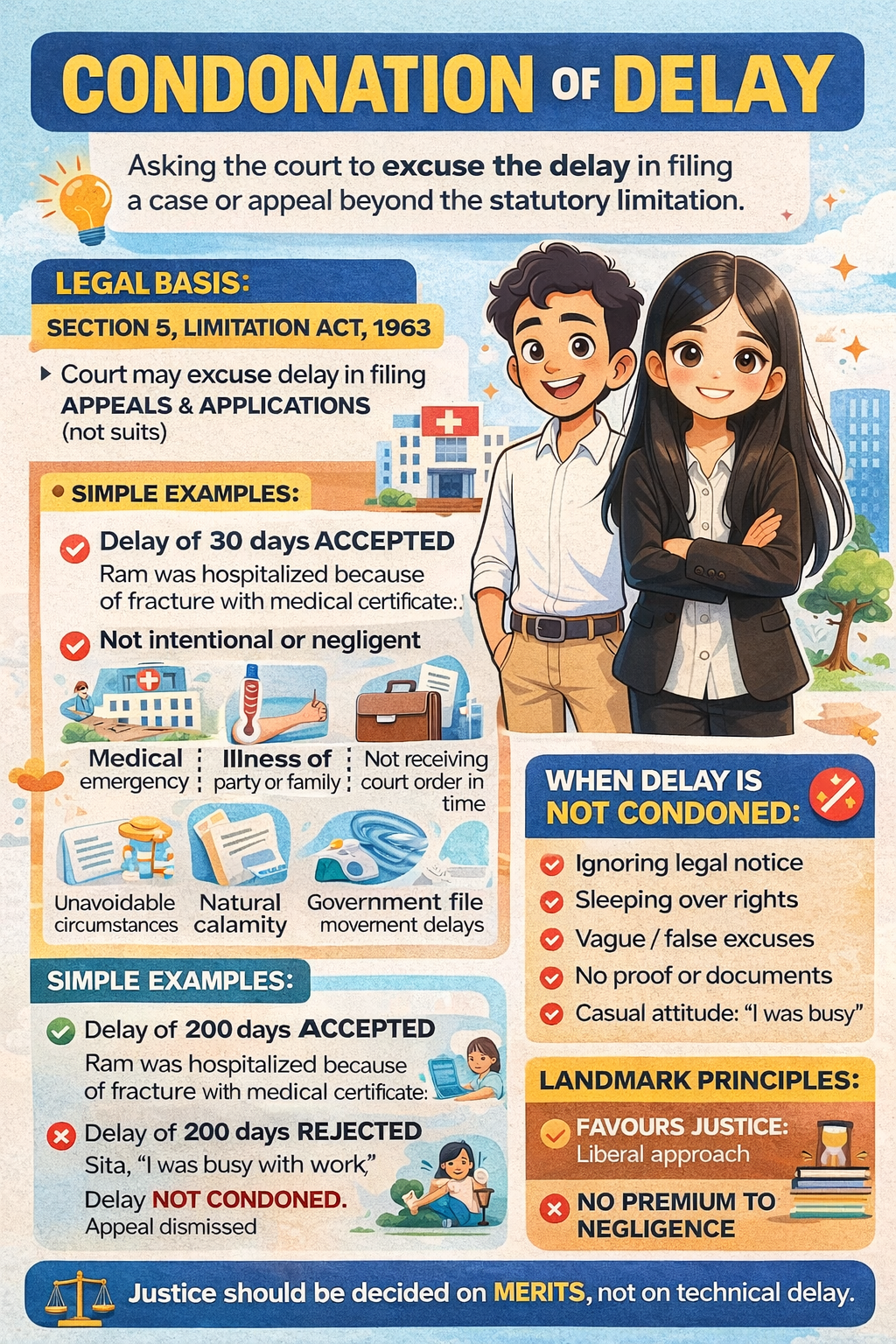
Condonation of Delay

Meaning

“Condonation of delay” means asking the court to excuse the delay when a party fails to file a case/appeal/application within the statutory limitation period.

The court can forgive the delay if there is a sufficient cause.


Legal Basis

Section 5 – Limitation Act, 1963

Court may condone delay in:

  • Appeals
  • Applications
    (But NOT suits)

Purpose

To ensure justice is not denied merely because a party was late due to circumstances beyond their control.


What Is “Sufficient Cause”?

The cause must be:
✔ Genuine
✔ Reasonable
✔ Beyond the party’s control
✔ Not intentional or negligent

Common accepted reasons:

  • Medical emergency
  • Illness of party or family
  • Not receiving court order in time
  • Wrong legal advice
  • Unavoidable circumstances
  • Natural calamity
  • Government file movement delays (for govt. departments)

When Delay Is Not Condoned

  • Ignoring legal notices
  • Sleeping over rights
  • Vague or false excuses
  • Delay caused intentionally
  • No proof or documents
  • Casual attitude: “I was busy”

Landmark Principles

1. Liberal Approach (Favours Justice)

Collector, Land Acquisition v. Katiji (1987)
➡ Courts should adopt a liberal approach because refusing condonation may lead to injustice.

2. No Premium to Negligence

➡ But courts do NOT condone when delay is due to carelessness or lack of diligence.

3. Government cases

➡ Some relaxation, but even govt. must show sufficient cause.


Simple Examples

Example 1: Delay Accepted

Ram had to file an appeal within 90 days, but he filed on the 120th day (30 days late).

Reason:
He was hospitalised due to a fracture and submitted:

  • Medical certificate
  • Hospital record

➡ Court accepts → Delay condoned
➡ Appeal registered and heard on merits.


Example 2: Delay Rejected

Sita filed an appeal 200 days late.

Reason given:
“I was busy with work.”

No documents. No sufficient cause.

➡ Court rejects → Delay not condoned
➡ Appeal dismissed as “time-barred.”


Example 3: Wrong Legal Advice

A person files appeal late because lawyer gave wrong date or wrong limitation period.

If supported with details or affidavit:

➡ Courts generally condone such delay.


Example 4: Did Not Receive Copy of Order

Limitation starts from knowledge of order.

If party never received the certified copy:

➡ Delay may be condoned.


Conclusion

Condonation of delay exists to ensure:

Justice should be decided on merits, not on technical delay.

But the party seeking condonation must show good cause, proper explanation, and diligence, with documents wherever possible.


1. Draft Application for Condonation of Delay

(U/S 5 of Limitation Act, 1963)**

IN THE COURT OF ____________________

Case Title: ___________________________
Case No.: _____________________________

APPLICATION UNDER SECTION 5 OF THE LIMITATION ACT FOR CONDONATION OF DELAY

Most Respectfully Submitted:

  1. That the applicant is filing the accompanying (appeal/revision/application) against the order dated //____, passed by the learned __________ Court.
  2. That the statutory period of limitation for filing the present proceeding is ____ days, however the applicant could not file it within the prescribed time and there is a delay of ___ days.
  3. That the delay has occurred due to reasons mentioned below, which constitute a sufficient cause:
    • The applicant was suffering from illness/medical issues from //____ to //____ and was advised complete rest.
      —OR—
    • The applicant was out of station due to family emergency.
      —OR—
    • The counsel inadvertently misplaced the file / certified copies were supplied late.
      —OR—
    • Any other genuine reason (customize).
  4. That the delay is neither intentional nor deliberate, but due to circumstances beyond the control of the applicant.
  5. That if the delay is not condoned, the applicant will suffer irreparable loss, whereas no prejudice will be caused to the opposite party.
  6. That the present application is made bona fide and in the interest of justice.

PRAYER

In the above circumstances, it is most respectfully prayed that this Hon’ble Court may kindly:

a) Condone the delay of ___ days in filing the accompanying (appeal/revision/application), and
b) Pass any other order(s) deemed fit in the interest of justice.

Applicant
Through Counsel
(Name & Signature)
Date:
Place:


2. Draft Reply / Objections to Application for Condonation of Delay

IN THE COURT OF ____________________

Case Title: ________________________
Case No.: _________________________

REPLY/OBJECTION TO APPLICATION U/S 5 OF THE LIMITATION ACT FOR CONDONATION OF DELAY

Most Respectfully Submitted:

  1. That the Respondent opposes the application for condonation of delay filed by the Applicant.
  2. That the Applicant has failed to show any sufficient cause for the inordinate delay of ___ days. The reasons mentioned in the application are vague, false, and unsupported by any evidence.
  3. That the Applicant has been grossly negligent and careless and has approached this Hon’ble Court only after an adverse order was passed.
  4. That the Applicant has not produced medical documents / travel proofs / certified copy delay slips or any material to justify the delay.
  5. That condoning such delay would defeat the purpose of limitation law, which requires parties to act with diligence.
  6. That the application is filed only to delay the proceedings and harass the Respondent.

PRAYER

Therefore, it is humbly prayed that the application filed by the Applicant under Section 5 of the Limitation Act be dismissed, and the delay may not be condoned.

Respondent
Through Counsel
(Name & Signature)
Date:
Place:


3. Oral Arguments (Applicant Side – For Condonation)

  • “My Lord, the applicant has shown sufficient cause under Section 5 of the Limitation Act.”
  • “The delay is neither intentional nor deliberate; it occurred due to circumstances beyond control.”
  • “Courts have repeatedly held that ‘substantial justice must prevail over technicalities.’
  • “If delay is not condoned, the applicant will suffer irreparable loss.”
  • “No prejudice will be caused to the respondent if the delay is condoned.”

4. Oral Arguments (Respondent Side – Against Condonation)

  • “The applicant has completely failed to establish sufficient cause for delay.”
  • “The explanation is vague and unsupported by any proof.”
  • “There is clear negligence and lack of diligence.”
  • “Limitation laws exist to prevent stale claims; condoning such delay defeats the object of the Act.”
  • “The application is a misuse of process only to delay proceedings.”

A. Case Laws Supporting Condonation of Delay (Applicant Side)

(When you want the delay to be condoned)


1. Collector, Land Acquisition v. Mst. Katiji (1987) 2 SCC 107

Principle:

  • Courts must adopt a liberal approach in condonation of delay.
  • Substantial justice should prevail over technicalities.
  • A litigant does not gain by filing a delayed appeal.

2. N. Balakrishnan v. M. Krishnamurthy (1998) 7 SCC 123

Principle:

  • Length of delay is not important; the acceptability of the explanation is what matters.
  • Unless delay causes real prejudice to the opposite party, it should generally be condoned.

3. State of Nagaland v. Lipok AO (2005) 3 SCC 752

Principle:

  • A rational, pragmatic, and liberal approach must be followed.
  • Court should not take “too strict” or “pedantic” views.

4. Improvement Trust, Ludhiana v. Ujagar Singh (2010) 6 SCC 786

Principle:

  • Refusing condonation may lead to meritorious matters being thrown out.
  • Justice-oriented approach required.

5. Ram Nath Sao v. Gobardhan Sao (2002) 3 SCC 195

Principle:

  • Courts should not give undue importance to “technical” delays when substantial rights are involved.

6. State of Haryana v. Chandra Mani (1996) 3 SCC 132

Principle:

  • Government litigation often faces procedural delays; courts should adopt a justice-oriented view.


B. Case Laws Opposing Condonation of Delay (Respondent Side)

(When you want the delay not to be condoned)


1. P.K. Ramachandran v. State of Kerala (1997) 7 SCC 556

Principle:

  • Law of limitation must be applied strictly.
  • Delay cannot be condoned merely on sympathy or equity.
  • “Sufficient cause” must be proved, not assumed.

2. Office of the Chief Post Master General v. Living Media India Ltd. (2012) 3 SCC 563

Principle:

  • The government does not enjoy special status in law of limitation.
  • Delay due to “bureaucratic inefficiency” is not a valid explanation.

3. Basawaraj v. Special Land Acquisition Officer (2013) 14 SCC 81

Principle:

  • If the explanation is unsatisfactory, delay cannot be condoned.
  • Court cannot act on equity against the express provisions of limitation.

4. Lanka Venkateswarlu v. State of A.P. (2011) 4 SCC 363

Principle:

  • Delay caused by negligence, inaction, or lack of bona fides must not be condoned.

5. Manindra Land & Building Corporation v. Bhutnath Banerjee AIR 1964 SC 1336

Principle:

  • Court must examine whether the applicant had acted with due diligence.
  • Unexplained delay → condonation must be rejected.

6. Ramlal v. Rewa Coalfields Ltd., AIR 1962 SC 361

Principle:

  • Once limitation expires, a valuable right accrues to the opposite party.
  • This right should not be lightly taken away.


Summary Table (Easy for Court Use)

For CondonationAgainst Condonation
Katiji (1987) – Liberal approachP.K. Ramachandran (1997) – Limitation strict
N. Balakrishnan (1998) – Length irrelevantLiving Media (2012) – Govt. can’t excuse delay
Lipok AO (2005) – Practical viewBasawaraj (2013) – No equity against limitation
Improvement Trust (2010) – Merits over technicalityLanka Venkateswarlu (2011) – Negligence fatal
Ram Nath Sao (2002) – Avoid injusticeRamlal (1962) – Opposite party gains right
Order 1 Rule 10 CPC 1908 - Best Advocate in Delhi Dwarka

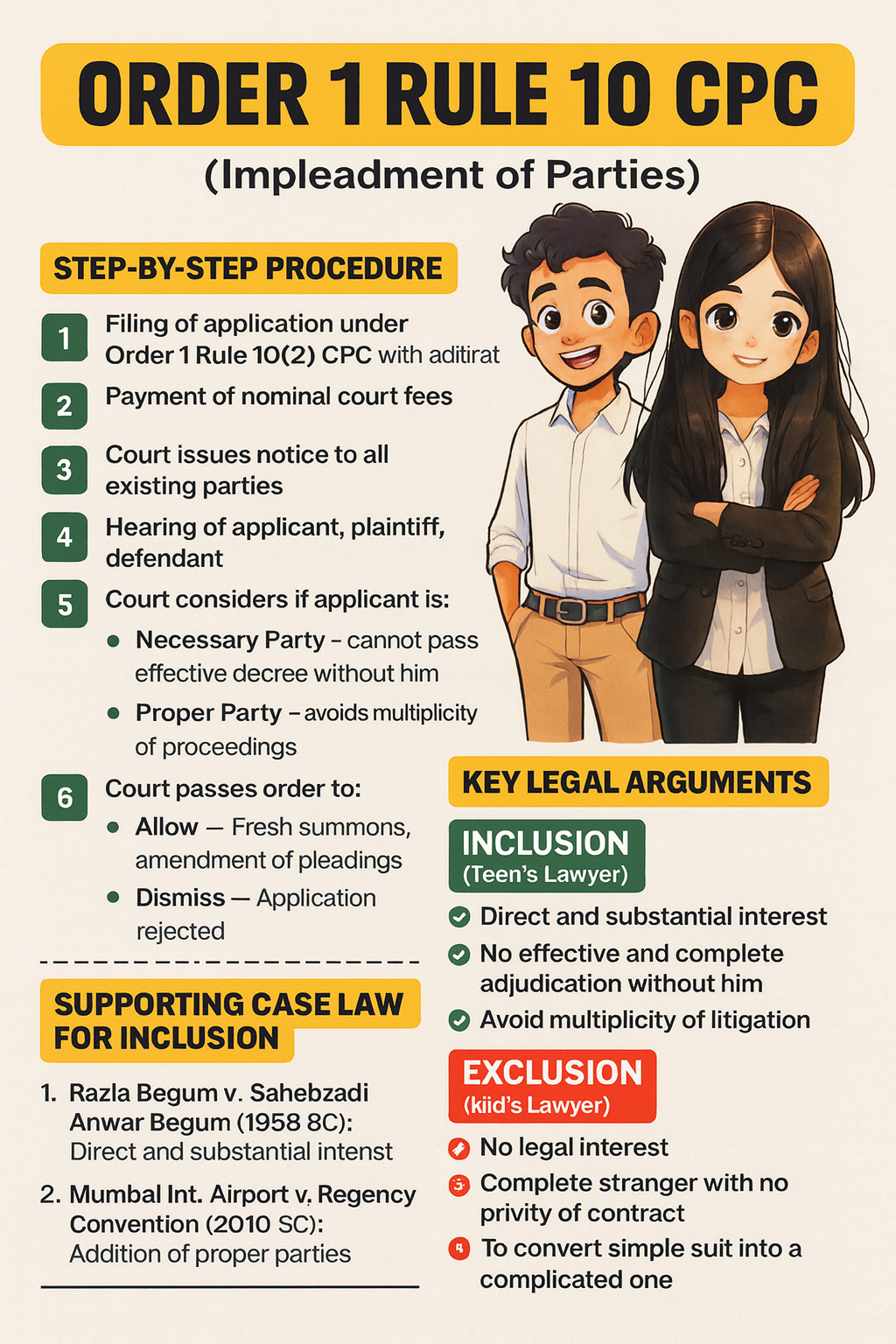
Order 1 Rule 10 CPC – Procedure (Impleadment of Parties)

Purpose

Order 1 Rule 10 CPC empowers the court to add, strike out, or substitute parties so that all real and necessary controversies involved in the suit can be effectively adjudicated.


Relevant Provisions

Order 1 Rule 10(1)

  • Court may strike out or add parties at any stage of the proceedings.
  • Can be done without application (suo motu) or on application of a party.

Order 1 Rule 10(2) (Most Important)

  • Court may add any person:
    • Who ought to have been joined (necessary party), or
    • Whose presence is necessary for complete and effective adjudication (proper party).

Step-by-Step Procedure

Step 1: Filing Application

  • Application under Order 1 Rule 10(2) CPC
  • Filed by:
    • Plaintiff, or
    • Defendant, or
    • Proposed party (third person)
  • Supported by an affidavit

Contents of application:

  • Description of the proposed party
  • Nature of interest in the suit property/subject matter
  • Reason why presence is necessary/proper
  • Stage of the suit

Step 2: Court Fees

  • Nominal court fee (as per State amendment / court rules)

Step 3: Issuance of Notice

  • Court issues notice to existing parties
  • Opportunity of hearing is given to:
    • Plaintiff
    • Defendant
    • Proposed party (if present)

Step 4: Hearing & Consideration by Court

Court examines:

  • Whether the proposed party is a:
    • Necessary party (no effective decree possible without him), or
    • Proper party (helps in complete adjudication)
  • Whether impleadment will:
    • Change nature of suit ❌
    • Cause delay or prejudice ❌
    • Lead to multiplicity of proceedings ❌

Step 5: Order of the Court

  • If Allowed:
    • Party is added as Plaintiff or Defendant
    • Amendment of plaint/written statement permitted
    • Fresh summons issued to newly added party
  • If Rejected:
    • Application dismissed with reasons

Step 6: Amendment of Pleadings

  • Plaintiff amends the plaint under Order 6 Rule 17 CPC
  • Newly added party files Written Statement
  • Suit proceeds further

Key Legal Principles (For Arguments)

Necessary Party

A person without whom no effective decree can be passed
Example: Co-owner in partition suit

Proper Party

A person whose presence enables complete adjudication
Example: Subsequent purchaser in property dispute


Important Case Laws

  • Razia Begum v. Sahebzadi Anwar Begum (1958 SC)
    → Interest must be direct and substantial
  • Mumbai International Airport v. Regency Convention Centre (2010 SC)
    → Distinction between necessary & proper party
  • Kasturi v. Iyyamperumal (2005 SC)
    → In specific performance suits, strangers generally not allowed

When Order 1 Rule 10 Application is Rejected

  • Applicant has no legal interest
  • Impleadment alters the nature of suit
  • Application filed only to delay proceedings

Practical Drafting Tip

Always mention:

  • “To avoid multiplicity of litigation”
  • “For complete and effective adjudication”

DRAFT APPLICATION

(Under Order 1 Rule 10(2) CPC – Impleadment of Party)

IN THE COURT OF ____________

Civil Suit No. ____ of 20__

A …………………………… Plaintiff
Versus
B …………………………… Defendant

APPLICATION UNDER ORDER 1 RULE 10(2) CPC

Most Respectfully Submitted:

  1. That the above-mentioned suit is pending adjudication before this Hon’ble Court.
  2. That the present suit relates to (brief description of subject matter / property / transaction).
  3. That the applicant (name of proposed party) has a direct, legal and substantial interest in the subject matter of the suit inasmuch as:
    • (State how right/title/interest arises)
    • (Mention documents, if any)
  4. That without the presence of the applicant, no effective and complete adjudication of the issues involved in the suit is possible.
  5. That the applicant is a necessary / proper party and ought to have been impleaded at the time of filing of the suit.
  6. That non-impleadment will result in multiplicity of litigation and conflicting decisions.
  7. That the impleadment will not change the nature of the suit nor cause prejudice to any party.
  8. That this Hon’ble Court is empowered to implead parties at any stage of proceedings under Order 1 Rule 10 CPC.

PRAYER

It is therefore most respectfully prayed that this Hon’ble Court may be pleased to:

a) Allow the present application;
b) Implead (name of proposed party) as Plaintiff / Defendant No.__;
c) Permit amendment of pleadings;
d) Pass any other order deemed fit in the interest of justice.

Applicant
Through Counsel
Place:
Date:


REPLY / OBJECTION

(To Application under Order 1 Rule 10 CPC)

IN THE COURT OF ____________

Civil Suit No. ____ of 20__

Reply on behalf of Defendant / Plaintiff

  1. That the application is false, frivolous, and misconceived and liable to be dismissed.
  2. That the applicant has no legal or enforceable right in the subject matter of the suit.
  3. That the applicant is neither a necessary party nor a proper party as:
    • Effective decree can be passed without his presence.
    • His alleged interest is remote and speculative.
  4. That the suit is confined to (specific relief) and the applicant is a stranger to the contract / transaction.
  5. That impleadment will:
    • Change the nature of the suit
    • Delay trial
    • Cause serious prejudice to the replying party
  6. That the application is filed only to delay proceedings and harass the parties.
  7. That Order 1 Rule 10 CPC cannot be used to expand the scope of the suit.

PRAYER

It is therefore prayed that the application under Order 1 Rule 10 CPC be dismissed with costs.

Respondent
Through Counsel
Place:
Date:


ORAL ARGUMENTS (FOR ALLOWING APPLICATION)

May it please Your Honour:

  1. The applicant has a direct and substantial interest in the subject matter.
  2. Without his presence, no effective decree can be passed.
  3. Order 1 Rule 10 CPC empowers the Court at any stage.
  4. The impleadment will avoid multiplicity of litigation.
  5. The nature of the suit remains unchanged.
  6. Supreme Court in Mumbai International Airport case (2010) clearly allows addition of proper parties for complete adjudication.

Hence, the application deserves to be allowed.


ORAL ARGUMENTS (FOR DISMISSAL)

May it please Your Honour:

  1. Applicant is a complete stranger to the suit.
  2. No legal right is disclosed—only a commercial or personal interest.
  3. Effective decree can be passed without the applicant.
  4. Order 1 Rule 10 CPC cannot be used to convert a simple suit into a complex one.
  5. Supreme Court in Kasturi v. Iyyamperumal bars impleadment of strangers.
  6. Application is a delay tactic.

Hence, the application is liable to be dismissed.


PRACTICAL COURT TIP

If you are Plaintiff opposing impleadment, argue dominus litis principle.
If you are Applicant, stress complete adjudication + multiplicity avoidance.

5 Key Point - Husband Counter-125 CrPC - 144 BNSS

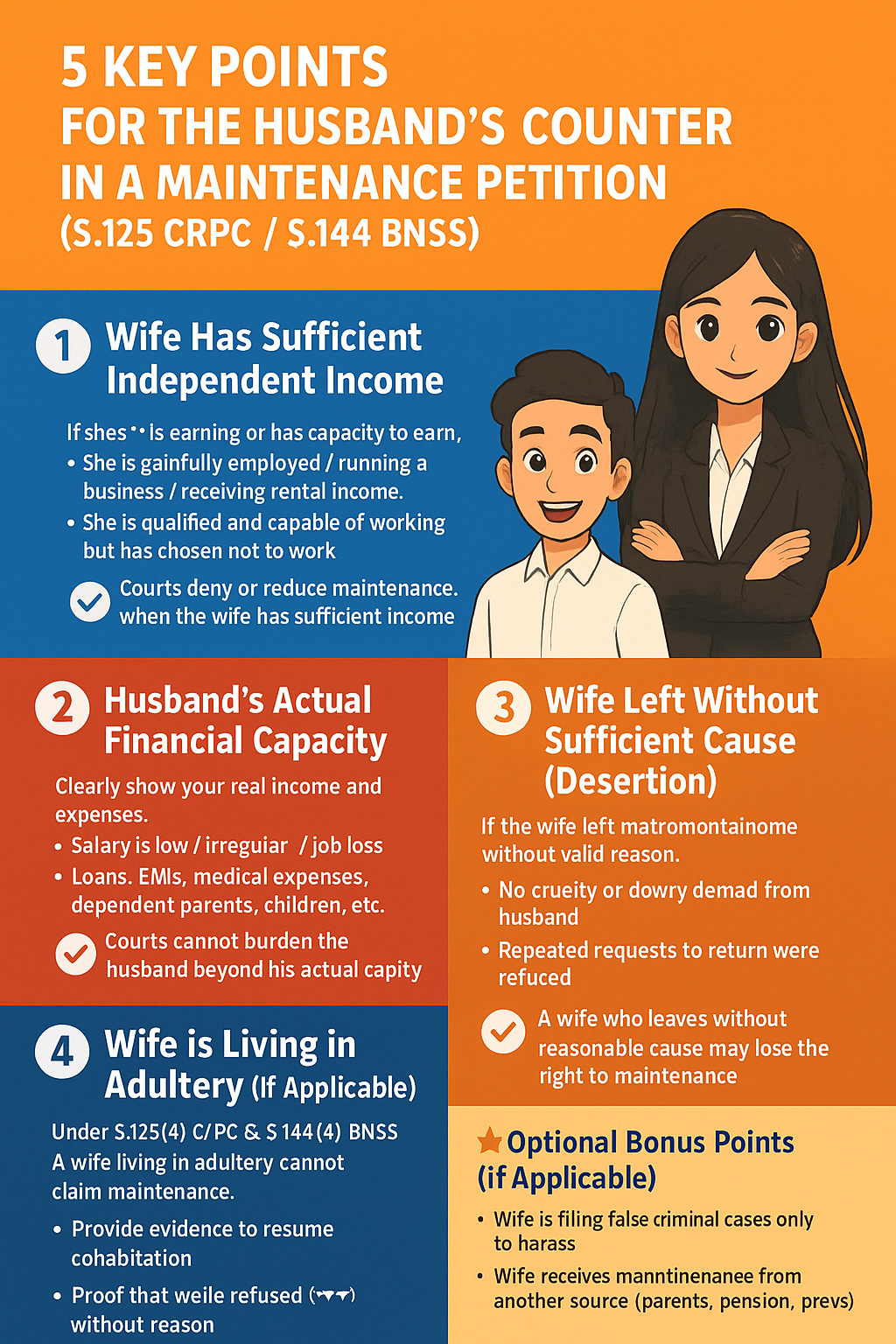
5 Key Points for the Husband’s Counter

in a Maintenance Petition (S.125 CrPC / S.144 BNSS)**

1. Wife Has Sufficient Independent Income

If the wife is earning or has the capacity to earn, highlight:

  • She is gainfully employed / running a business / receiving rental income.
  • She is qualified and capable of working but has chosen not to work.
  • Provide documents like salary slips, social media business pages, GST details, property records, etc.

Courts deny or reduce maintenance when the wife has sufficient income.


2. Husband’s Actual Financial Capacity

Clearly show your real income and expenses:

  • Salary is low / irregular / job loss
  • Loans, EMIs, medical expenses, dependent parents, children, etc.
  • Attach proof: bank statements, loan statements, doctor reports.

Courts cannot burden the husband beyond his actual capacity.


3. Wife Left Without Sufficient Cause (Desertion)

If the wife left the matrimonial home without valid reason:

  • No cruelty or dowry demand from husband
  • Repeated requests to return were refused
  • Mediation notices were ignored

A wife who leaves without reasonable cause may lose the right to maintenance.


4. Wife is Living in Adultery (If Applicable)

Under S.125(4) CrPC & S.144(4) BNSS:

  • A wife living in adultery cannot claim maintenance.
  • Provide evidence if available (messages, photos, call records, witness statements).

Courts strictly apply this bar when adultery is proven.


5. Husband is Ready to Maintain, But Wife Refused to Live With Him

Show willingness for reconciliation:

  • Attempts for settlement/mediation
  • Written offers to resume cohabitation
  • Proof that wife refused without reason

If the husband is willing and the wife refuses, she may not be entitled to maintenance.


Optional Bonus Points (If Applicable)

✔ Wife is filing false criminal cases only to harass
✔ Wife receives maintenance from another source (parents’ pension, previous case, etc.)
✔ Wife is intentionally suppressing her income
✔ Husband already bearing expenses of child, rent, schooling, etc.

Family Matters, Divorce Case, Dowry Act, Domestic Violence, Child Custody, Adoption, Court Marriage, Maintenance in Family cases .

Decree - Order - Judgement Clarity

DECREE vs ORDER vs JUDGMENT – Complete Clarity

Courtroom-ready explanation of “Decree vs Order vs Judgment” with core differences, examples, and legal clarity under the Civil Procedure Code (CPC), 1908.


1. JUDGMENT (Section 2(9) CPC)

Meaning:

A judgment is the statement of reasons given by the Judge for arriving at a decision.

What it contains:

✔ Facts
✔ Issues
✔ Evidence discussion
✔ Legal reasoning
✔ Findings
✔ Final conclusion

Example:

Judge explains:

  • What evidence proves?
  • Who is right?
  • Why the relief is allowed or refused?

End Result: Leads to Decree or Order.


2. DECREE (Section 2(2) CPC)

Meaning:

A decree is the formal expression of the final adjudication of rights of parties in the suit.

When decree is passed?

✔ Always in a suit
✔ Always after a Judgment
✔ When substantive rights are finally decided

Types of Decree:

  1. Preliminary – rights declared but further action required (e.g., partition, accounts)
  2. Final – completely disposes of the suit
  3. Partly preliminary & partly final

Example:

Court orders:

  • The plaintiff is the owner of the property.
  • Defendant is permanently restrained.

This is a Decree.


3. ORDER (Section 2(14) CPC)

Meaning:

An order is any decision of a court which is not a decree.

When order is passed?

✔ In a suit, application, or miscellaneous proceedings
✔ On procedural matters
✔ On interim issues

Example:

  • Order on stay application
  • Order to issue summons
  • Order rejecting amendment of plaint
  • Order granting temporary injunction (Order 39)

CORE DIFFERENCES (Easy Table)

PointDecreeOrderJudgment
DefinitionFormal adjudication of rightsDecision not amounting to decreeReasoning behind decree/order
Arises FromOnly from a suitSuit/application/proceedingJudge’s reasoning
ContainsFinal rightsProcedural/Interim decisionsFacts + Evidence + Reasons
Appealable?Mostly yes (S.96)Only specific orders (Order 43)No direct appeal (only with decree)
Need of Judgment?Must follow a judgmentMay or may not followMust precede decree
TypesPreliminary/Final/PartlyOnly one typeNo types
EffectConcludes the suitDoes not conclude suitBasis of final decision

SIMPLE EXAMPLE TO UNDERSTAND DIFFERENCE

Case:

Plaintiff files a suit for possession + injunction.

Judge writes reasoning → JUDGMENT

Judge then passes final decision →

“Plaintiff is owner. Defendant must vacate.”
This is the DECREE

During trial:

Court rejects defendant’s adjournment application.
This is an ORDER


Key Practical Points for Lawyers & Students

✔ Judgment explains WHY

✔ Decree tells WHAT

✔ Order handles HOW/PROCEDURE


Why this matters?

Because appeals, execution, review, revision, and limitation periods ALL depend on whether the decision is a decree, order, or judgment.

Exhibits & Annexures in Civil Pleadings - Usha Vats & Associates

Understanding Exhibits and Annexures in Civil Pleadings

(Meaning, Differences, Purpose & Practical Tips)


1. What Are Exhibits in Civil Cases?

Exhibits are documents or material evidence relied upon during the trial, formally admitted by the court and given exhibit numbers.

Examples of Exhibits

  • Sale deed
  • Agreement to sell
  • Photographs
  • Receipts
  • Medical reports
  • CCTV footage
  • Expert reports

How Exhibits Are Marked?

  • Plaintiff’s exhibits: Ex. PW-1/1, Ex. PW-1/2, etc.
  • Defendant’s exhibits: Ex. DW-1/1, Ex. DW-1/2, etc.

Exhibits become part of evidence after they are proved and marked by the court.


2. What Are Annexures in Civil Pleadings?

Annexures are documents attached along with pleadings or applications, only to support or strengthen the written pleadings.

They are not evidence yet.
They are only attachments, not exhibits.

Examples of Annexures

  • Copies of notices
  • Copies of reply
  • Email/Webpage printouts
  • Ledger/statement copy
  • Photographs (before admission)
  • Any supporting document to show prima facie case

How Annexures Are Numbered?

  • Annexure P-1, Annexure P-2 (for petitioners)
  • Annexure R-1, Annexure R-2 (for respondents)

Annexures remain annexures until proved in court.


3. Key Difference Between Exhibit and Annexure

FeatureExhibitsAnnexures
StageDuring evidenceDuring filing
PurposeUsed as evidenceUsed as supporting documents
Court markingYes (Ex. PW/DW…)No court marking
AdmissibilityEvidence only after proofNot evidence unless later proved
Given byCourtParty
Legal effectStrong – forms part of evidenceLimited – only supports pleadings

4. When Do Annexures Become Exhibits?

An annexure becomes an exhibit only when:

✔ It is shown to witness during examination
✔ Opposite party is allowed to inspect
✔ Court admits it in evidence
✔ Court marks it as an exhibit

Until then, it is not evidence.


5. Practical Example

Situation:

A plaintiff files a suit for recovery of ₹5 lakh based on an agreement.

In the Plaint:

  • Agreement copy (Annexure P-1)
  • Legal notice copy (Annexure P-2)
  • Postal receipt (Annexure P-3)

During Evidence:

When plaintiff (PW-1) comes for examination:

  • The agreement is shown to PW-1 → marked as Ex. PW1/1
  • Postal receipt → Ex. PW1/2
  • Legal notice → Ex. PW1/3

Now all annexures become exhibits.


6. Why Are Exhibits Important?

✔ Court relies on exhibits only, not annexures
✔ Judgment is based on admitted evidence
✔ Exhibits help prove:

  • Ownership
  • Relationship
  • Transactions
  • Payments
  • Injuries
  • Loss, damage, breach

7. Why Are Annexures Important?

✔ Help court understand the case at filing stage
✔ Useful to support interim applications
✔ Guides court in granting temporary injunction or stay
✔ Shows prima facie case

Notice of Motion - Usha Vats & Associates

NOTICE OF MOTION

Meaning, Purpose, Procedure & Example

What is a Notice of Motion?

A Notice of Motion is a formal written request submitted to the court informing that a party wants the court to hear and decide a specific application.
It notifies the opposite party about:

  • What relief you are seeking
  • On what grounds
  • On which date the court will hear the application

It ensures transparency and fairness so the opposite party gets a chance to appear and oppose.


Where is Notice of Motion Used?

It is commonly used in:
✔ Civil cases
✔ Interim applications
✔ Injunction matters
✔ Family disputes
✔ Commercial suits
✔ High Court writ & appellate matters


Purpose of a Notice of Motion

A Notice of Motion serves to:

  • Inform the other side about the application
  • Prevent ex-parte orders (unless urgent)
  • Give the court a clear schedule
  • Maintain principles of natural justice

When is Notice of Motion Required?

You must file a Notice of Motion when:

  1. Court rules require prior notice to the other party
  2. You are seeking interim relief (like stay, injunction, status quo)
  3. The matter is not extremely urgent
  4. Local High Court/CPC rules mandate a motion procedure

Two Types of Notice of Motion

1. Ordinary Notice of Motion

  • Given to the opposite party in advance
  • Listed on a fixed date
  • Used for routine applications

2. Urgent/Ex-Parte Notice of Motion

Filed when immediate relief is needed and waiting may cause irreparable loss.
E.g.,

  • Property being demolished
  • Someone issuing illegal threats
  • Urgent stay of a government order

Court may pass temporary ex-parte orders and later hear the other side.


Contents of a Notice of Motion

A typical Notice of Motion includes:
✔ Court name & case number
✔ Parties’ names
✔ Applicant’s request (relief)
✔ Grounds for the request
✔ Date of hearing
✔ Advocate’s name & signature
✔ Supporting affidavit


Example of Reliefs Sought Through Notice of Motion

A Notice of Motion may request:

  • Stay of proceedings
  • Temporary injunction under Order 39 CPC
  • Appointment of receiver
  • Police protection
  • Discovery & inspection of documents
  • Modification of prior orders
  • Urgent interim directions

Sample Line from a Notice of Motion

“The Applicant above named hereby moves this Hon’ble Court for an order of temporary injunction restraining the Respondent from disposing of the suit property until final disposal of the suit.”


Landmark Judgments on Motion/Notice Requirements

1. A. Venkatasubbiah Naidu v. S. Chellappan (2000)

Court must give notice to the opposite party before granting injunction unless delay defeats justice.

2. Morgan Stanley v. Kartick Das (1994)

Ex-parte injunctions should be granted only in exceptional circumstances.

3. Shiv Kumar Chadha v. MCD (1993)

Courts must record reasons for granting an ex-parte injunction.


Quick Summary

TopicExplanation
MeaningFormal request notifying the court & opposite party about an application
PurposeTransparency, fairness, natural justice
TypesOrdinary & Urgent (Ex-parte)
Used ForInterim relief, injunction, stay, directions
JudgmentsVenkatasubbiah, Morgan Stanley, Shiv Kumar Chadha