
best advocate in delhi

REMEDIES IF POLICE REFUSE TO REGISTER AN FIR?

1. Approach Senior Police Officers (SP / DSP / Higher Authority)

  • Under Criminal Procedure Code (CrPC) Section 154(3), if the duty-in-charge (e.g. SHO) refuses to record the FIR, you can send the complaint in writing to the relevant Superintendent of Police (SP).
  • The SP has the power to direct registration/investigation or to investigate personally.
  • Always keep a written copy / acknowledgement / postal receipt as proof — document date, time, officer name, complaint details.

2. File a Complaint before a Magistrate (Private Complaint)

  • Under CrPC Section 156(3) (read with Section 190/200), you can directly approach a Judicial Magistrate or Metropolitan Magistrate if police refuse to act.
  • The Magistrate can take cognizance, order police to register the FIR / investigate, or treat it as a complaint case and proceed accordingly.

3. File a Writ Petition in High Court / Supreme Court

  • If police (even after escalation) remain inactive or refuse to register FIRs for serious cognizable offenses, you may approach the High Court under Article 226 (or Supreme Court under Article 32) to seek a mandamus / direction to police to act.
  • Courts can also award compensation or take constitutional-law grounds (right to life & liberty, fair investigation) into account.

4. Human Rights / Oversight Bodies

  • You may lodge a complaint before State Human Rights Commission (SHRC) or National Human Rights Commission (NHRC) if police refusal involves rights-violation (e.g. custodial issues, discrimination, serious offences) and ask for inquiry or intervention
  • Some states also have Police Complaints Authorities or oversight mechanisms which can be approached.

5. Record & Document the Refusal — Build a Paper Trail

  • Always demand a written acknowledgment of your complaint from the police (or note their refusal, badge/sho name, time, date).
  • This documentation will help in court / magistrate / human-rights commission proceedings if police claim there was “no complaint.”

6. Use Alternative Filing Methods (if allowed)

  • If local police station refuses citing jurisdiction, you can file a “Zero-FIR” at any police station regardless of territorial jurisdiction (especially in serious cases, travel-involved crimes). While codified status may vary, many courts treat complaints as valid.
  • If complaint is sent by email / letter / post and contains full substance of offence, some courts treat it as valid information — especially under newer laws (or where allowed).

Key Legal Principles & Landmark Precedents

  • Lalita Kumari v. Government of Uttar Pradesh (2013) — The Supreme Court of India held that once information discloses a cognizable offence, the police “must” register the FIR immediately; refusal is legally indefensible.
  • Sakiri Vasu v. State of U.P. (2008) 2 SCC 409 — Supreme Court recognized that refusal to register FIR can be challenged; and that Section 154(3) CrPC provides recourse by writing to SP.
  • Courts have consistently held that non-registration of FIR causes violation of fundamental rights (right to life & liberty) especially when there is unlawful detention or denial of access to justice.

Practical Steps (Checklist) for Someone Facing FIR-Refusal

  1. Immediately write and submit a complaint to SHO; ask for acknowledgment → or record refusal incident (officer name, time, date).
  2. If no FIR, send detailed information to SP under Section 154(3) CrPC by registered post / with proof.
  3. If SP also refuses or doesn’t act → file a private complaint before the Magistrate under Section 156(3) / 190 / 200 CrPC.
  4. If Magistrate doesn’t act or there’s repeated inaction → file writ petition in High Court for directions + possible compensation.
  5. Optionally — lodge complaint with NHRC / SHRC / Police Complaints Authority (if available) for rights-violation / misconduct by police.
  6. Maintain full records: correspondence, copies of applications/complaints, proof of refusal, time-stamps, witness names, any medical or other evidence of offence.

When Police Can Legally Refuse FIR (and You May Not Get It Registered)

  • If the complaint does not disclose a cognizable offence — e.g. minor civil disputes, non-cognizable offences, or facts insufficient to constitute offence. Courts expect refusal only when complaint clearly lacks legal merit.
  • If complaint is vague, frivolous or fabricated, or false — then refusal may be upheld.

Even in those cases, police must give written reasons or at least note in the General Diary (GD/SHD). Blanket or arbitrary refusal without reason remains subject to challenge


best advocate in delhi

If the father already has the child in his care (interim/actual custody) and wants permanent, exclusive custodial rights, what is the remedy?

If the father already has the child in his care (interim/actual custody) and wants permanent, exclusive custodial rights, he can approach the competent court under the following laws:


1. File a Petition Under the Guardians and Wards Act, 1890 (GWA)

Section 7 – Application for Appointment as Guardian

The father can file a petition before the District Court / Family Court seeking to be declared the:

  • Guardian of the person of the minor, and
  • Permanent custodian of the child

The court examines what is in the best welfare of the child.

Key Factors Court Considers:

  • Child’s emotional, physical, educational welfare
  • Father’s financial stability
  • Father’s capacity to provide safe home & upbringing
  • Mother’s ability/inability to care for the child
  • Wishes of the child (if above 9 years, court may consider)
  • Any history of violence, neglect, addiction, or instability in the mother

2. Seek “Permanent Custody” Under the Hindu Minority & Guardianship Act, 1956 (HMGA)

If the parties are Hindu, the father may additionally claim under:

Section 6 & 13 – Natural Guardian + Welfare of Child

Father is a natural guardian (after the mother), but the child’s welfare overrides all rules.

The court may grant him sole custody if welfare favors the father.


3. If the Child is Already Living With the Father

This is a strong factor.

He can request:

Confirmation of existing custody

Permanent custody order

Conditions for mother’s visitation (if required)

Court generally does not disturb a stable, healthy custody arrangement.


4. If Mother Abandoned the Child or Not Taking Responsibility

The father may additionally seek:

Declaration that mother is unfit (only if there is evidence)

Restriction or supervision of her visitation rights

Sole decision-making authority regarding education, health & travel


5. Filing Procedure

  1. Draft & file Guardianship and Custody Petition
  2. Attach evidence:
    1. School records
    1. Medical records
    1. Proof of father’s income/stability
    1. Proof mother is not taking responsibility (if applicable)
  3. Court issues notice to mother
  4. Court conducts hearing, interviews child (if applicable)
  5. Final order granting sole permanent custody

6. Landmark Judgments Supporting Sole Custody to the Better Caregiver

Here are important judgments where courts gave sole custody to one parent on welfare principle:

1️. Gaurav Nagpal v. Sumedha Nagpal (2009)

Supreme Court held → Child’s welfare is supreme, not the right of parents.

2️. Roxann Sharma v. Arun Sharma (2015)

Court emphasized → Custody must go to the parent providing a more stable & safe environment.

3️. Vivek Singh v. Romani Singh (2017)

Court allowed sole custody to the parent with proven emotional bonding.

4️. J. Venkatachalam v. J. Saritha (Madras HC)

Child already living with one parent → Court usually continues that custody.


Summary: Remedy for Father

File guardianship + permanent custody application

Show welfare, stability, education, emotional bonding

Seek sole custody + limited/supervised visitation for mother

Use evidence to prove child’s welfare is best with father

best advocate in dwarka

Whether Wife Can Claim Share in Husband’s Self-Acquired Property

�� 1. General Rule under Hindu Law

Under the Hindu Succession Act, 1956 and general principles of Hindu law:

A wife has no right to claim a share in her husband’s self-acquired property during his lifetime.

Self-acquired property is the exclusive and absolute property of the husband, and no other family member (including wife, children, or relatives) can claim a share unless:

  • Husband dies intestate (without a Will)
  • Husband voluntarily transfers/gifts a share

This is a well-settled principle in Indian property law.


�� 2. Statutory Basis

A. Hindu Succession Act, 1956

  • Gives wife rights only after the husband’s death, not during his lifetime.
  • Wife becomes Class I heir u/s Schedule – Class I Heirs.

B. Hindu Minority and Guardianship Act, 1956

  • Husband/father is natural guardian of minor children.
  • Does not give wife a right in husband’s property.

C. Married Women’s Property Act, 1874

  • Wife’s property remains exclusively hers.
  • Husband’s self-acquired property remains exclusively his.

D. Domestic Violence Act, 2005

  • Gives wife right of residence,
    but not ownership rights in husband’s self-earned property.

�� 3. Key Legal Distinction

QuestionLegal Position
Can wife claim a share while husband is alive?❌ No
Can wife claim right to residence?✔ Yes (DV Act)
Can wife claim maintenance?✔ Yes (S.125 CrPC + personal laws)
Can wife claim share after husband’s death?✔ Yes (HSA as Class I heir)
Does long marriage give property rights?❌ No

�� 4. Important Supreme Court Judgments


1️ Arunachala Gounder v. Ponnusamy (2022, SC)

Principle:
Self-acquired property is the absolute property of the owner.

“No family member has a right in self-acquired property of a living person.”

This applies to wife as well.


2️ S.R. Batra v. Taruna Batra (2007, SC)

Topic: “Right to residence vs. ownership”

Held:

“Wife has a right to residence but no right to claim ownership in husband’s property.”

Even if the marriage is long, she cannot demand partition.


3️ Neelam v. Ram Asarey (2014, SC)

Held:

“Maintenance does not create proprietary rights in husband’s property.”

Thus, maintenance ≠ share in property.


4️ Shamim Ara v. State of U.P. (2002, SC)

Though related to maintenance, the Court clarified:

“Length of marriage does not create property rights.”

Even 25–30 years of marriage gives no automatic share.


5️ Ramesh Verma v. Lajesh Saxena (2017, SC)

Held:

“Wife gets a share in husband’s property only after his death, if he dies intestate.”

Till then, the property remains exclusively the husband’s.


�� 5. When Can Wife Actually Get a Share? (Two Scenarios Only)

 1. On the husband’s death (intestate succession)

She becomes Class I heir and shares property equally with:

  • Children
  • Mother of husband

 2. If the property is converted into joint property

If husband:

  • Makes wife co-owner
  • Executes gift deed
  • Adds name in sale deed

Only then she gets a legal share.


�� 6. Situations Where Women Often Get Confused

❌ “25 years of marriage → equal share”

Incorrect. Marriage duration does not create ownership rights.

❌ “Wife lives in husband’s house → shares”

Incorrect. Residence ≠ ownership.

❌ “Wife contributed to household → ownership rights”

Incorrect under Indian law, except in exceptional equity cases during divorce alimony.


�� 7. Practical Rights Available to a Wife

While she cannot claim a share, she can claim:

 Maintenance (Sec. 125 CrPC / HMA / Personal laws)

 Right to residence (DV Act, 2005)

 Protection from eviction

 Alimony on divorce (can be substantial)

 Share after husband’s death

But ownership in self-earned property during husband’s lifetime = NO.


�� 8. Conclusion (Exam/Interview + Advocate Answer)

A Hindu wife has no legal right to claim a share or partition in her husband’s self-acquired property during his lifetime, irrespective of the duration of marriage. She only has rights of maintenance, residence, and succession after his death. The Supreme Court consistently upholds this rule.

best advocate in dwarka court Delhi

Child Custody When a Child Below 5 Is With the Father: What Remedies Does the Mother Have?

Child custody battles become especially sensitive when the child is very young. Under Indian law, a child below five years is generally presumed to need the care, affection and emotional support of the mother. This principle is widely recognized under the Hindu Minority and Guardianship Act (HMGA), 1956, as well as by multiple court judgments.

But what happens when the father has kept the child and files a case seeking permanent custody?
Does the mother still have strong legal remedies?

The answer is YES—the mother has several powerful remedies under both civil and criminal law.

This blog explains all possible legal options available to a mother in such situations.


1 File for Immediate Custody Under the Guardians and Wards Act (GWA), 1890

The first and most important remedy is to file:

 Petition for Custody + Interim Custody (Section 7 & 12, GWA)

The mother can file a separate petition before the Family Court seeking:

  • Permanent custody
  • Interim custody (urgent temporary relief)
  • Visitation rights if interim custody is not granted immediately

Why this is powerful?

Courts follow a general rule:

A child under five years should ordinarily be with the mother, unless she is proven unfit.

Therefore, the mother has a strong chance of getting interim custody quickly.


2 Seek Immediate Pick-Up / Interim Restoration of Child

The mother can request the court:

 “Pick-Up Order” / “Restoration Order”

If the father has forcibly taken the child, withheld the child, or is preventing contact, the court can order the child to be:

  • Produced before the court
  • Handed back to the mother temporarily
  • Shifted to the mother’s custody until trial

Family courts frequently grant such urgent relief, especially for children under five.


3 File a Habeas Corpus Petition in the High Court

If the child is being illegally detained by the father and not produced before the mother, she can file:

 Writ of Habeas Corpus (Article 226, Constitution of India)

This is used when:

  • The father refuses to allow the mother to meet the child
  • The child is kept in a hidden location
  • The father took the child suddenly or without consent

High Courts treat minor children as persons who cannot decide for themselves, so illegal custody can be challenged through a habeas corpus petition.

This often results in very fast relief.


4 File a Complaint for Child Removal or Kidnapping (in extreme cases)

If the child was taken forcefully, secretly, or in violation of a court order:

 Section 97 CrPC – Search Warrant for Recovery of Child

A Magistrate can issue a warrant to produce the child immediately.

 Kidnapping from lawful guardian (Section 361 IPC)

A father may commit an offence only if:

  • He takes the child away from the lawful guardian (the mother),
  • Without consent, AND
  • With the intention to deprive the lawful guardian of custody.

This remedy is used rarely and only in serious cases.


5 File for Visitation and Contact Rights Immediately

Even if permanent custody cannot be granted instantly, the mother should file for:

 Regular visitation

 Video calls

 Weekend or overnight access

Courts believe that both parents should remain connected with the child.

This helps in two ways:

  1. The bond between mother and child is preserved.
  2. It prevents the father from creating distance or alienation.

6 File for Maintenance for the Child (and for Herself if Eligible)

The mother can file for:

 Child Maintenance (Section 125 CrPC / Personal Laws)

Even if the father is keeping the child, the mother is still entitled to:

  • Her own maintenance
  • Separate child maintenance, if the child stays with her even part-time

Financial security strengthens the mother’s overall custody case.


7 Prove the “Welfare of the Child” Standard

All custody cases revolve around:

What is in the best interest and overall welfare of the child?

The mother should highlight:

  • Emotional bonding
  • Breastfeeding needs (if applicable)
  • Stability and safe environment
  • Schooling, health, and routine
  • Father’s neglect, violence, or instability (if any)

Courts prioritize younger children staying with the mother unless exceptional circumstances exist.


Key Case Law: Mother’s Preferential Right for Child Under 5

Courts have consistently held:

A young child (below five) should naturally be with the mother unless proven otherwise.

This principle strengthens the mother’s position significantly.


Final Thoughts

If the father files a permanent custody case for a child under five, the mother is not helpless. She has multiple legal avenues—fast and effective.

Her main remedies include:

  • Petition for custody
  • Interim custody / pick-up orders
  • Habeas corpus in the High Court
  • Visitation and contact rights
  • Maintenance
  • Criminal remedies (in extreme cases)

With the right legal approach, courts generally favour placing a very young child with the mother.

BEST ADVOCATE IN DWARKA COURT

REMEDIES AGAINST BUILDER FOROVER-PRICING & DELAY IN POSSESSION

. File Consumer Complaint (Best & Fastest Remedy)

You can file a complaint before:

  • District Consumer Commission (up to ₹50 lakh)
  • State Consumer Commission (₹50 lakh – ₹2 crore)
  • National Consumer Commission (NCDRC) (above ₹2 crore)

Reliefs you can claim:

  • Refund of excess money charged
  • Compensation for mental harassment
  • Interest for delay
  • Penalty on the builder
  • Order to give immediate possession

Consumer courts treat delay & overpricing as deficiency in service and unfair trade practice.


2️. RERA Complaint (Real Estate Regulatory Authority)

If your project is RERA-registered, you can file a complaint under Section 31.

You can claim:

  • Interest for every month of delay
  • Refund + interest
  • Penalty on builder
  • Order for timely possession

RERA is very strict about project timelines and pricing.


3️. File Complaint Under Unfair Trade Practices

Charging more than agreed price, adding unauthorized charges, or revising cost arbitrarily is illegal.

You can challenge:

  • Hidden charges
  • Additional construction cost
  • Parking charges
  • Club membership
  • GST disputes

These can be challenged before Consumer Court or RERA.


4️. Civil Suit for Specific Performance / Injunction

If builder refuses to follow the agreement, you may file a civil suit for:

  • Specific performance (forcing builder to hand over property)
  • Permanent injunction
  • Refund & damages

5️. Criminal Action (in Serious Cases)

If the builder committed fraud or cheating, FIR may be filed for:

  • Section 406 IPC – Criminal breach of trust
  • Section 420 IPC – Cheating
  • Section 468/471 IPC – Forgery (if documents manipulated)

This is usually taken when the builder completely stops responding or misappropriates funds.


6️. Complaint to RERA Adjudicating Officer

For compensation related to:

  • Delay
  • Overpricing
  • False promises
  • Loss due to project changes
best advocate in dwarka court

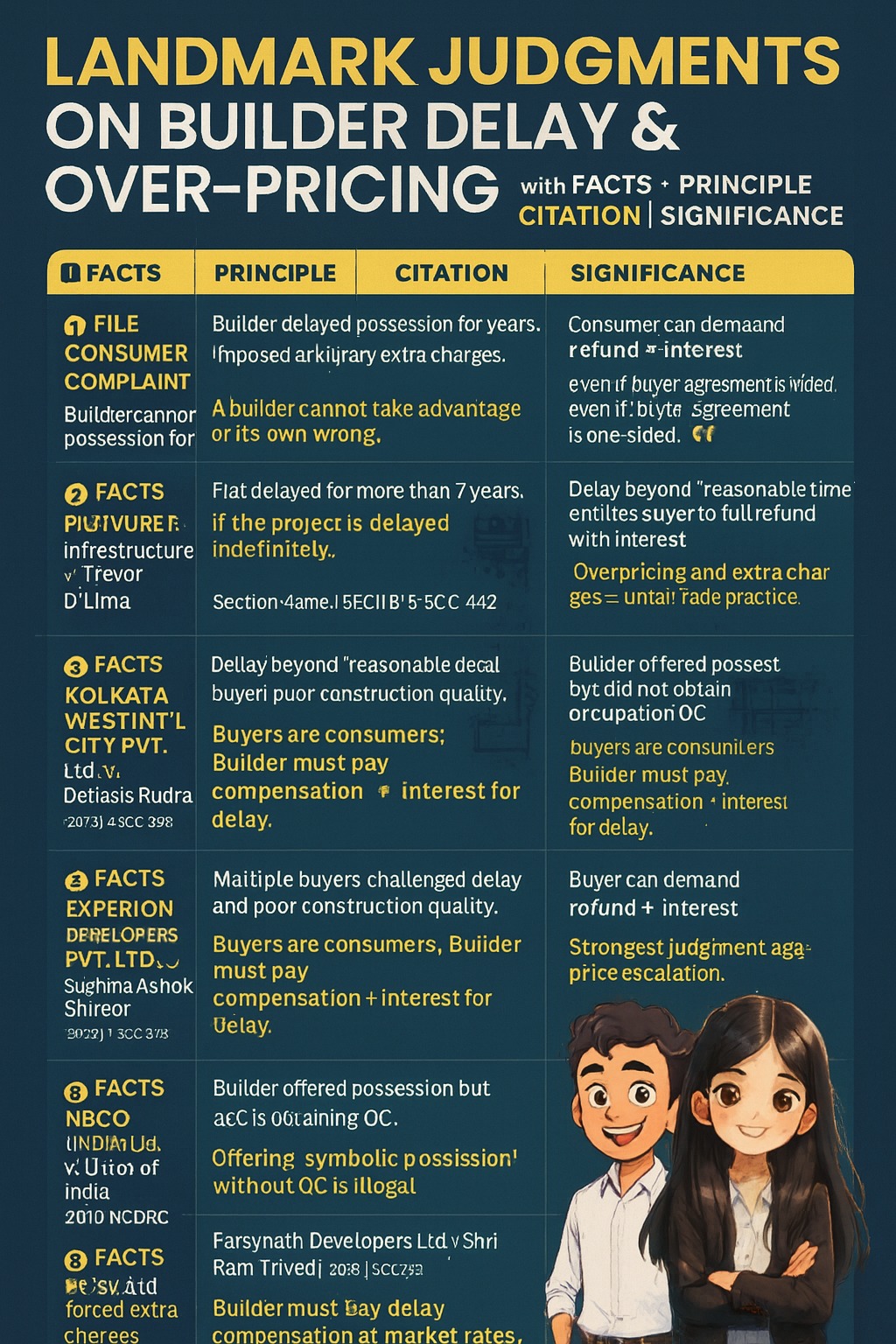
LANDMARK JUDGMENTS ON BUILDER DELAY & OVER-PRICING

Pioneer Urban Land & Infrastructure Ltd. v. Govindan Raghavan (2019) 5 SCC 725

Facts:

Builder delayed possession for years and imposed arbitrary extra charges.

Principle:

A builder cannot take advantage of its own wrong. Delay + unfair charges = deficiency in service.

Significance:

Consumer can demand refund + interest, even if buyer agreement is one-sided.


2️. Fortune Infrastructure v. Trevor D’Lima (2018) 5 SCC 442

Facts:

Flat delayed for more than 7 years.

Principle:

If the project is delayed indefinitely, the buyer can seek full refund, not forced to wait.

Significance:

Court held that “waiting endlessly is unfair”. Buyer has the right to exit the project.


3️. Kolkata West International City Pvt Ltd v. Devasis Rudra (2019) 4 SCC 303

Facts:

Builder delayed possession for 6+ years.

Principle:

A delay beyond “reasonable time” entitles the buyer to full refund with interest.

Significance:

Even if agreement has no clear possession date, unreasonable delay is enough for refund.


4️. Experion Developers Pvt Ltd v. Sushma Ashok Shiroor (2022) 1 SCC 319

Facts:

Builder charged excess/additional amounts beyond agreement.

Principle:

Builder cannot impose any extra charge unless authorized in the buyer agreement.

Significance:

Overpricing and extra charges = unfair trade practice.


5️. Wing Commander Arifur Rahman Khan v. DLF Southern Homes (2020) 16 SCC 512

Facts:

Multiple buyers challenged delay and poor construction quality.

Principle:

Buyers are consumers. Builder must pay compensation + interest for delay.

Significance:

Class-action style case — strong precedent for group complaints.


6️. IREO Grace Realtech Pvt. Ltd. v. Abhishek Khanna (2021) 3 SCC 241

Facts:

Builder offered possession but occupation certificate was not obtained.

Principle:

Offering “symbolic possession” without OC is illegal.

Significance:

Buyer can demand refund + interest.


7️. NBCC (India) Ltd. v. Shri Ram Trivedi (2021) 5 SCC 273

Facts:

Builder delayed and demanded more money for escalation in cost.

Principle:

No increase in price unless specifically provided in the agreement.

Significance:

Strongest judgment against price escalation.


8️. Parsvnath Developers Ltd. v. Union of India (2019 NCDRC)

Facts:

Delay + forced extra charges.

Principle:

Builder must pay delay compensation at market rates.

Significance:

NCDRC imposed heavy penalties on the builder.


9️. DLF Homes Panchkula Pvt Ltd v. D.S. Dhanda (2019) 11 SCC 379

Facts:

Extra and unfair charges imposed.

Principle:

Consumer courts can strike down arbitrary costs.

Significance:

Overpricing = unfair trade practice.


10. Emaar MGF Land Ltd. v. Amit Puri (2015) 4 CPJ 036

Facts:

Delay beyond agreed date.

Principle:

Reasonable compensation must be paid for every month of delay.

Significance:

Used widely for compensation calculation.

BEST ADVOCATE IN DELHI

HOW TO READ A LEGAL JUDGEMENT ?

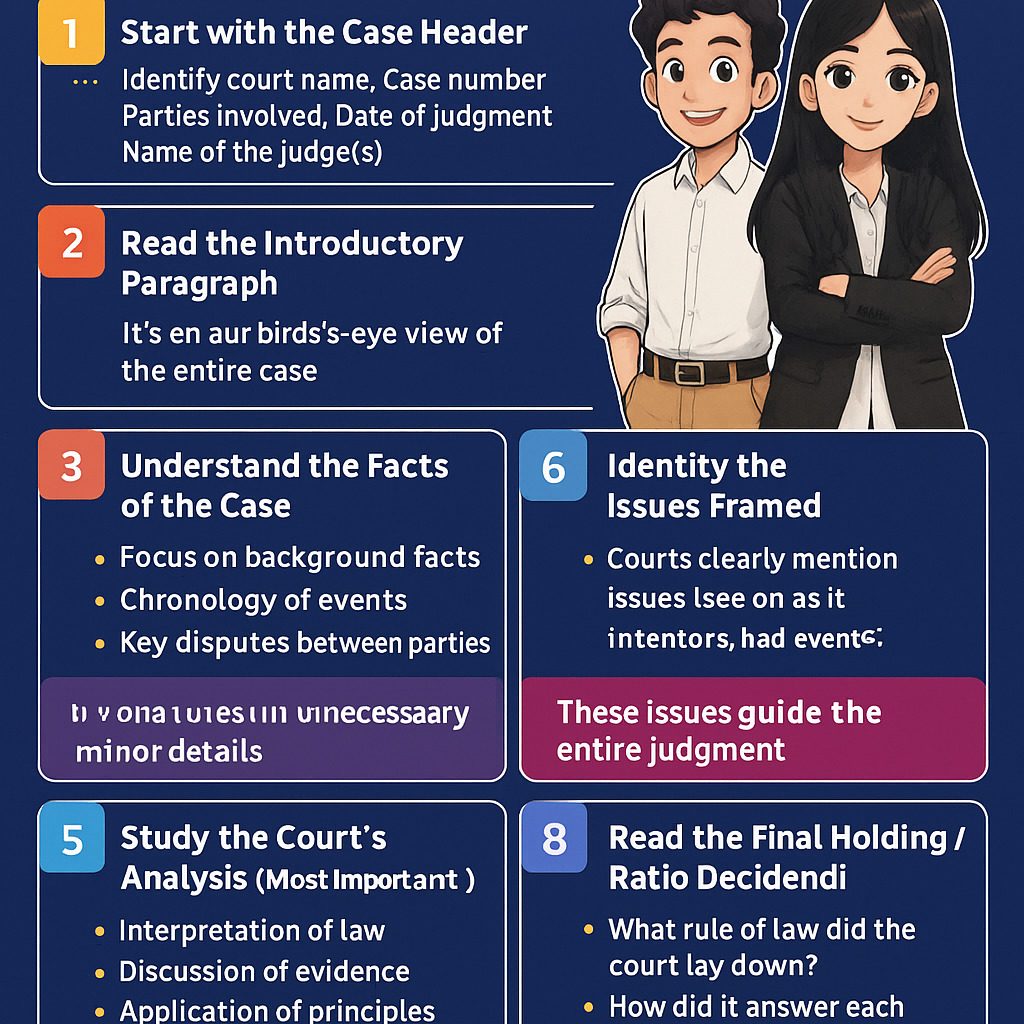
Steps to Read a Legal Judgment (Easy & Practical Guide)

1. Start with the Case Header

Identify the basics:

  • Court name
  • Case number
  • Parties involved
  • Date of judgment
  • Name of the judge(s)
    This helps you understand the context before diving in.

2. Read the Introductory Paragraph

This section usually tells you:

  • What the case is about
  • Which law or issue is being decided
  • Whether it’s an appeal, writ, revision, or trial order

It gives a bird’s-eye view of the entire case.


3. Understand the Facts of the Case

Focus on:

  • Background facts
  • Chronology of events
  • Key disputes between parties

Don’t get lost in unnecessary minor details.
Identify only the material facts.


4. Note the Procedural History

Check:

  • Orders of lower courts
  • Appeals/ revisions
  • Findings already recorded

This helps you understand why the case reached this court.


5. Identify the Issues Framed

Courts clearly mention the issues/questions, such as:

  • “Whether the accused had the intention…”
  • “Whether the contract is enforceable…”
  • “Whether the FIR should be quashed…”

These issues guide the entire judgment.


6. Examine Arguments by Both Sides

Focus on:

  • Petitioner/Appellant arguments
  • Respondent/State arguments
  • Evidence relied upon
  • Statutory provisions used

This shows how each side built its case.


7. Study the Court’s Analysis (Most Important Part)

This section contains:

  • Interpretation of law
  • Discussion of evidence
  • Application of principles
  • Precedents cited
  • Logic of the judge

This is where the legal reasoning lies.


8. Read the Final Holding / Ratio Decidendi

This is the legal principle the court establishes.

Ask:

  • What rule of law did the court lay down?
  • How did it answer each issue?
  • Why did it decide in favor of one side?

9. Note the Final Order (Operative Part)

Court may:

  • Acquit / Convict
  • Allow / Dismiss petition
  • Quash FIR
  • Grant compensation
  • Modify sentence

This is the practical outcome of the judgment.


Extract Key Takeaways

For exam, practice, or drafting, write:

  • Facts (short)
  • Issues
  • Rule of law (ratio)
  • Findings
  • Final conclusion
    This becomes your quick reference note.

Bonus Tips

✔ Highlight only essential paragraphs

✔ Avoid reading long quotations fully—understand the essence

✔ Compare with other similar precedents

✔ Note dissenting opinions (if any)

✔ Maintain a personal “Case Law Notebook”